 Indietro
Linear Motion: Physics with Calculus Study Notes
Guida di studio - Note intelligenti
 Appunti personalizzati basati sui tuoi materiali, ampliati con definizioni chiave, esempi e contesto.
Linear Motion
Motion Is Relative
Motion is always described relative to a reference point or object. Understanding the relativity of motion is fundamental in physics, as it allows us to specify how objects move in relation to each other.
Reference Frame: The perspective from which motion is observed (e.g., walking on Earth vs. Earth's motion around the Sun).
Relative Motion: Your speed relative to Earth differs from your speed relative to the Sun.
Example: If you walk on a road, you are moving relative to Earth, but since Earth is moving around the Sun, your motion relative to the Sun is different.

Speed
Speed is a scalar quantity that measures how fast an object moves, defined as the distance covered per unit time.
Formula:
Units: Meters per second (m/s) in SI units.
Example: If a girl runs 4 meters in 2 seconds, her speed is 2 m/s.
Average Speed
Average speed is the total distance traveled divided by the total time taken. It does not account for variations in speed during the journey.
Formula:
Example: Driving 200 km in 2 hours yields an average speed of 100 km/h.
Instantaneous Speed
Instantaneous speed is the speed at a specific moment in time, often measured by a speedometer.
Example: While driving, your instantaneous speed may differ from your average speed due to acceleration or deceleration.
Velocity
Velocity is a vector quantity that describes both the speed and direction of an object's motion.
Magnitude: The speed of the object.
Direction: The direction in which the object is moving.
Formula:
Constant Velocity: Requires both constant speed and constant direction (straight-line motion).
Acceleration
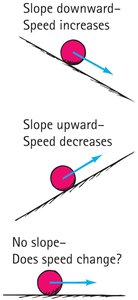
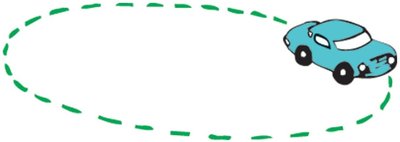
Acceleration is the rate at which velocity changes over time. It can result from changes in speed, direction, or both.
Formula:
Units: Meters per second squared (m/s2).
Example: If a car's speed increases from 40 km/h to 45 km/h in 5 seconds, the acceleration is .
Acceleration can occur:
When speeding up or slowing down (change in speed).
When changing direction (e.g., turning a corner).
Galileo's Inclined Plane Experiments
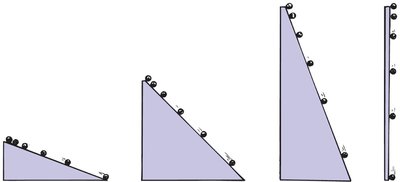
Galileo studied acceleration using inclined planes, discovering that steeper inclines produce greater acceleration. When the incline is vertical, the acceleration matches that of free-falling objects.
Free Fall
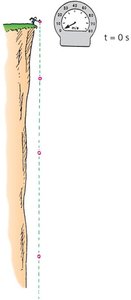
Free fall describes the motion of objects falling under the influence of gravity alone, with negligible air resistance. All objects in free fall accelerate at the same rate, denoted by g.
Acceleration due to gravity: (often rounded to 10 m/s2 for simplicity).
Velocity after time t:
Example: After 1 second, velocity is 10 m/s; after 2 seconds, 20 m/s; after 3 seconds, 30 m/s.
Distance Fallen in Free Fall
The distance covered by an object starting from rest and accelerating is given by:
Formula:
Example: After 1 second, distance is 5 m; after 2 seconds, 20 m; after 3 seconds, 45 m; after 4 seconds, 80 m.
Velocity Vectors and Vector Addition
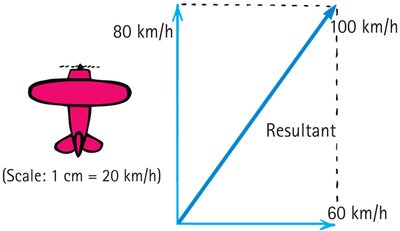
Velocity vectors represent both magnitude and direction. When multiple velocities act simultaneously (e.g., wind and airplane), their effects are combined using vector addition, often visualized with the parallelogram rule.
Resultant Vector: The combined effect of two or more vectors.
Parallelogram Rule: Used to determine the resultant when vectors are not aligned.
Example: An airplane flying at 80 km/h with a crosswind of 60 km/h results in a resultant velocity of 100 km/h.
Vector Angles
When two vectors of equal magnitude are perpendicular, the resultant forms a 45-degree angle with each vector.
Example: Running horizontally at 4 m/s in vertical rain falling at 4 m/s results in a resultant velocity at a 45-degree angle.
Summary Table: Key Concepts in Linear Motion
Concept | Definition | Formula | Units |
|---|---|---|---|
Speed | Distance per unit time | m/s | |
Velocity | Speed with direction | m/s | |
Acceleration | Rate of change of velocity | m/s2 | |
Free Fall Velocity | Velocity after time t in free fall | m/s | |
Free Fall Distance | Distance fallen after time t in free fall | m |
Additional info: All equations are presented in SI units for consistency. Vector addition is fundamental for understanding motion in two or more dimensions.
