 Indietro
Magnetic Forces and Circuits with Capacitors: Study Notes for Physics with Calculus
Guida di studio - Note intelligenti
 Appunti personalizzati basati sui tuoi materiali, ampliati con definizioni chiave, esempi e contesto.
Magnetic Forces and Circuits with Capacitors
Introduction
This study guide covers key concepts from electromagnetism, focusing on magnetic forces on current-carrying conductors and the analysis of circuits containing resistors and capacitors. These topics are central to college-level Physics with Calculus, particularly in chapters related to electric circuits and magnetism.
Direct-Current Circuits with Capacitors
Analyzing Circuits with Resistors and Capacitors
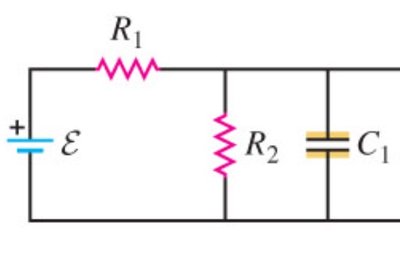
When analyzing circuits that include resistors (R), capacitors (C), and a source of electromotive force (EMF, \( \mathcal{E} \)), it is important to apply Kirchhoff's rules and the properties of capacitors in steady-state (fully charged) conditions.
Kirchhoff's Loop Rule: The sum of the potential differences around any closed loop in a circuit is zero.
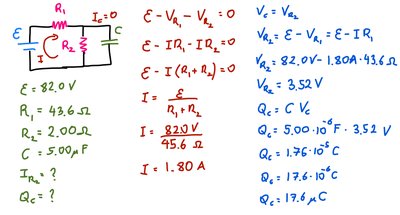
Capacitor in Steady-State: When a capacitor is fully charged, the current through it is zero, and it acts as an open circuit.
Finding Current: The current through a resistor in a steady-state circuit can be found using Ohm's Law and the rules for series and parallel circuits.
Finding Charge on a Capacitor: The charge \( Q \) on a capacitor is given by \( Q = CV \), where \( V \) is the voltage across the capacitor.
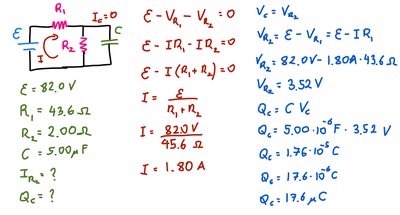
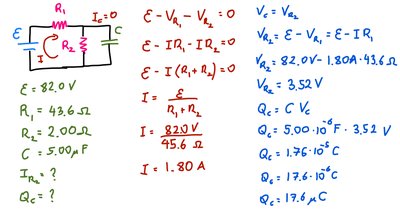
Example: For a circuit with \( \mathcal{E} = 82.0\,\text{V} \), \( R_1 = 43.6\,\Omega \), \( R_2 = 2.00\,\Omega \), and \( C = 5.00\,\mu\text{F} \), after the capacitor is fully charged, the current through \( R_2 \) and the charge on the capacitor can be calculated as shown below.
Magnetic Force on a Current-Carrying Conductor
Fundamental Concepts
The force experienced by a current-carrying wire in a magnetic field is a cornerstone of electromagnetism. This force is described by the Lorentz force law and is essential for understanding electric motors, generators, and many other devices.
Lorentz Force Law: The force on a charge \( q \) moving with velocity \( \vec{v} \) in a magnetic field \( \vec{B} \) is given by:
Force on a Current-Carrying Wire: For a straight wire of length \( \vec{l} \) carrying current \( I \) in a magnetic field \( \vec{B} \):
Direction: The direction of the force is given by the right-hand rule: point your thumb in the direction of current, fingers in the direction of the magnetic field, and your palm points in the direction of the force.
Drift Velocity: The average velocity of charge carriers (usually electrons) in a conductor is called the drift velocity, denoted \( \vec{v}_d \).
Example: A positive charge moving through a magnetic field experiences a force perpendicular to both its velocity and the field.
Mathematical Formulation of Magnetic Force
Equations and Calculations
The force on a differential element of charge or current in a magnetic field can be expressed in several equivalent forms, useful for both conceptual understanding and problem-solving.
Differential Force on a Charge:
Differential Force on a Current Element:
Total Force on a Wire:
Special Case (Uniform Field and Straight Wire):
Motion of Charged Particles in Magnetic Fields
Path of a Charged Particle
When a charged particle enters a region with a uniform magnetic field, it experiences a force perpendicular to both its velocity and the field, resulting in circular or helical motion depending on the initial velocity direction.
Force Direction: Determined by the right-hand rule for positive charges and left-hand rule for negative charges.
Possible Paths: The particle may follow a straight, circular, or helical path depending on its initial velocity relative to the field.
Example: An electron entering a magnetic field perpendicular to its velocity will move in a circular path.

Summary Table: Key Equations in Magnetism and Circuits
Concept | Equation | Description |
|---|---|---|
Lorentz Force | Force on a charge in electric and magnetic fields | |
Force on a Wire | Force on a current-carrying wire in a magnetic field | |
Charge on Capacitor | Charge stored on a capacitor | |
Ohm's Law | Relationship between voltage, current, and resistance |
Additional info:
These notes are based on standard college-level Physics with Calculus curriculum, specifically covering material from chapters on direct-current circuits and magnetism (Ch. 25, 27).
All equations are presented in SI units.
