 Indietro
Magnetism: Principles, Forces, and Applications
Guida di studio - Note intelligenti
 Appunti personalizzati basati sui tuoi materiali, ampliati con definizioni chiave, esempi e contesto.
Magnetism
Introduction to Magnetism
Magnetism is a fundamental force of nature, closely related to electricity, and is described by the behavior of magnetic fields and their interactions with materials and electric currents. This chapter explores the properties of magnets, the origin of magnetic fields, and their effects on charges and currents.
Magnets and Magnetic Poles
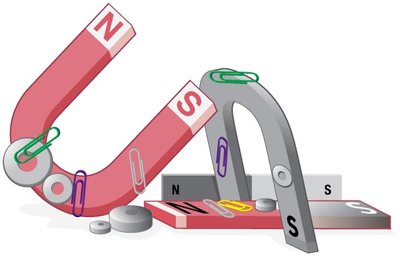
Magnetic Poles: Every magnet has two poles: North (N) and South (S). Poles always exist in pairs; isolated magnetic poles (monopoles) have not been observed.
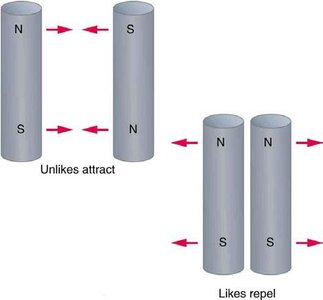
Attraction and Repulsion: Like poles repel, unlike poles attract. Both poles attract certain metals, such as iron, which can become magnetized.
Permanent Magnets: Materials like iron, cobalt, and nickel can retain magnetization due to the alignment of microscopic magnetic domains.
Magnetic Domains and Ferromagnetism
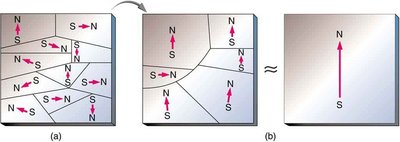
Ferromagnetic materials contain regions called magnetic domains, where atomic magnetic moments are aligned. In an unmagnetized state, domains are randomly oriented, but an external magnetic field can align them, resulting in a net magnetization.
Domain Alignment: When domains align with an external field, the material becomes magnetized. This alignment can persist even after the external field is removed (hysteresis).
De-magnetization: Randomization of domains can occur through heating or mechanical shock, reducing magnetization.
Magnetic Field (B) and Field Lines
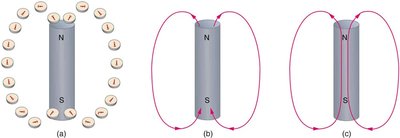
The magnetic field (B) is a vector field that describes the magnetic influence on moving charges, currents, and magnetic materials. The direction and strength of the field are represented by magnetic field lines.
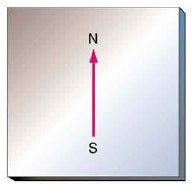
Direction: Field lines point from the North pole to the South pole outside the magnet and are tangent to the field at any point.
Strength: Proportional to the density of field lines (lines per unit area).
Properties: Field lines never cross and always form closed loops.
Unit: The SI unit of magnetic field is the tesla (T); another common unit is the gauss (G) (1 T = 10,000 G).

Earth as a Magnet
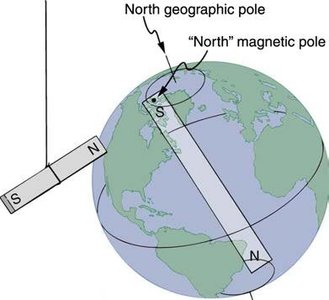
The Earth itself acts as a giant magnet, with a magnetic field that protects life by deflecting charged particles from space. The geographic North Pole corresponds to the magnetic South Pole, which is why a compass needle's North pole points northward.
Electric Currents and Magnetic Fields
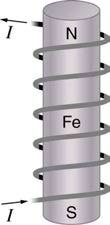
Electric currents produce magnetic fields. The direction of the field around a current-carrying wire is given by the right-hand rule (RHR-2): if the thumb points in the direction of current, the fingers curl in the direction of the magnetic field.
Magnetic Field of a Long Straight Wire: where is the permeability of free space ( T·m/A), is current, and is the distance from the wire.
Force on a Moving Charge in a Magnetic Field (Lorentz Force)
A charge moving with velocity in a magnetic field experiences a force:
Lorentz Force: or, in magnitude, where is the angle between and .
Direction: Determined by the right-hand rule (RHR-1). For negative charges, the force direction is opposite.
Work: The magnetic force does no work; it only changes the direction of motion, not the speed.
Circular Motion of Charges in a Uniform Magnetic Field
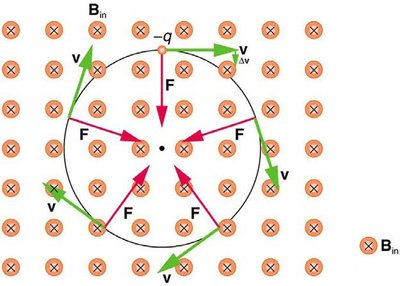
If a charged particle moves perpendicular to a uniform magnetic field, it undergoes uniform circular motion. The magnetic force provides the centripetal force:
Radius of path:
Period of revolution:
Mass Spectrometer
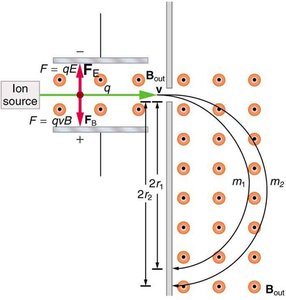
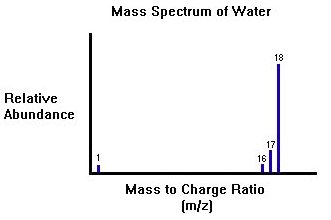
A mass spectrometer uses the deflection of charged particles in a magnetic field to measure the mass-to-charge ratio () of ions. This technique is widely used in chemistry and biology for molecular identification.
Radius of ion path:
Hall Effect
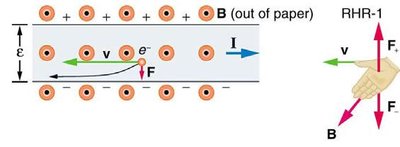
The Hall effect occurs when a current-carrying conductor is placed in a magnetic field, resulting in a transverse voltage (Hall voltage) due to the deflection of charge carriers. The sign of the Hall voltage reveals the type of charge carriers (positive or negative).
At equilibrium:
Hall voltage: (where is the width of the conductor)
Force on a Current-Carrying Wire
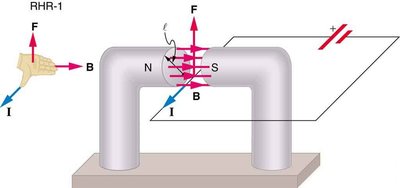
A wire carrying current in a magnetic field experiences a force:
Direction is given by the right-hand rule; maximum force when current is perpendicular to the field.
Magnetic Field Due to a Loop and Solenoid
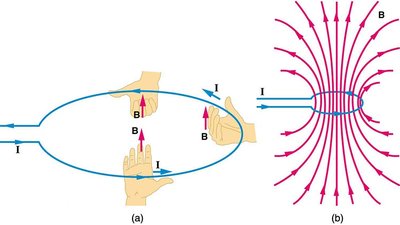
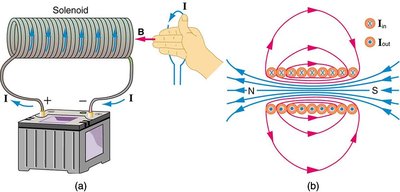
A current-carrying loop produces a magnetic field similar to a bar magnet. A solenoid (a coil of wire) creates a nearly uniform magnetic field inside.
Field at center of a loop: (for a loop of radius )
Field inside a solenoid: where is turns per unit length, is total turns, is length.
Force Between Two Parallel Wires
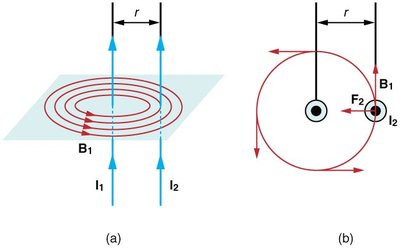
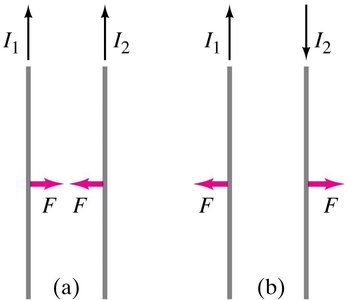
Two parallel wires carrying currents exert forces on each other due to their magnetic fields. The force per unit length between two wires separated by distance is:
Parallel currents attract; antiparallel currents repel.
Torque on a Current Loop; Magnetic Moment
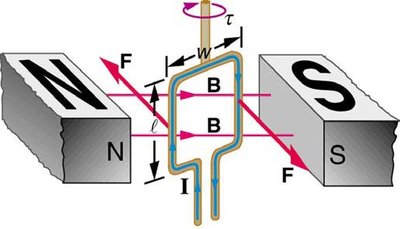
A current loop in a magnetic field experiences a torque that tends to align the loop's magnetic moment with the field. The torque is given by:
Where is the number of turns, is current, is area, is field strength, and is the angle between the field and the normal to the loop.
Applications: Galvanometers, Motors, and Electromagnets
Galvanometer: Measures small currents by the torque on a coil in a magnetic field.
Electric Motor: Converts electrical energy to mechanical rotation using the torque on a current loop.
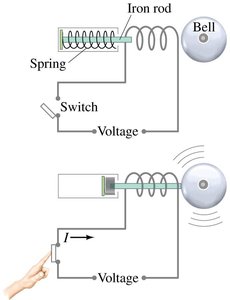
Electromagnet: A solenoid with an iron core greatly increases the magnetic field, used in devices like relays and bells.
Ferromagnetism: Domains and Hysteresis
Ferromagnetic materials exhibit hysteresis, meaning their magnetization depends on their magnetic history. Domains can remain aligned after the external field is removed, leading to permanent magnetization.
Summary of Key Equations
Force on a charge:
Force on a wire:
Field of a straight wire:
Field inside a solenoid:
Force between wires:
Torque on a loop:
