 Indietro
Microstates, Macrostates, and the Second Law of Thermodynamics
Guida di studio - Note intelligenti
 Appunti personalizzati basati sui tuoi materiali, ampliati con definizioni chiave, esempi e contesto.
Microstates and Macrostates
Definitions and Distinctions
In statistical mechanics, the concepts of microstate and macrostate are fundamental for understanding the behavior of thermodynamic systems.
Microstate: A microstate is a specific, detailed configuration of a system, describing the exact state of every particle. For example, a particular sequence of heads and tails in five coin flips (e.g., HTTHT) is a microstate.
Macrostate: A macrostate is defined by macroscopic properties (such as total energy, number of heads in coin flips, or pressure and temperature in a gas) and encompasses all microstates that share these properties. For example, all sequences with exactly two heads in five coin flips form a macrostate.
Degeneracy (W or Ω): The number of microstates corresponding to a given macrostate. Higher degeneracy means the macrostate is more probable.
Example: In poker, a specific hand (e.g., 2♠ 3♣ 5♦ 7♥ 9♠) is a microstate, while all hands classified as 'full house' form a macrostate.
Probability in Binary Systems
Binary systems, such as coin flips, are useful models for understanding microstates and macrostates.
"Flipping a coin 5 times and getting the sequence HTTHT" is a microstate.
"Flipping a coin 5 times and getting two heads" is a macrostate.
The probability of a specific microstate (e.g., HTTHT) is , where N is the number of flips.
The probability of a macrostate is proportional to its degeneracy: , where W is the number of microstates in the macrostate.
Most and Least Likely States
The most likely macrostate is the one with the highest degeneracy (most microstates).
For five coin flips, the macrostate with two or three heads is most likely, while all heads or all tails (only one microstate each) are least likely.
Entropy and the Second Law of Thermodynamics
Entropy: Definition and Formula
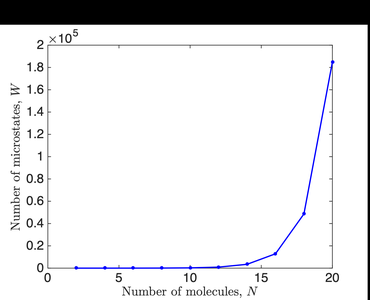
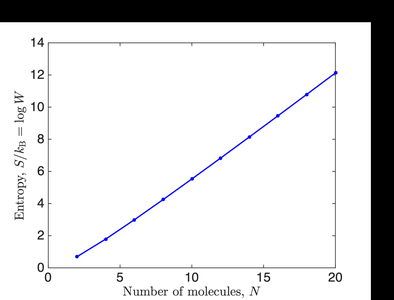
Entropy (S) is a measure of the number of possible microstates (W) corresponding to a macrostate. It quantifies the disorder or randomness of a system.
The formula for entropy is: where is Boltzmann's constant and is the degeneracy.
Entropy applies to macrostates because it is a property of the overall system, not of individual microstates.
Example: For a macrostate with only one microstate, .
Why the Natural Logarithm?
The natural logarithm in the entropy formula ensures that entropy is an extensive property (it scales with system size) and allows for the additive property of entropy when combining independent systems.
The Second Law of Thermodynamics
The Second Law of Thermodynamics states that the entropy of an isolated system will spontaneously increase until equilibrium is reached. This means systems evolve toward the most probable macrostate (the one with the highest degeneracy).
Isolated systems tend to maximize entropy.
The law is probabilistic: while it is overwhelmingly likely for entropy to increase, rare fluctuations can temporarily decrease entropy, but these are extremely improbable for large systems.
Degeneracy Calculations
Degeneracy can be calculated for various systems:
For coin flips: , where N is the total number of flips, is the number of heads, and is the number of tails.
For distributing q identical objects into N containers: This formula is used for problems like distributing energy quanta among oscillators.
Examples and Applications
Ideal Gas Example: Dividing a box of ideal gas molecules in half, the most likely macrostate is the one with the highest number of possible arrangements (degeneracy).
Entropy Calculation: For a macrostate with W possible arrangements, entropy is .
Coherent vs. Incoherent Motion
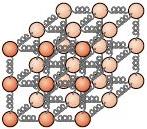
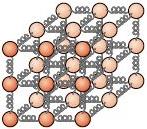
A macrostate where all atoms move coherently in one direction is highly unlikely (low degeneracy).
A macrostate where atoms move randomly in all directions is much more likely (high degeneracy).
Does Life Violate the Second Law?
Life does not violate the second law of thermodynamics. Living systems maintain order locally by increasing entropy in their surroundings, ensuring that the total entropy of the universe still increases.
Summary Table: Microstates, Macrostates, and Entropy
Term | Definition | Example |
|---|---|---|
Microstate | Specific arrangement of all particles in a system | HTTHT in 5 coin flips |
Macrostate | Set of microstates with the same macroscopic property | All sequences with 2 heads in 5 coin flips |
Degeneracy (W or Ω) | Number of microstates in a macrostate | 10 ways to get 2 heads in 5 flips |
Entropy (S) | Measure of disorder; | for 10 microstates |
