 Indietro
Mini-Textbook Study Notes: Modulation, Noise, Filters, and Linearity in Physics of Sound
Guida di studio - Note intelligenti
 Appunti personalizzati basati sui tuoi materiali, ampliati con definizioni chiave, esempi e contesto.
Amplitude and Frequency Modulation in Sound
Amplitude Modulated (AM) Signals
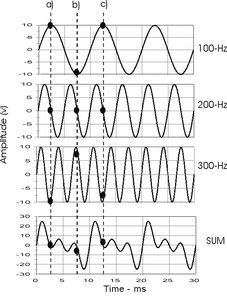
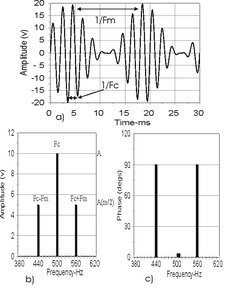
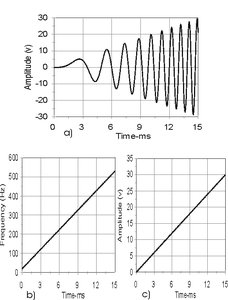
Amplitude Modulation (AM) is a process where the amplitude of a carrier wave is varied in proportion to a modulating signal, often used in sound and radio transmission. AM can occur by adding two sine waves or by modulating the amplitude of a single sine wave.
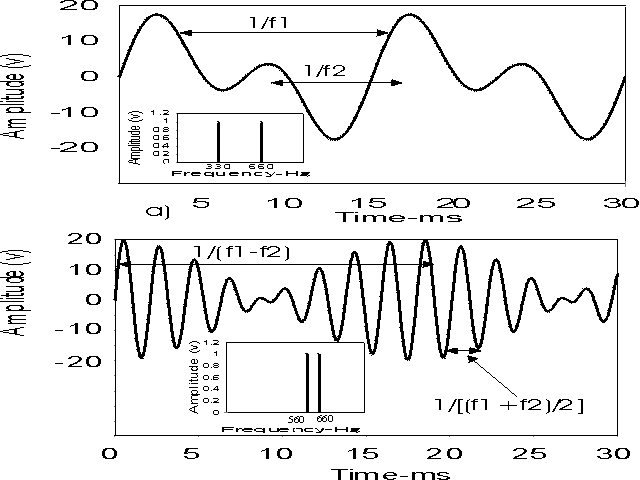
Superposition of Sine Waves: When two sine waves of different frequencies are added, the resulting waveform exhibits amplitude modulation.
Beating: If the frequencies are close, a beating pattern is formed. The perceived frequency is the average, , and the amplitude modulation (beat frequency) is .
Mathematical Representation: For a single sine wave with amplitude modulation: where is the carrier frequency, is the modulation frequency, and is the modulation index.
Frequency Modulated (FM) Signals
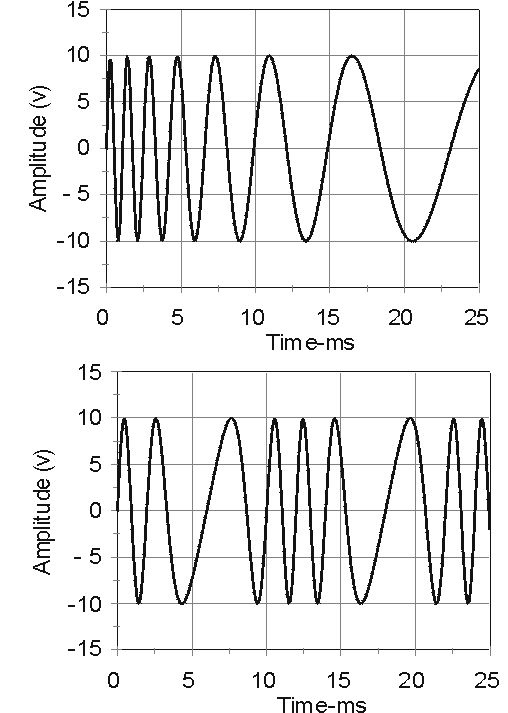
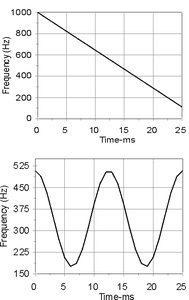
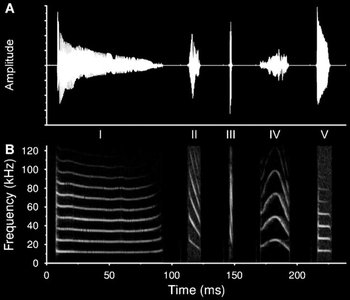
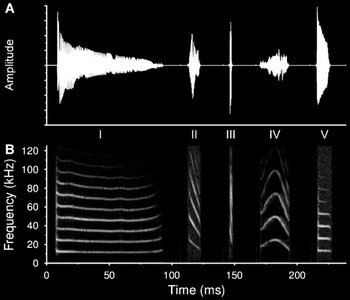
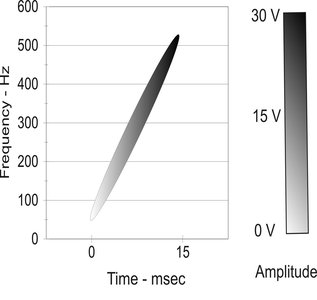
Frequency Modulation (FM) involves varying the frequency of a carrier wave in accordance with the amplitude of a modulating signal. FM is widely used in communication systems and in biological echolocation (e.g., bats).
FM Signal: The instantaneous frequency of the carrier is varied by the modulating signal.
Applications: FM is used in radio broadcasting and animal echolocation.






Noise in Acoustic Signals
Types and Measures of Noise
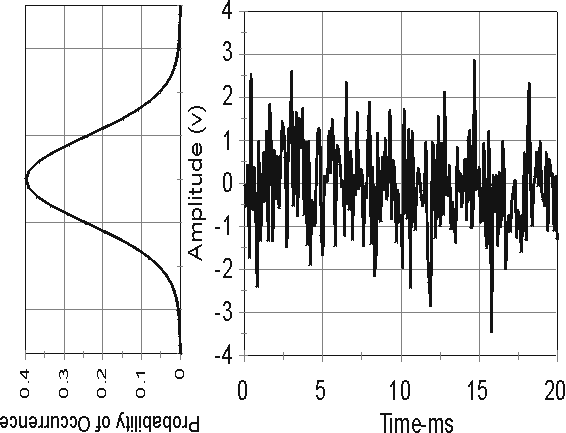
Noise is a random sound with amplitude that varies unpredictably over time within a specified frequency band. It is classified by its bandwidth and spectral properties.
Narrowband Noise (NBN): Noise with a small frequency bandwidth.
Wideband Noise (WBN): Noise with a large frequency bandwidth.
White Noise: Power is spread equally across all frequencies.
Pink Noise: Power decreases with increasing frequency (linear roll-off).
Brown Noise: Power decreases more steeply with frequency.
Blue Noise: Power increases with frequency.
Intensity Measures:
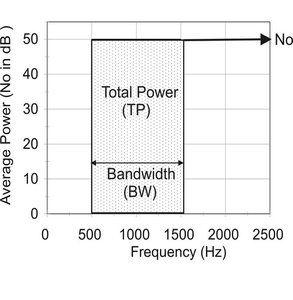
Total Power (TP): Sum of amplitudes of all sinusoids in the spectrum.
Spectrum Level (N_0): Average noise intensity in a 1 Hz band.
Relationship:
Filters in Acoustics and Signal Processing
Introduction to Filters
Filters are devices or algorithms that selectively allow certain frequencies to pass while attenuating others. They are essential in modifying, analyzing, and understanding complex sounds.
Purpose: To change the relative amplitude of some frequencies in a complex sound while leaving others unaltered.
Frequency Selectivity: Filters perform frequency-selective attenuation or amplification.
Applications: Used in audio engineering, hearing aids, and scientific analysis of sound.
Types of Filters
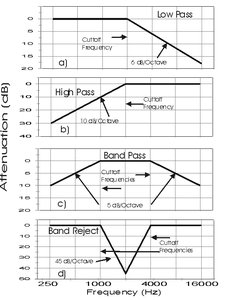
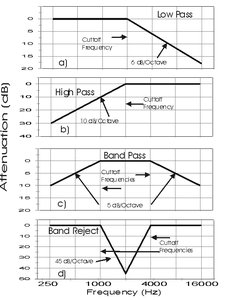
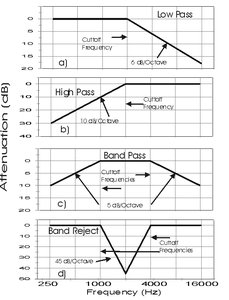
Low Pass Filter: Allows frequencies below a cutoff frequency () to pass.
High Pass Filter: Allows frequencies above a cutoff frequency () to pass.
Band Pass Filter: Allows frequencies between two cutoff frequencies to pass.
Band Reject (Notch) Filter: Attenuates frequencies between two cutoff frequencies.

Filter Characteristics
Cutoff Frequency (): The frequency at which the signal energy decreases by half (3 dB point).
Roll-off Rate: The rate of attenuation beyond the cutoff, measured in dB/octave (octave = frequency doubling).
Bandwidth (BW): The frequency range between the low and high cutoff frequencies ().
Broadband vs. Narrowband: Broadband filters have wide bandwidth; narrowband filters have narrow bandwidth.
Phase Delay: Filters can introduce frequency-dependent phase shifts, described by the phase spectrum.
Filter Analysis and Impulse Response
The characteristics of a filter can be determined by analyzing its response to an impulsive input (e.g., a click). Fourier analysis reveals how energy is distributed across frequencies.
Impulse Response: The output of a filter to a brief input signal.
Time-Frequency Tradeoff: Narrowband filters have longer response times and greater frequency selectivity, but may 'ring' (prolonged response).
Linearity in Physical Systems
Definition and Properties of Linearity
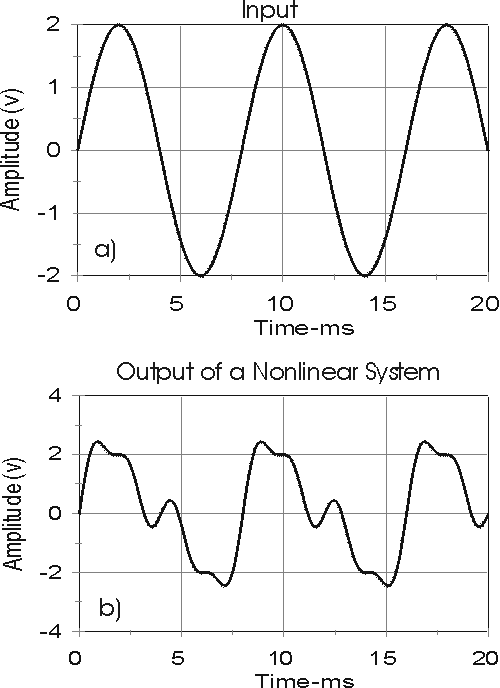
A system is linear if it satisfies the principles of superposition and homogeneity. Linearity is crucial for predicting system responses and for the use of Fourier analysis in signal processing.
Superposition: The response to multiple inputs is the sum of the responses to each input individually.
Homogeneity: Scaling the input by a factor scales the output by the same factor.
Predictability: The response to any input can be predicted from the response to sinusoidal inputs.
Linearity in Devices: Microphones, speakers, and amplifiers are ideally linear; some parts of the auditory system are approximately linear.
Nonlinearity: If a device introduces new frequency components (distortion), it is nonlinear.
Mathematical Representation
Linear System: , or
Fourier Analysis: Used to decompose complex signals into sinusoids, leveraging linearity for analysis and prediction.
Summary Table: Filter Types and Properties
Filter Type | Passes | Attenuates | Key Parameter(s) |
|---|---|---|---|
Low Pass | Frequencies below | Frequencies above | Cutoff frequency (), Roll-off rate |
High Pass | Frequencies above | Frequencies below | Cutoff frequency (), Roll-off rate |
Band Pass | Frequencies between and | Frequencies outside this range | Low and high cutoff frequencies, Bandwidth |
Band Reject | Frequencies outside and | Frequencies between and | Low and high cutoff frequencies, Bandwidth |
Key Equations
AM Signal:
Noise Power:
Decibel Change for Half Energy:
Bandwidth:
Summary
This guide covers the physics of amplitude and frequency modulation, the nature and measurement of noise, the function and classification of filters, and the concept of linearity in physical systems. These principles are foundational for understanding sound, signal processing, and the operation of many physical and biological systems.
