 Indietro
Models, Measurements, and Vectors: Foundations for Physics with Calculus
Guida di studio - Note intelligenti
 Appunti personalizzati basati sui tuoi materiali, ampliati con definizioni chiave, esempi e contesto.
Models, Measurements & Vectors
Introduction to Physical Quantities and Vectors
Physics uses models and measurements to describe the natural world quantitatively. Vectors are essential mathematical tools for representing quantities that have both magnitude and direction, such as displacement, velocity, and force.
Scalar and Vector Quantities
Scalar Quantity: A physical quantity described by magnitude only (e.g., mass, temperature, distance).
Vector Quantity: A physical quantity described by both magnitude and direction (e.g., displacement, velocity, force).
Distance and Displacement
Distance and displacement are fundamental concepts in describing motion:
Distance: The total length of the path traveled, regardless of direction. It is a scalar quantity.
Displacement: The straight-line vector from the initial position to the final position. It is a vector quantity and can be represented as:
Where is the initial position vector and is the final position vector.
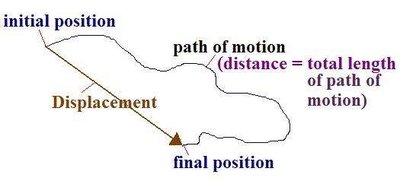
Vector Representation and Direction
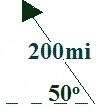
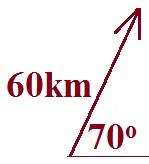
Vectors are represented graphically by arrows. The length of the arrow indicates the magnitude, and the arrow points in the direction of the vector. Directions are often specified using angles measured from a reference axis (e.g., the positive x-axis or compass directions).
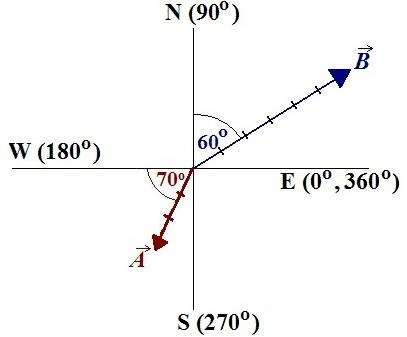
Coordinate System and Quadrants
The Cartesian coordinate system divides the plane into four quadrants, which helps in specifying the direction of vectors and their components.
Quadrant I: (+x, +y)
Quadrant II: (−x, +y)
Quadrant III: (−x, −y)
Quadrant IV: (+x, −y)
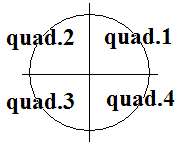
Vector Components
Any vector in a plane can be resolved into two perpendicular components: one along the x-axis and one along the y-axis. This process is called vector decomposition.
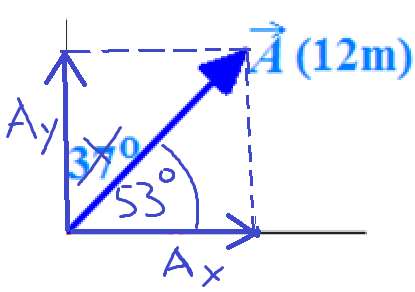
The x-component () and y-component () of a vector can be found using trigonometry:
Where is the magnitude of the vector and is the angle it makes with the x-axis.
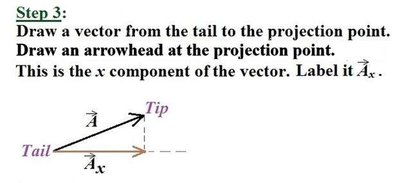
Finding the x-component
Draw the x-axis from the tail of the vector.
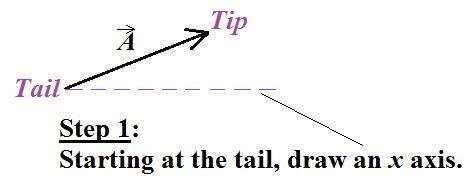
From the tip, draw a line perpendicular to the x-axis to find the projection point.

Draw the x-component vector from the tail to the projection point.
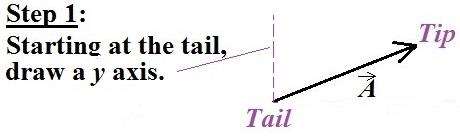
Finding the y-component
Draw the y-axis from the tail of the vector.
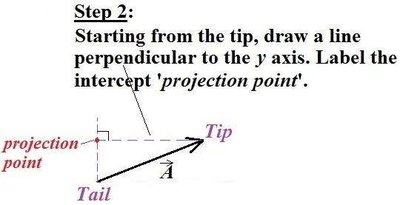
From the tip, draw a line perpendicular to the y-axis to find the projection point.
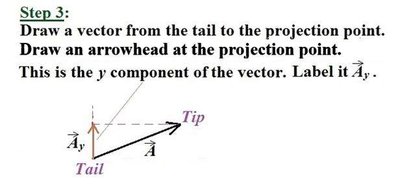
Draw the y-component vector from the tail to the projection point.
Graphical Representation of Vector Components
On a grid, vectors and their components can be visualized as forming right triangles, with the vector as the hypotenuse and the components as the legs.
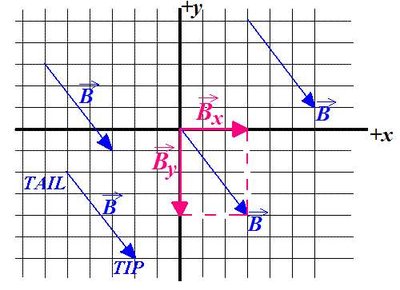
Examples of Vector Decomposition
Consider a vector with magnitude 12 m at an angle of 37° from the x-axis:
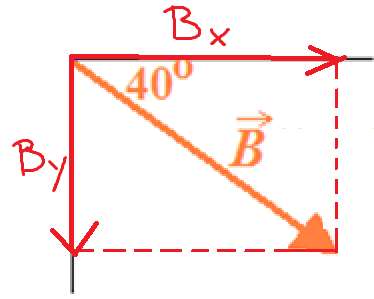
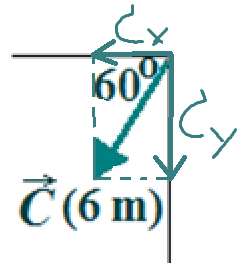
Similarly, for vector (15 m, 40° below x-axis) and (6 m, 60° below x-axis):
General Vector Addition and Subtraction
Vectors can be added or subtracted graphically (tip-to-tail method) or analytically (by adding/subtracting components):
Resultant Vector: The sum of two or more vectors.
For vectors and :
Component form: ,
Magnitude:
Direction:
Vector Subtraction
Subtracting a vector is equivalent to adding its negative:
Summary Table: Scalar vs. Vector Quantities
Quantity | Scalar | Vector |
|---|---|---|
Distance/Displacement | Distance | Displacement |
Speed/Velocity | Speed | Velocity |
Mass/Force | Mass | Force |
Temperature/Acceleration | Temperature | Acceleration |
Additional info: Understanding vectors and their components is foundational for all subsequent topics in Physics with Calculus, including kinematics, dynamics, and fields.
