 Indietro
Motion Along a Straight Line: Kinematics and Calculus-Based Analysis
Guida di studio - Note intelligenti
 Appunti personalizzati basati sui tuoi materiali, ampliati con definizioni chiave, esempi e contesto.
Chapter 2: Motion Along a Straight Line
Introduction to Kinematics
Kinematics is the branch of mechanics that describes the motion of objects without considering the forces that cause the motion. In one-dimensional motion, position, velocity, and acceleration are the primary quantities used to describe the motion of a particle.
Mechanics: Study of force, matter, and motion.
Kinematics: Study of the geometry of motion.
Particle: An object treated as a point mass with no internal structure.
Coordinate System: Reference point (origin) and axes to specify position.
Position and Displacement
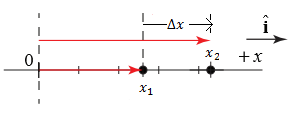
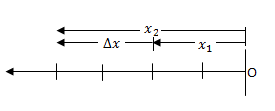
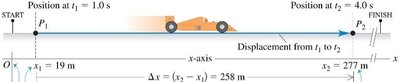
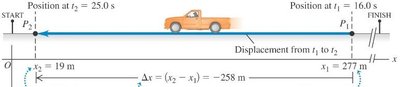
The position of a particle in one dimension is specified by the coordinate x. Displacement is the change in position between two points and is a vector quantity.
Position: Location relative to a reference point.
Displacement:
Displacement can be positive or negative depending on direction.
Displacement is a vector; it only considers the change, not the path.
Speed and Velocity
Speed is the scalar measure of how fast an object moves, while velocity is a vector that includes direction. Average velocity is displacement divided by time interval.
Speed: (always positive)
Average Velocity:
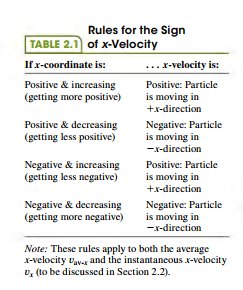
Sign of velocity depends on direction of motion.
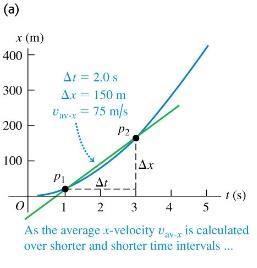
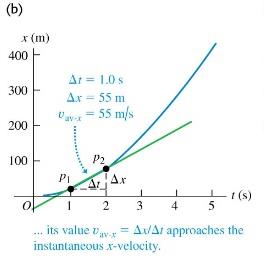
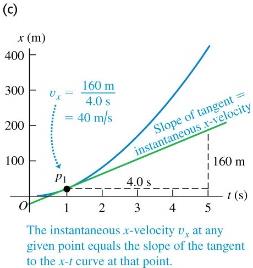
Instantaneous Velocity
Instantaneous velocity is the velocity at a specific instant and is defined as the derivative of position with respect to time.
Instantaneous Velocity:
Positive means motion in positive x-direction; negative means motion in negative x-direction.
Instantaneous speed is the magnitude of instantaneous velocity.
Example: Cheetah Chase
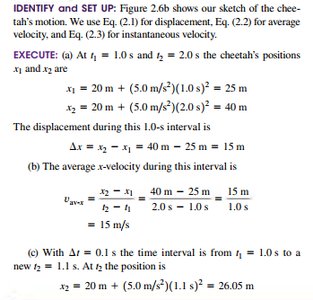
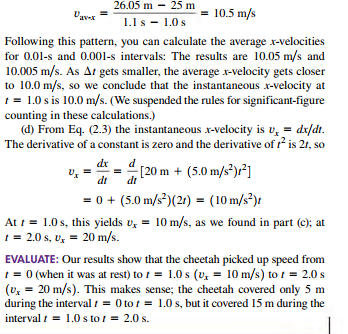
Consider a cheetah running with position given by . Calculations of displacement, average velocity, and instantaneous velocity illustrate the concepts.
Displacement:
Average velocity:
Instantaneous velocity:
Acceleration
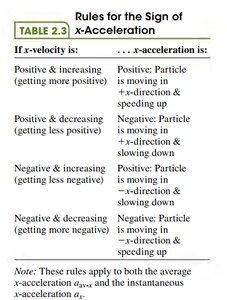
Acceleration describes the rate of change of velocity with time. It can be average or instantaneous, and is a vector quantity.
Average Acceleration:
Instantaneous Acceleration:
Acceleration is the second derivative of position:
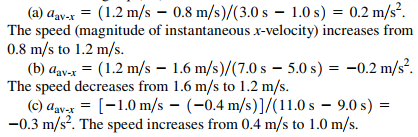
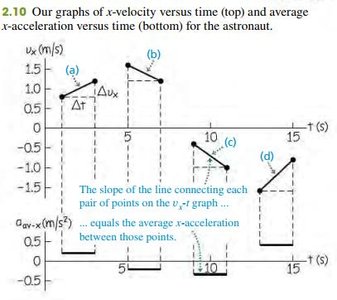
Example: Astronaut Maneuvering Unit
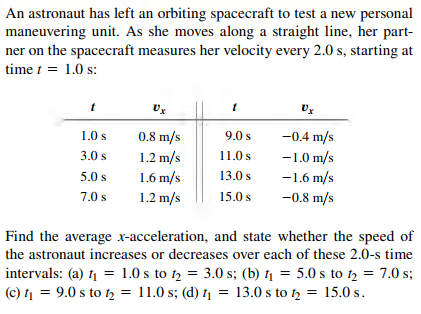
An astronaut's velocity is measured at intervals; average acceleration is calculated for each interval.
Use for each interval.
Interpret whether speed increases or decreases based on sign.
Equations of Motion with Constant Acceleration
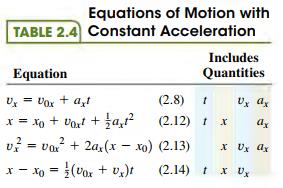
For straight-line motion with constant acceleration, the following equations relate position, velocity, and acceleration:
Free Fall and Vertical Motion
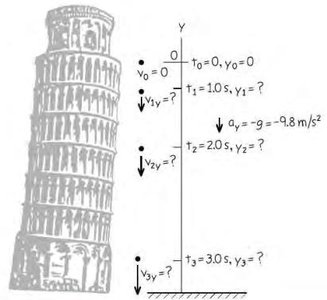
Objects in free fall experience constant acceleration due to gravity, . The direction of acceleration is always downward.
For vertical motion:
Choose positive y-direction as upward; then
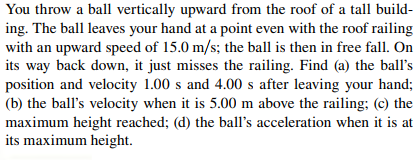
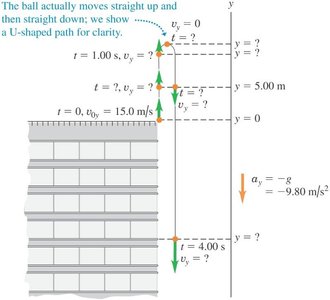
Example: Ball Thrown Vertically Upward
A ball is thrown upward with initial velocity. Its position and velocity at various times, maximum height, and acceleration at maximum height are calculated using kinematic equations.
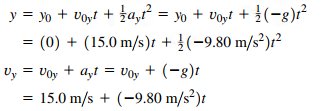
Position:
Velocity:
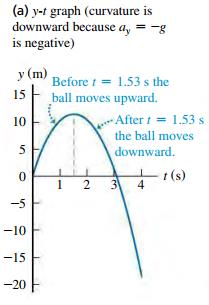
Maximum height: Set and solve for
Acceleration at maximum height:
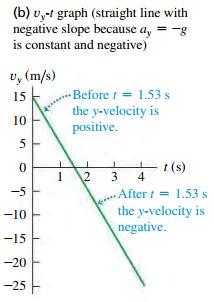
Graphical Interpretation of Motion
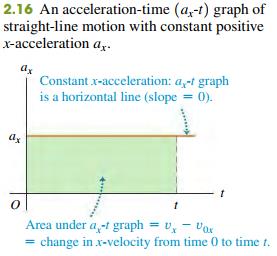
Graphs of position, velocity, and acceleration versus time provide visual understanding of motion. The slope of the position-time graph gives velocity, and the slope of the velocity-time graph gives acceleration.
Area under acceleration-time graph gives change in velocity.
Area under velocity-time graph gives change in position.
Calculus-Based Kinematics
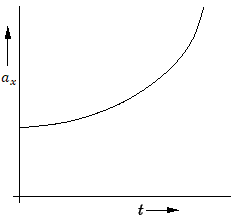
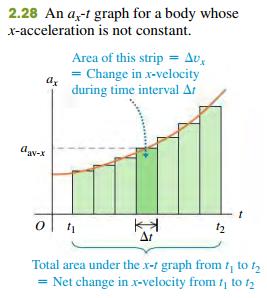
When acceleration is not constant, calculus is used to find velocity and position from acceleration functions.
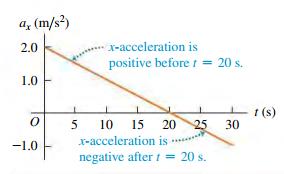
Area under vs. graph gives change in velocity.
Area under vs. graph gives change in position.
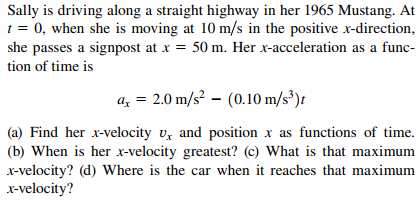
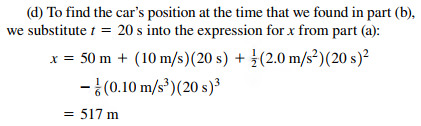
Example: Variable Acceleration
A car's acceleration is given by . Find velocity, position, and maximum velocity.
Velocity:
Position:
Maximum velocity occurs when
Summary Table: Equations of Motion
Equation | Includes Quantities |
|---|---|
t, , | |
t, x, , | |
x, , | |
t, x, |
*Additional info: Calculus-based integration is essential for variable acceleration cases, allowing for general solutions beyond constant acceleration scenarios.*
