 Indietro
Motion in One Dimension: Physics with Calculus Study Notes
Guida di studio - Note intelligenti
 Appunti personalizzati basati sui tuoi materiali, ampliati con definizioni chiave, esempi e contesto.
Motion in One Dimension
Introduction to Linear Motion
Motion in one dimension is the study of objects moving along a straight line, either horizontally or vertically. This foundational topic introduces key concepts such as position, velocity, acceleration, and the mathematical relationships that describe their changes over time.
Describing Motion
Position and Coordinate Systems
To analyze motion, we use a coordinate system. For horizontal motion, the x-axis is used, with positive direction typically to the right. For vertical motion, the y-axis is used, with positive direction upward. The position of an object is its location relative to the origin of the chosen axis.
Position (x or y): The location of an object along a straight line, measured from an origin.
Displacement (Δx or Δy): The change in position, defined as final position minus initial position.
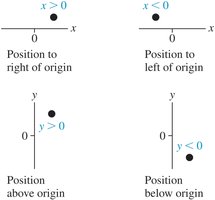
Motion Diagrams
Motion diagrams represent an object's position at successive times. They help visualize how an object moves, whether at constant speed, speeding up, or slowing down.

Position vs. Time Graphs
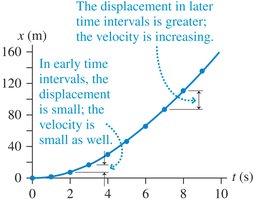
A position-versus-time graph plots an object's position on the vertical axis and time on the horizontal axis. The slope of this graph at any point gives the object's velocity at that instant.
Steeper slope: Faster speed.
Positive slope: Motion in the positive direction.
Negative slope: Motion in the negative direction.
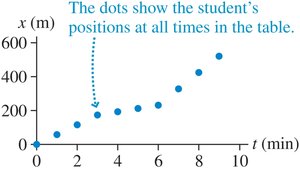

Velocity
Velocity is the rate of change of position with respect to time. It is a vector quantity, meaning it has both magnitude and direction.
Average velocity:
Instantaneous velocity: The slope of the position-time graph at a specific instant.
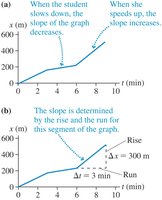
Velocity vs. Time Graphs
A velocity-versus-time graph shows how an object's velocity changes over time. The area under the velocity-time graph represents the object's displacement.
Constant velocity: Horizontal line.
Changing velocity: Sloped line (indicates acceleration).
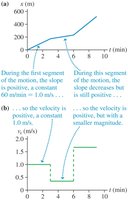
Example: Interpreting Graphs
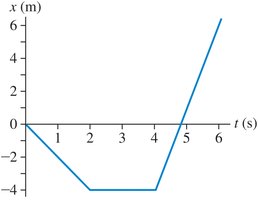
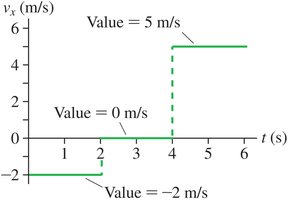
Given a position-time graph with segments of different slopes, you can construct the corresponding velocity-time graph by calculating the slope for each segment.
Uniform Motion
Definition and Characteristics
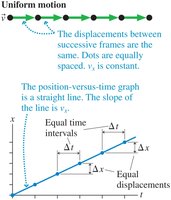
Uniform motion (or constant-velocity motion) occurs when an object moves in a straight line with constant speed. The position-time graph is a straight line, and the velocity-time graph is a horizontal line.
Equation:
Displacement is proportional to time:
Proportional Relationships
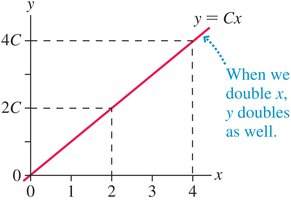
When two variables are proportional, changing one by a factor changes the other by the same factor. For uniform motion, displacement and time are proportional.
General form:
If doubles, doubles.
Instantaneous Velocity
Definition and Calculation
The instantaneous velocity is the velocity of an object at a specific instant. It is found by taking the slope of the tangent to the position-time curve at that point.
Mathematical definition:
Acceleration
Definition and Units
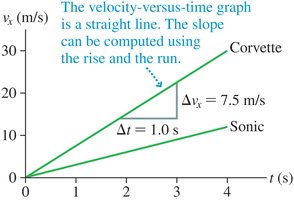
Acceleration is the rate of change of velocity with respect to time. It is a vector quantity and can be positive or negative depending on the direction of velocity change.
Average acceleration:
SI units: meters per second squared (m/s2)
Sign of Acceleration
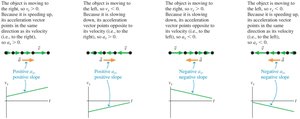
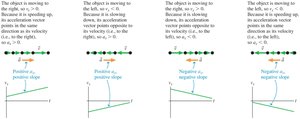
The sign of acceleration depends on the direction of velocity and whether the object is speeding up or slowing down. If velocity and acceleration have the same sign, the object speeds up; if opposite, it slows down.
Motion with Constant Acceleration
Kinematic Equations
For motion with constant acceleration, the following equations describe the relationships between position, velocity, acceleration, and time:
Quadratic Relationships
When a variable is proportional to the square of another, the relationship is quadratic. For example, in constant acceleration, displacement is proportional to the square of time.
General form:
Free Fall
Definition and Properties
Free fall describes the motion of objects under the influence of gravity alone. All objects in free fall near Earth's surface experience the same acceleration, regardless of mass.
Free-fall acceleration: (downward)
Use kinematic equations with for upward motion and for downward motion.
Problem-Solving Strategies
Four-Step Approach
Strategize: Identify the type of problem and relevant principles.
Prepare: Draw diagrams, list knowns and unknowns, and organize information.
Solve: Apply appropriate equations and perform calculations.
Assess: Check units, reasonableness, and completeness of the answer.
Pictorial and Graphical Representations
Drawing motion diagrams, graphs, and listing values helps visualize and organize the problem, making it easier to apply the correct equations and reasoning.
Summary Table: Key Equations for One-Dimensional Motion
Quantity | Equation | Description |
|---|---|---|
Displacement (uniform motion) | Constant velocity | |
Velocity (constant acceleration) | Linear change in velocity | |
Position (constant acceleration) | Quadratic in time | |
Velocity squared | Relates velocity and displacement |
Applications and Examples
Uniform motion: A hockey puck sliding at constant speed.
Constant acceleration: A car accelerating from rest, or braking to a stop.
Free fall: A dropped ball, or a diver jumping off a cliff.
Summary of Concepts
Velocity is the rate of change of position.
Acceleration is the rate of change of velocity.
Uniform motion has constant velocity; constant acceleration motion has a linear velocity-time graph and a parabolic position-time graph.
Free fall is a special case of constant acceleration, with downward.
