 Indietro
Motion in One Dimension: Physics with Calculus Study Notes
Guida di studio - Note intelligenti
 Appunti personalizzati basati sui tuoi materiali, ampliati con definizioni chiave, esempi e contesto.
Motion in One Dimension
Introduction to Linear Motion
Motion in one dimension refers to the movement of objects along a straight line, either horizontally or vertically. This chapter focuses on describing and analyzing such motion using position, velocity, and acceleration, and introduces graphical and mathematical methods for problem-solving.
Uniform Motion
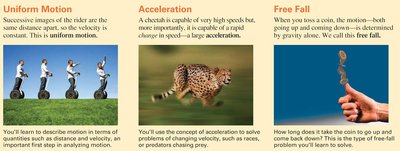
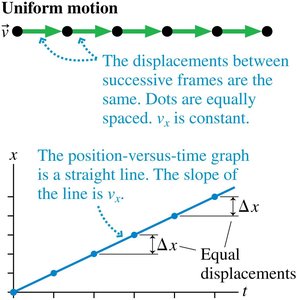
Uniform motion occurs when an object moves in a straight line at a constant velocity, meaning equal displacements occur during any successive equal-time intervals.
Definition: Motion with constant velocity; position changes by equal amounts in equal time intervals.
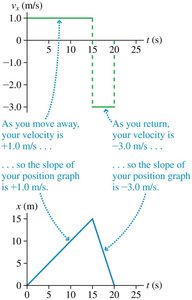
Position-versus-time graph: A straight line indicates uniform motion.
Equation:
Position equation:
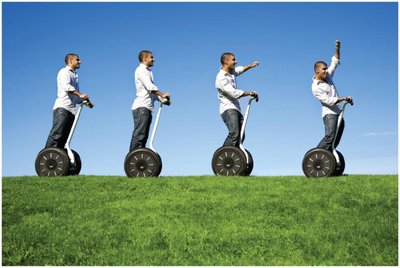
Example: A rider moving at constant speed; successive images are equally spaced.

Acceleration
Acceleration is the rate at which an object's velocity changes with time. It is a vector quantity, meaning it has both magnitude and direction.
Definition:
Units: meters per second squared (m/s2)
Graphical interpretation: The slope of a velocity-versus-time graph represents acceleration.
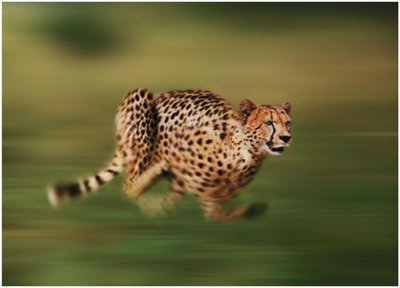
Example: A cheetah rapidly increasing its speed demonstrates large acceleration.
Free Fall
Free fall describes the motion of objects under the influence of gravity alone, with no other forces acting. All objects in free fall experience the same acceleration, regardless of mass.
Free-fall acceleration: (on Earth)
Direction: Always points downward.
Equations: Use kinematic equations with for vertical motion.
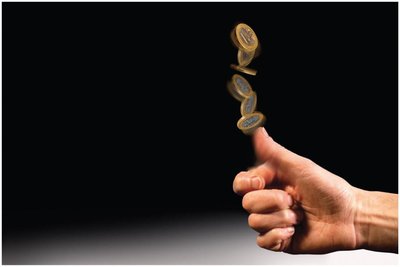
Example: Tossing a coin upward and watching it fall back down.
Representing Position
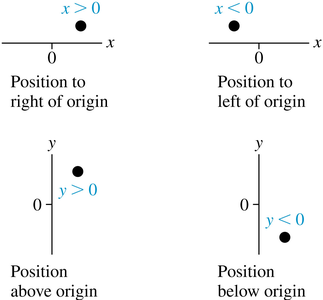
Position is described using a coordinate axis. The x-axis is used for horizontal motion, and the y-axis for vertical motion. The origin is the reference point.
Positive direction: Right (x-axis), Up (y-axis)
Negative direction: Left (x-axis), Down (y-axis)
Position notation: (right of origin), (left of origin), (above origin), (below origin)
Motion Diagrams
Motion diagrams visually represent the position of an object at successive times. They help analyze the type of motion and changes in velocity.
Uniform motion: Dots are equally spaced.
Accelerated motion: Dots get closer or farther apart.

Position-versus-Time Graphs
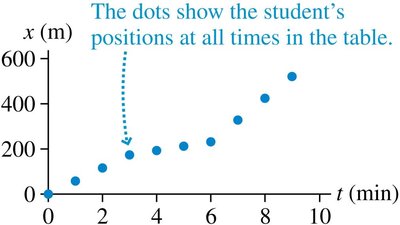
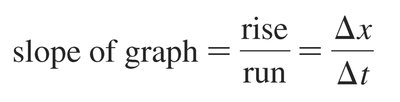
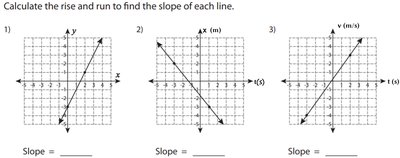
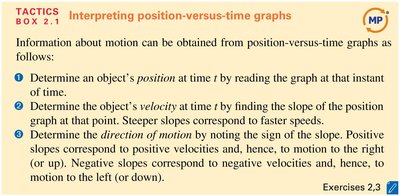
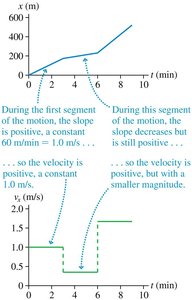
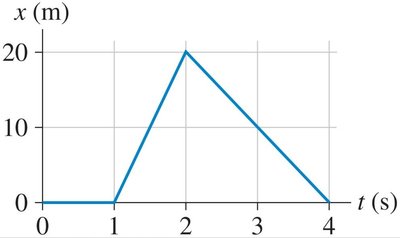
Position-versus-time graphs are fundamental for analyzing motion. The slope of the graph at any point gives the velocity.
Slope interpretation:
Steeper slope: Faster speed
Positive slope: Motion to the right/up
Negative slope: Motion to the left/down

Velocity-versus-Time Graphs
Velocity-versus-time graphs provide another way to represent motion. The area under the curve gives the displacement.
Constant velocity: Horizontal line
Changing velocity: Sloped line
Displacement: Area under the curve



Equations of Uniform Motion
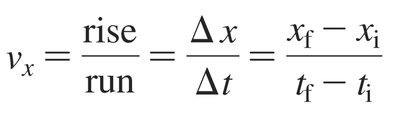
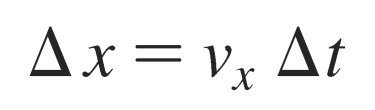
For uniform motion, the displacement is proportional to the time interval. The velocity tells us how much the position changes each second.
Displacement equation:
Position equation:
Proportional Relationships and Ratio Reasoning
Proportional relationships allow us to solve problems using ratios. If two variables are proportional, their ratios remain constant.
Proportionality:
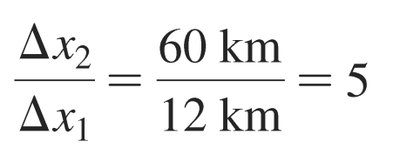
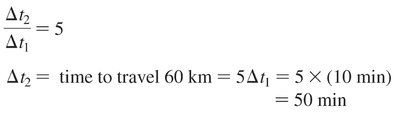
Ratio reasoning: If , then
Example Problems
Example problems illustrate the application of concepts and equations to real-world scenarios.
Example 1: Calculating the time for a train to travel a given distance using ratio reasoning.
Example 2: Determining the speed of a soccer ball and the time for a goalie to react.

Summary Table: Key Concepts in 1D Motion
Concept | Definition | Equation |
|---|---|---|
Position | Location relative to origin | or |
Displacement | Change in position | |
Velocity | Rate of change of position | |
Acceleration | Rate of change of velocity | |
Uniform Motion | Constant velocity | |
Free Fall | Motion under gravity |
Additional info:
All equations are valid for motion along a straight line (1D), and can be adapted for horizontal (x-axis) or vertical (y-axis) motion.
Ratio reasoning is a powerful tool for solving proportional motion problems.
Motion diagrams, position-time graphs, and velocity-time graphs are essential for visualizing and analyzing motion.
