 Indietro
Motion in One Dimension: Physics with Calculus Study Notes
Guida di studio - Note intelligenti
 Appunti personalizzati basati sui tuoi materiali, ampliati con definizioni chiave, esempi e contesto.
Motion in One Dimension
Introduction to Linear Motion
Motion in one dimension, also known as 1D kinematics, is the study of objects moving along a straight line. This foundational topic in physics introduces the concepts of position, velocity, and acceleration, and provides the mathematical tools to analyze and predict motion.
Describing Motion
Position and Displacement
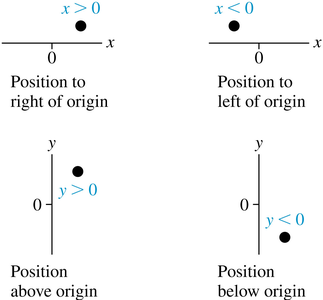
Position describes the location of an object along a coordinate axis. Displacement is the change in position, defined as the difference between the final and initial positions.
Position (x or y): The location of an object relative to an origin.
Displacement (Δx): The change in position, Δx = xf - xi.
Coordinate Axes: The x-axis is used for horizontal motion, and the y-axis for vertical motion.
Motion Diagrams
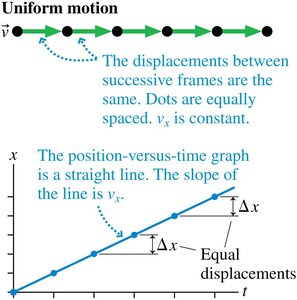
Motion diagrams visually represent an object's position at successive time intervals. They help in understanding the nature of motion (uniform or accelerated).
Equally spaced dots indicate uniform motion (constant velocity).
Increasing or decreasing spacing indicates acceleration (changing velocity).

Position vs. Time Graphs
Graphs of position versus time provide a quantitative way to analyze motion. The slope of the graph at any point gives the velocity.
Slope of the graph:
Steeper slope: Indicates higher velocity.
Curved graph: Indicates changing velocity (acceleration).
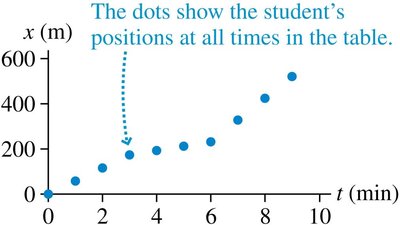
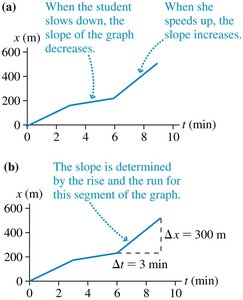
Interpreting Position-Time Graphs
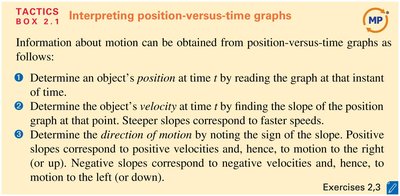
Key information can be extracted from position-time graphs:
Position at a given time
Velocity from the slope
Direction of motion from the sign of the slope
Velocity
Average and Instantaneous Velocity
Velocity is the rate of change of position with respect to time. It is a vector quantity, having both magnitude and direction.
Average velocity:
Instantaneous velocity: The slope of the tangent to the position-time graph at a specific instant.
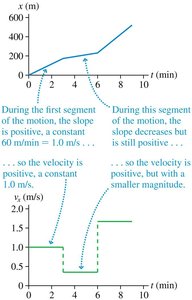

Velocity vs. Time Graphs
Velocity-time graphs provide another way to represent motion. The area under the velocity-time graph gives the displacement.
Constant velocity: Horizontal line on the graph.
Changing velocity: Sloped or curved line.
Displacement: Area under the curve.

Uniform Motion
Definition and Equations
Uniform motion occurs when an object moves in a straight line with constant velocity. The position changes by equal amounts in equal time intervals.
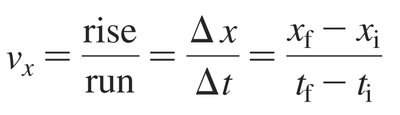
Equation for uniform motion:
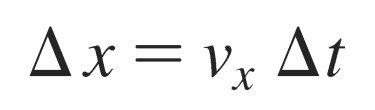
Displacement:

Proportional Relationships and Ratio Reasoning
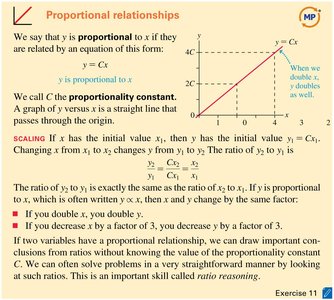
In uniform motion, displacement is proportional to time. Ratio reasoning allows for quick solutions to problems involving proportional relationships.
If you double the time, you double the displacement.
Ratio of distances equals the ratio of times for constant velocity.
Acceleration
Definition and Units
Acceleration is the rate of change of velocity with respect to time. It is a vector quantity and can be positive (speeding up) or negative (slowing down).
Average acceleration:
SI unit: meters per second squared (m/s2)
Acceleration from Velocity-Time Graphs
The slope of a velocity-time graph gives the acceleration. The area under the acceleration-time graph gives the change in velocity.
Positive slope: Positive acceleration
Negative slope: Negative acceleration
Equations of Motion with Constant Acceleration (Kinematic Equations)
The "Big 4" Kinematic Equations
For motion with constant acceleration, the following equations are used:
These equations allow you to solve for unknowns when three of the five variables (initial velocity, final velocity, acceleration, displacement, and time) are known.
Free Fall
Definition and Properties
Free fall describes the motion of objects under the influence of gravity alone, with air resistance neglected. All objects in free fall near Earth's surface experience the same constant acceleration downward, denoted by g.
Free-fall acceleration: (downward)
Use kinematic equations with for vertical motion.
At the highest point of upward motion, velocity is zero but acceleration is still .
Problem-Solving Strategies
Steps for Solving Kinematics Problems
Draw a motion diagram and choose a coordinate system.
List known and unknown quantities.
Select the appropriate kinematic equation.
Solve algebraically, then substitute numbers.
Check units and assess the reasonableness of your answer.
Summary Table: Key Kinematic Quantities and Equations
Quantity | Symbol | Equation | SI Unit |
|---|---|---|---|
Displacement | Δx | m | |
Average velocity | v_x | m/s | |
Acceleration | a_x | m/s2 | |
Final velocity | vx,f | m/s | |
Position (constant a) | xf | m | |
Velocity (no time) | vx,f | m/s |
Examples and Applications
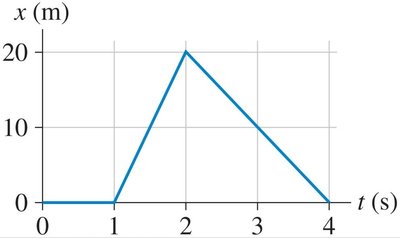
Example: Analyzing a Car's Position Graph
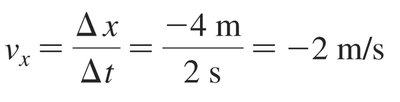
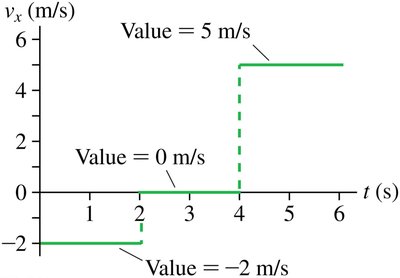
Given a position-time graph with segments of different slopes, calculate velocity for each segment using .
Draw the corresponding velocity-time graph, noting constant velocity for straight segments and zero velocity for flat segments.
Example: Free Fall
Drop an object from rest:
Find time to hit the ground and velocity upon impact using kinematic equations with .
Example: Ratio Reasoning in Uniform Motion
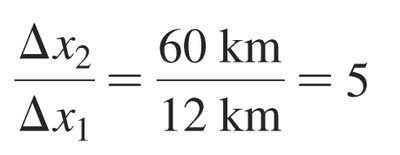
If a train travels 12 km in 10 min, it will travel 60 km in 50 min (since and ).
Key Concepts Review
Uniform motion: Constant velocity, straight-line motion.
Acceleration: Rate of change of velocity; can be positive or negative.
Free fall: Motion under gravity alone; all objects accelerate downward at near Earth's surface.
Kinematic equations: Used for constant acceleration problems in one dimension.
