 Indietro
Motion in One Dimension: Velocity, Acceleration, and Freely Falling Bodies
Guida di studio - Note intelligenti
 Appunti personalizzati basati sui tuoi materiali, ampliati con definizioni chiave, esempi e contesto.
Motion in One Dimension
Velocity and Position by Integration
In kinematics, the relationships between acceleration, velocity, and position can be derived using calculus. When acceleration as a function of time, a(t), is known, velocity and position can be found by integration.
Velocity from Acceleration: The velocity at time t is given by integrating acceleration:
Position from Velocity: The position at time t is found by integrating velocity:
These integrals represent the area under the acceleration-time and velocity-time graphs, respectively.
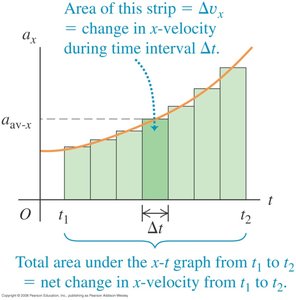
Additional info: The area under the acceleration vs. time graph between two points gives the change in velocity over that interval.
Deriving Equations for Constant Acceleration
When acceleration is constant, the equations of motion can be derived efficiently using calculus. These equations are fundamental for analyzing motion in one dimension.
First Equation (Velocity-Time):
Second Equation (Position-Time):
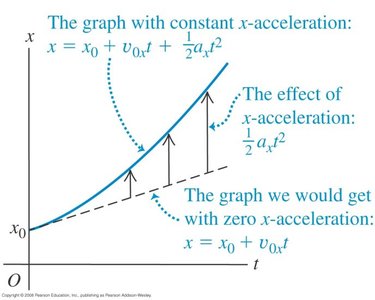
Third Equation (Velocity-Position, Time Eliminated):
This equation is especially useful when time is not given or required.
Average Velocity (for constant acceleration):
The average velocity is the arithmetic mean of the initial and final velocities.
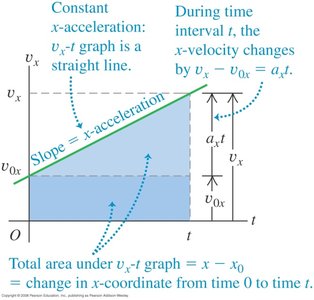
Additional info: The area under the velocity-time graph gives the displacement, and the slope of the velocity-time graph gives the acceleration.
Summary Table: Constant Acceleration Equations
Equation | Excluded Variable | Included Variables |
|---|---|---|
x | v, v_0, a, t | |
v | x, x_0, v_0, a, t | |
t | v, v_0, a, x, x_0 |
Freely Falling Bodies
Acceleration Due to Gravity
Objects in free fall near the Earth's surface experience a constant acceleration downward, denoted by g. The value of g on Earth is approximately 9.80 m/s2. This acceleration is independent of the object's mass (neglecting air resistance).
On Earth:
On the Moon:
On the Sun:
Historical Note: Aristotle believed heavier objects fall faster, but Galileo demonstrated that all objects fall with the same acceleration in the absence of air resistance.
Example Problems: Free Fall
Example 1: Dropping a Ball from a Height
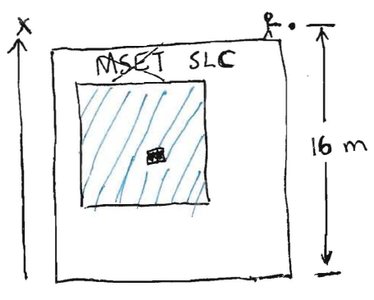
A ball is dropped from a height of 16 m. Find the time it takes to hit the ground.
Given: , ,
Equation:
Solving for t:
Example 2: Ball Thrown Upward
A ball is thrown upward at 10 m/s. Find the time to reach maximum height.
Given: , , at max height
Equation:
Example 3: Speed When Hitting the Ground
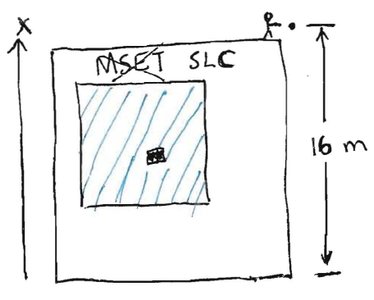
Find the speed of the ball when it returns to the ground after being thrown upward from 16 m at 10 m/s.
Given: , , ,
Equation:
Example 4: Time to Hit the Ground (Quadratic Formula)
Find the time for the ball to hit the ground when thrown upward from 16 m at 10 m/s.
Given: , , ,
Equation:
Use the quadratic formula:
Plug in values to solve for t.
Key Takeaways
Integration connects acceleration, velocity, and position in kinematics.
Constant acceleration leads to three core equations of motion, each useful depending on known and unknown variables.
Freely falling bodies experience constant acceleration due to gravity, regardless of mass (ignoring air resistance).
Quadratic equations may be required when solving for time in projectile motion problems.
