 Indietro
Motion in Two or Three Dimensions: Projectile Motion, Relative Velocity, and Pendulum Dynamics
Guida di studio - Note intelligenti
 Appunti personalizzati basati sui tuoi materiali, ampliati con definizioni chiave, esempi e contesto.
Motion in Two or Three Dimensions
Projectile Motion
Projectile motion describes the movement of objects launched into the air, subject only to gravity and negligible air resistance. The motion can be analyzed by separating it into horizontal and vertical components, each governed by distinct physical principles.
Horizontal Motion: The horizontal velocity (vx) remains constant throughout the flight, as there are no horizontal forces acting (assuming air resistance is negligible).
Vertical Motion: The vertical velocity (vy) changes due to the constant downward acceleration caused by gravity (g = 9.80\ \mathrm{m/s^2}).
Trajectory: The path of a projectile is a parabola, symmetric about its peak if it lands at the same height from which it was launched.
Key Equations:
Horizontal displacement:
Vertical displacement:
Time of flight (for level ground):
Range:
Maximum height:
Symmetry: The time to rise to the peak equals the time to fall from the peak to the ground.
Velocity Components: At launch, both vx and vy are positive if launched upward and to the right. At the peak, vy is zero, but vx remains constant.
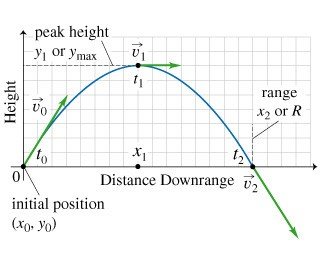
Example: A ball launched at an angle has initial velocity components determined by and . At the peak, and is unchanged.




Additional info: The horizontal and vertical motions are independent, but occur over the same time interval. The range is maximized at a launch angle of 45 degrees.
Conceptual Understanding and Assumptions
Projectile motion analysis assumes negligible air resistance and constant gravitational acceleration. These assumptions are valid for dense projectiles moving close to Earth's surface, but not for objects like feathers or rockets.
Additional info: For objects not landing at the same height as launch, the equations must be modified accordingly.
2-D Motion and Displacement
Displacement in two dimensions is a vector quantity, measured from the starting point to the ending point, regardless of the path taken.
Displacement Vector:
Cartesian Coordinates: Position is specified by (x, y, z) in three dimensions.
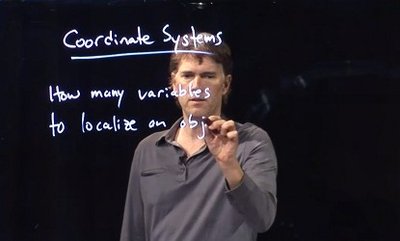
Example: A particle at the corner of a cube with dimensions 2 × 2 × 2 m has coordinates (2, 2, 2).
Motion Diagram: Human Cannonball
The motion diagram for a human cannonball illustrates projectile motion, showing the trajectory, maximum height, and landing point.
Vertical Acceleration: Always equal to free fall acceleration, .
Horizontal Velocity: Remains constant throughout the flight.
Vertical Velocity: Decreases to zero at the peak, then increases in the negative direction.


Additional info: Both dropped and thrown balls reach the ground simultaneously, as horizontal motion does not affect vertical fall time.
Range and Flight Time of Projectiles
The range and flight time of a projectile depend on its initial velocity and launch angle. A higher launch angle increases flight time but may decrease range due to reduced horizontal speed.
Range Equation:
Maximum Range: Achieved at .
Flight Time:


Example: A projectile fired at 60° spends more time in the air than one fired at 30°, due to a greater vertical velocity component.
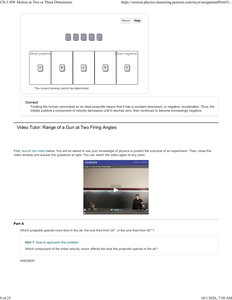
Additional info: The direction of acceleration in a pendulum is always toward the center of the circular path (radially inward).
Relative Velocity in Two Dimensions
Relative velocity describes how the velocity of one object appears from the reference frame of another. This is crucial in problems involving moving media, such as air or water.
Relative Velocity Equation:
Frame of Reference: Always specify the reference frame when measuring velocity.
Vector Addition: Use vector diagrams to add velocities.

Example: An airplane flying westward with a southward wind must adjust its heading to compensate for the wind, using vector addition to determine the correct direction.
Problem-Solving Strategies
Solving projectile and relative velocity problems involves:
Defining a coordinate system
Listing known and unknown quantities
Applying relevant equations
Evaluating the reasonableness of the answer
Additional info: Always check units and compare calculated speeds to real-world values for context.
Pendulum Motion and Acceleration
A pendulum exhibits motion in a circular arc, with acceleration directed toward the center of the circle (centripetal acceleration) at the lowest point, and tangential acceleration at the endpoints.
Acceleration Direction: At the endpoints, acceleration is tangent to the path; at the midpoint, it is centripetal.
Velocity: Zero at endpoints, maximum at the lowest point.
Additional info: The acceleration vector is unrelated to the direction of velocity; it points in the direction of the change in velocity.
Summary Table: Key Properties of Projectile Motion
Property | Horizontal Component | Vertical Component |
|---|---|---|
Velocity | Constant | Changes due to gravity |
Acceleration | Zero | Constant, downward () |
Displacement | ||
Time of Flight | Depends on | |
Range | — |
2-D Motion and Speed
In two-dimensional motion, speed at any point is found using the coordinates as functions of time and the acceleration as a function of time.
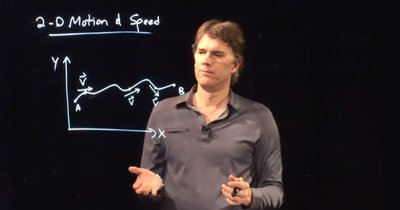
Additional info: The speed is the magnitude of the velocity vector: .
