Indietro
Newton's First Law of Motion—Inertia: Foundations, Forces, and Equilibrium
Guida di studio - Note intelligenti
 Appunti personalizzati basati sui tuoi materiali, ampliati con definizioni chiave, esempi e contesto.
Chapter 2: Newton's First Law of Motion—Inertia
Aristotle's Ideas of Motion
Early concepts of motion were shaped by Aristotle, who distinguished between two types of motion: natural and violent. These ideas laid the groundwork for later scientific advancements.
Natural motion: Motion that arises from the "nature" of an object, depending on its composition of the four classical elements (earth, water, air, fire). For example, smoke rises and clay falls due to their inherent natures.
Speed and weight: Aristotle believed that the speed of falling objects was proportional to their weight.
Heavenly vs. earthly motion: Different rules were thought to apply to celestial bodies compared to objects on Earth.
Violent motion: Motion resulting from external forces (pushes or pulls). Objects remain at rest in their "proper place" unless acted upon by a force.
Galileo's Concept of Inertia
Galileo challenged Aristotle's views through experimentation, introducing the concept of inertia and laying the foundation for Newton's laws.
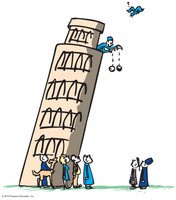
Leaning Tower of Pisa experiment: Galileo demonstrated that, in the absence of air resistance, objects of different weights fall at the same rate.
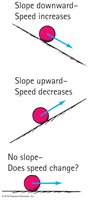
Inclined plane experiments: Galileo observed that a ball rolling down a slope increases in speed, while a ball rolling up a slope decreases in speed. On a level surface, the ball maintains its speed, illustrating inertia.
Inertia: The property of matter to resist changes in its state of motion. This principle is famously demonstrated by the tablecloth trick, where objects at rest remain at rest when the cloth is quickly pulled away.
Newton's First Law of Motion (Law of Inertia)
Newton's First Law, also known as the Law of Inertia, formalizes Galileo's insights: an object remains at rest or in uniform motion in a straight line unless acted upon by a nonzero net force.
Statement: "Every object continues in a state of rest or of uniform speed in a straight line unless acted on by a nonzero net force."
Force (F): A push or pull acting on an object. The SI unit is the newton (N).
Net Force and Vectors
Understanding forces requires distinguishing between vectors and scalars, and calculating the net force acting on an object.
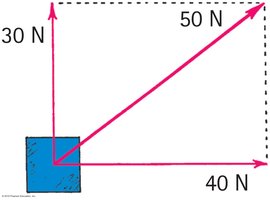
Vector: A quantity with both magnitude and direction (e.g., velocity, force, acceleration). Represented by arrows; the length indicates magnitude, and the arrowhead shows direction.
Scalar: A quantity with only magnitude (e.g., mass, volume, temperature).

Net force: The vector sum of all forces acting on an object. Determines the object's acceleration and change in motion.
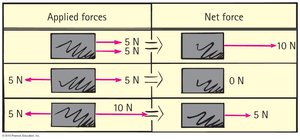
Examples: If two 5-N forces act in the same direction, the net force is 10 N. If they act in opposite directions, the net force is 0 N.
Resultant: The sum of two or more vectors. For vectors at right angles, use the Pythagorean theorem:
The Equilibrium Rule
Equilibrium occurs when all forces acting on an object are balanced, resulting in no change in motion.
Equilibrium: A state of no change in motion. The vector sum of all forces is zero:
Static equilibrium: The object is at rest.
Dynamic equilibrium: The object moves at constant speed in a straight line.
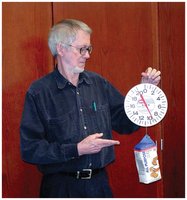
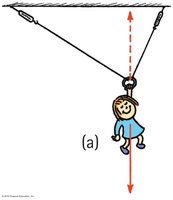
Example: A person hanging from two ropes experiences tension forces that balance their weight.
Support Force (Normal Force)
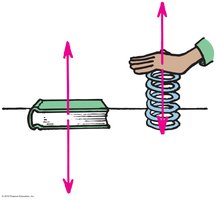
The support force, or normal force, is the upward force that balances the weight of an object resting on a surface.
Definition: The support force (N) is always perpendicular to the surface of contact.
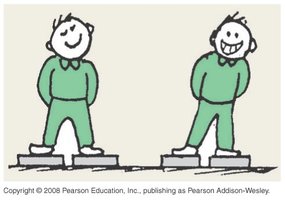
Example: When standing on two bathroom scales with weight evenly distributed, each scale reads half your weight.
Equilibrium of Moving Things
Objects can be in equilibrium whether at rest or moving at constant velocity. The forces acting on them must be balanced.
Static equilibrium: The object is at rest ().
Dynamic equilibrium: The object moves at constant speed in a straight line ().
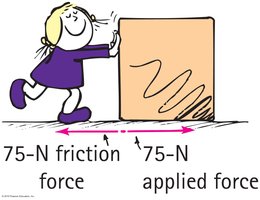
Example: If you push a crate at steady speed and the friction force is 75 N, your applied force must also be 75 N.
Types of Forces
Several types of forces commonly appear in physics problems:
Force (F): General term for a push or pull.
Tension (T): Force transmitted through a string, rope, or cable.
Normal force (N): Support force exerted by a surface.
Friction (f): Force opposing motion between surfaces in contact.
Weight (W): Gravitational force acting on an object ().
Drag (D): Force opposing motion through a fluid (air or water).
The Moving Earth
Historical debates about Earth's motion illustrate the application of inertia. Copernicus proposed that Earth moves around the Sun, raising questions about motion and reference frames.
Copernican model: Earth moves at about 30 km/s around the Sun. People questioned how objects could move with Earth (e.g., a bird catching a worm).
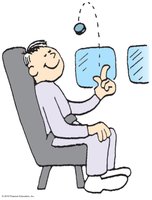
Inertia explains: Objects on Earth share its motion. For example, tossing a coin straight up in a moving vehicle, the coin lands back in your hand because it retains the vehicle's horizontal motion.