 Indietro
Newton’s Laws, Free-Body Diagrams, and Tension: Study Notes for Physics with Calculus
Guida di studio - Note intelligenti
 Appunti personalizzati basati sui tuoi materiali, ampliati con definizioni chiave, esempi e contesto.
Newton’s Laws and Free-Body Diagrams
Inertial Reference Frames
Understanding reference frames is crucial for correctly applying Newton’s Laws. An inertial reference frame is one in which Newton’s First Law (the law of inertia) holds true. In such frames, objects not acted upon by a net force move at constant velocity.
Non-inertial reference frames (e.g., an accelerating car) require extra care, as fictitious forces may appear.
Reference frames at rest or moving at constant velocity relative to the ground are (almost) inertial.
Accelerating frames are not inertial and complicate analysis.
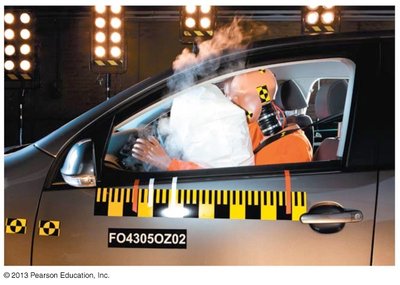
Example: In a car crash, you feel thrown forward because the car (your reference frame) decelerates rapidly, but your body tends to continue moving due to inertia.
Analyzing Motion in Reference Frames
When observing motion inside an accelerating system (like a spaceship), the apparent motion of objects can reveal the system’s acceleration.
If a released object appears to move forward inside the ship, the ship is accelerating backward relative to an inertial frame.
Kinematic equations can be used to calculate the acceleration of the reference frame based on the observed displacement and time.
Key Equation:
Solving for acceleration when and are known (assuming ):
Equilibrium and Newton’s Second Law
Static and Dynamic Equilibrium
An object is in equilibrium if the net force acting on it is zero. This can occur in two cases:
Static equilibrium: The object is at rest and remains at rest.
Dynamic equilibrium: The object moves with constant velocity (zero acceleration).

Key Principle: For equilibrium, in all directions.
Free-Body Diagrams
A free-body diagram is a visual tool to identify all forces acting on an object. Each force is represented as an arrow pointing in the direction it acts.
Draw all forces: gravity, normal force, friction, tension, etc.
Choose coordinate axes to simplify the problem (often aligning one axis with the direction of motion or incline).
Write Newton’s Second Law for each axis:
Example: Car on a Hill
For a car parked on a hill, the forces acting are gravity, the normal force, and friction. The frictional force balances the component of gravity parallel to the hill.
Frictional force:
where is the angle of the hill.
Tension and Ropes
Nature of Tension
Tension in a rope or string arises from the molecular forces that resist stretching. For most introductory problems, ropes are assumed to be massless and inextensible.
Tension is the same throughout a massless rope in equilibrium.
Tension pulls equally in both directions at any point in the rope.

Free-Body Diagrams with Tension
When analyzing systems with ropes, draw free-body diagrams for each object. The tension force acts away from the object along the rope.
Example: Ski Lift Problem
A skier of mass kg is pulled up a hill with a slope at constant speed. Neglecting friction, the tension in the rope can be found as follows:
Draw a free-body diagram, choosing axes parallel and perpendicular to the hill.
Write Newton’s Second Law for each axis:
For the -axis (along the hill):
For the -axis (perpendicular to the hill):
Solving for tension:
Tension in Multi-Object Systems
When multiple objects are connected by ropes (e.g., boxes on a frictionless surface), the tension can differ depending on the mass each segment must accelerate.

Key Point: The tension in the rope segment closer to the force source is greater if it must accelerate more mass.
Tension and Pulleys
In idealized problems, pulleys are assumed massless and frictionless, and only redirect the tension force. In reality, the mass of the rope and friction in the pulley can affect the tension, but these effects are usually neglected in introductory physics.
Summary Table: Forces in Equilibrium
Situation | Forces Involved | Equilibrium Condition | Key Equation |
|---|---|---|---|
Object at rest on a flat surface | Gravity, Normal force | ||
Object on an incline | Gravity, Normal force, Friction | , | , |
Object pulled by a rope | Tension, Gravity, Normal force | (up incline) |
Key Takeaways
Always identify the reference frame before applying Newton’s Laws.
Draw clear free-body diagrams to visualize all forces.
Apply Newton’s Second Law separately for each axis.
For equilibrium, set the sum of forces to zero.
Tension is the same throughout a massless rope in equilibrium, but can vary if the rope has mass or if pulleys are not ideal.
