 Indietro
Newton's Laws of Motion and Circular Motion: Structured Study Notes
Guida di studio - Note intelligenti
 Appunti personalizzati basati sui tuoi materiali, ampliati con definizioni chiave, esempi e contesto.
Newton's Laws of Motion
Historical Context and Newton's Contribution
The study of motion and its causes has ancient origins, but Isaac Newton revolutionized the field in 1687 with his formulation of three fundamental laws. These laws form the foundation of classical mechanics and are essential for understanding the behavior of objects under the influence of forces.
Key Point: Newton's laws are central to the study of dynamics, describing how forces affect the motion of objects.
Newton's First Law: Law of Inertia
Newton's First Law states that an object will remain at rest or move at a constant velocity unless acted upon by a net external force. This principle is known as the law of inertia.
Definition: Inertia is the tendency of an object to resist changes in its state of motion.
Example: A stationary object remains at rest, and a moving object continues in a straight line at constant speed unless a force (such as friction or a push) acts upon it.
Formula: No specific formula, but conceptually: If , then is constant.
Reference Frames and Inertial Frames
To properly apply Newton's laws, it is important to use inertial reference frames. An inertial frame is one in which Newton's laws hold true, i.e., it is either at rest or moving at constant velocity.
Non-inertial frames (accelerating or rotating) require additional fictitious forces for Newton's laws to apply.
Newton's Second Law: Relationship Between Force and Acceleration
Newton's Second Law quantifies the effect of forces on the motion of an object. It states that the acceleration of an object is proportional to the net force acting on it and inversely proportional to its mass.
Formula:
Superposition Principle: Forces add vectorially; analyze each direction separately.
Example: If a 10 kg object accelerates from rest to 50 m/s in 10 s, first calculate acceleration: . Then, force: .
Net Force and Its Components
The net force is the vector sum of all forces acting on an object. It is often useful to resolve forces into components along coordinate axes (e.g., x and y directions).
Example: For an object moving in the x-direction, only forces in that direction affect its acceleration.
Types of Forces
Several types of forces commonly appear in problems involving Newton's laws:
Gravitational Force: The force of attraction between masses. near Earth's surface.
Normal Force: The perpendicular contact force exerted by a surface.
Tension: The force transmitted through a string, rope, or cable.
Friction: The force that opposes motion between two surfaces.
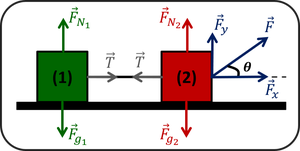
Example: In a system of two blocks connected by a rope, tension acts as a constraint, and the second law is applied to each block separately.
Frictional Forces
Friction opposes the relative motion of surfaces in contact. There are two main types:
Static Friction: Prevents motion up to a maximum value.
Kinetic Friction: Acts during motion.
Direction: Friction acts parallel to the surface and opposite to the direction of motion.
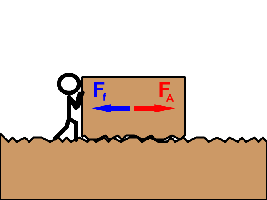
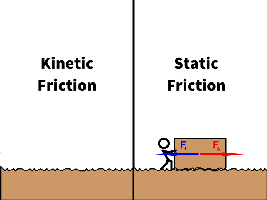
Example: When pushing a box, static friction resists initial movement; once moving, kinetic friction opposes continued motion.
Newton's Third Law: Action and Reaction
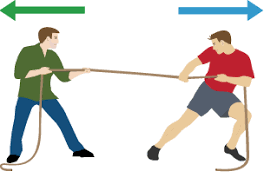
Newton's Third Law states that for every action, there is an equal and opposite reaction. When two bodies interact, the forces they exert on each other are equal in magnitude and opposite in direction.
Formula:
Example: In a tug-of-war, each person pulls on the rope with equal and opposite forces.
Circular Motion and Centripetal Force
Circular Motion: Velocity and Acceleration
Objects moving in a circle experience a change in direction of velocity, resulting in centripetal acceleration directed toward the center of the circle.
Formula for Centripetal Acceleration:
Direction: Always points toward the center of the circular path.
Centripetal Force
The centripetal force is the net force required to keep an object moving in a circle. It is not a new type of force, but rather the name given to the net force directed toward the center.
Formula:
Example: A car turning on a curve experiences centripetal force provided by friction between the tires and the road.

Key Point: The centripetal force is always directed radially inward, toward the center of the circle.
Summary Table: Types of Forces in Newtonian Mechanics
Force Type | Formula | Direction | Example |
|---|---|---|---|
Gravitational | Downward (toward Earth) | Weight of an object | |
Normal | Varies | Perpendicular to surface | Support force from ground |
Tension | Varies | Along rope/string | Pulling a sled |
Friction (static) | Opposes motion | Box at rest | |
Friction (kinetic) | Opposes motion | Box sliding | |
Centripetal | Toward center | Car on curve |
Additional info: These notes synthesize the main concepts from Chapters 04 and 05 of Giancoli's Physics with Calculus, focusing on Newton's laws and circular motion. All equations are provided in LaTeX format for clarity and academic rigor.
