 Indietro
Newton's Laws of Motion and Linear Motion: Study Notes for Physics with Calculus
Guida di studio - Note intelligenti
 Appunti personalizzati basati sui tuoi materiali, ampliati con definizioni chiave, esempi e contesto.
Newton's First Law of Motion – Inertia
Aristotle's Ideas of Motion
Early concepts of motion were developed by Aristotle, who classified motion into two types: natural and violent motion.
Natural motion: Objects move to their 'proper place' determined by their composition (earth, water, air, fire). On Earth, this is straight up or down; in the heavens, it is circular.
Violent motion: Motion caused by external forces, such as pushes or pulls.
Example: Stones fall to the ground (natural motion); wind pushes a ship (violent motion).
Galileo's Concept of Inertia
Galileo challenged Aristotle's views and introduced the concept of inertia, laying the groundwork for Newton's laws.
Inertia: The property of matter to resist changes in motion. It depends on the mass of the object.
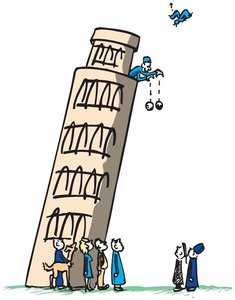
Galileo's experiments showed that, in the absence of friction, objects of different weights fall at the same rate and a moving object will continue moving unless acted upon by an external force.
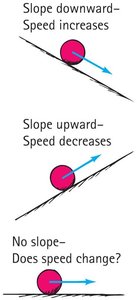
Example: Balls rolling on inclined planes: they speed up on downward slopes, slow down on upward slopes, and maintain constant speed on horizontal planes.
Newton's First Law of Motion
Also known as the law of inertia, it states:
Every object continues in a state of rest or uniform motion in a straight line unless acted on by a nonzero net force.
Net Force and Vectors
Net Force
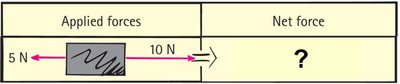
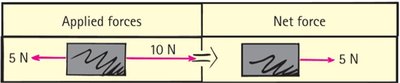
The net force is the vector sum of all forces acting on an object. It determines the object's acceleration.
Vector quantity: Has both magnitude and direction.
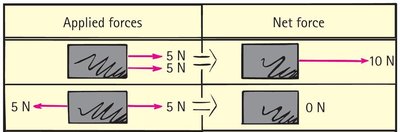
Example: Two 5-N forces in the same direction produce a 10-N net force; in opposite directions, the net force is zero.
Vectors and Resultants
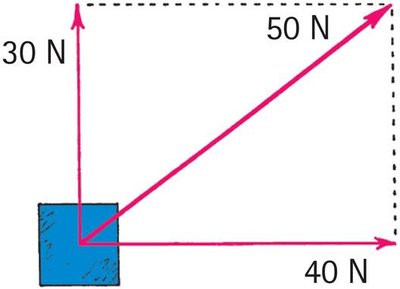
Vectors are quantities with both magnitude and direction. The resultant is the sum of two or more vectors.
For vectors at right angles, use the Pythagorean theorem:
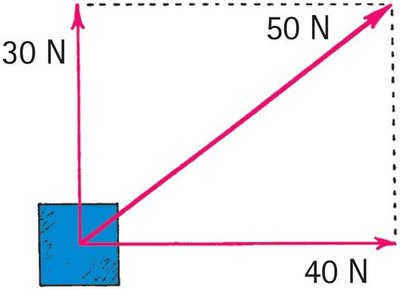
Example: A 30-N and a 40-N force at right angles result in a 50-N resultant.
The Equilibrium Rule
Definition and Application
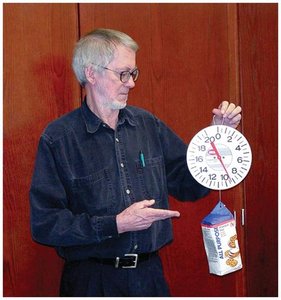
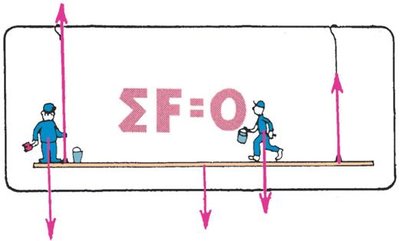
An object is in equilibrium when the vector sum of all forces acting on it is zero. This applies to both objects at rest (static equilibrium) and objects moving at constant velocity (dynamic equilibrium).
Equilibrium rule:
Example: A bag of flour hanging from a string is at rest because the upward tension equals the downward gravitational force.
Support Force (Normal Force)
Understanding Support Force
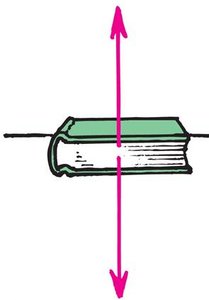
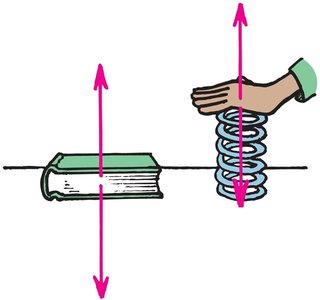
The support force is the upward force that balances the weight of an object resting on a surface. It is also called the normal force.
When you stand on a surface, the support force equals your weight if you are at rest.
Example: A book on a table is supported by the upward force from the table.


Equilibrium of Moving Things
Static and Dynamic Equilibrium
Equilibrium can be static (object at rest) or dynamic (object moving at constant velocity).
Static equilibrium: No motion (e.g., a crate at rest).
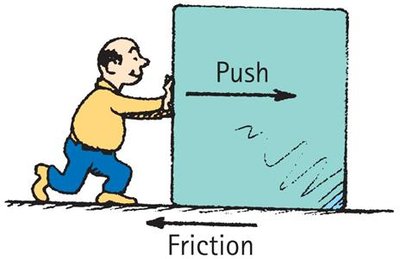
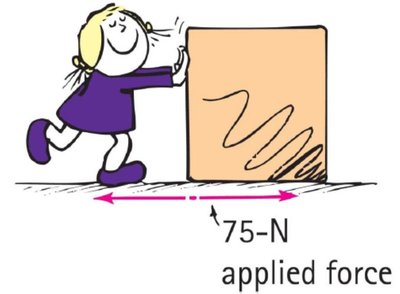
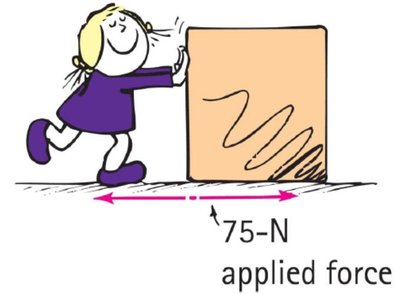
Dynamic equilibrium: Constant velocity (e.g., a crate pushed at steady speed).
The Moving Earth and Inertia
Copernican Principle and Inertia
Copernicus proposed that Earth moves around the Sun. Inertia explains why objects on Earth move with it.
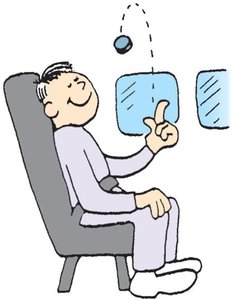
When you toss a coin straight up in a moving vehicle, it lands back in your hand because it retains the horizontal motion of the vehicle.
Linear Motion
Motion Is Relative
All motion is measured relative to a reference point. For example, your speed relative to Earth is different from your speed relative to the Sun.

Speed and Velocity
Speed: Distance covered per unit time.
Average speed:
Instantaneous speed: Speed at any given instant (e.g., speedometer reading).
Velocity: Speed with direction; a vector quantity.
Acceleration
Acceleration is the rate at which velocity changes over time. It can involve changes in speed, direction, or both.
Formula:
Unit:
Free Fall
Objects in free fall accelerate downward at (often approximated as ).
Velocity after time t:
Distance fallen from rest:
Newton's Second Law of Motion
Force, Mass, and Acceleration
Newton's second law relates force, mass, and acceleration:
Formula:
Acceleration is directly proportional to net force and inversely proportional to mass.
Friction
Friction is a force that opposes motion between two surfaces in contact. It depends on the nature of the surfaces and how hard they are pressed together.
Mass and Weight
Mass: Measure of inertia; does not change with location.
Weight: Force due to gravity; .
On Earth, weighs .
Free Fall and Nonfree Fall
In free fall, all objects accelerate at the same rate regardless of mass (neglecting air resistance).
In nonfree fall, air resistance reduces acceleration. Terminal velocity is reached when air resistance equals weight.
Newton's Third Law of Motion
Action and Reaction
For every action, there is an equal and opposite reaction. Forces always occur in pairs acting on different objects.
Example: When you push on a wall, the wall pushes back on you with equal force.
Action and reaction forces do not cancel because they act on different objects.
Applications
When a cannon fires a cannonball, the cannon recoils backward with a smaller acceleration due to its larger mass.
Birds fly by pushing air downward; the air pushes them upward.
Airplanes generate lift by deflecting air downward with their wings.
Summary Table: Newton's Three Laws of Motion
Law | Statement | Key Concept |
|---|---|---|
First Law (Inertia) | An object at rest remains at rest, and an object in motion remains in motion at constant velocity unless acted upon by a net force. | Inertia |
Second Law (Acceleration) | The acceleration of an object is directly proportional to the net force and inversely proportional to its mass. | |
Third Law (Action-Reaction) | For every action, there is an equal and opposite reaction. | Force pairs |
