 Indietro
Newton's Laws of Motion and the Concept of Force
Guida di studio - Note intelligenti
 Appunti personalizzati basati sui tuoi materiali, ampliati con definizioni chiave, esempi e contesto.
Newton's Laws of Motion
Introduction to Forces
In physics, a force is a fundamental concept that describes the interaction capable of changing the motion of an object. Forces are vector quantities, meaning they possess both magnitude and direction. Understanding forces is essential for analyzing why objects move or remain at rest.
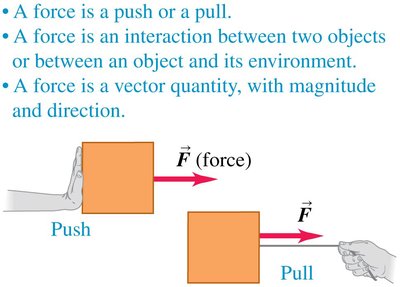
Force is a push or a pull.
It is an interaction between two objects or between an object and its environment.
Forces are represented as vectors, with both magnitude and direction.
Types of Forces
There are several common types of forces encountered in classical mechanics. Each type of force has distinct characteristics and plays a specific role in the analysis of motion.
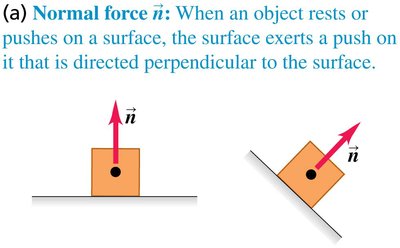
Normal Force (\( \vec{n} \)): The perpendicular contact force exerted by a surface on an object resting on it.
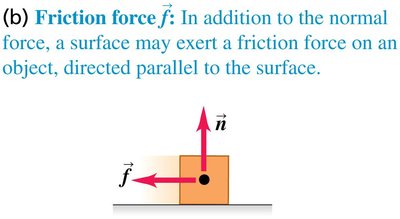
Friction Force (\( \vec{f} \)): The force exerted by a surface parallel to itself, opposing the relative motion or tendency of motion of an object.
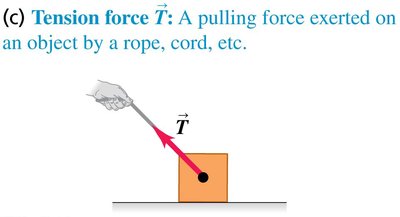
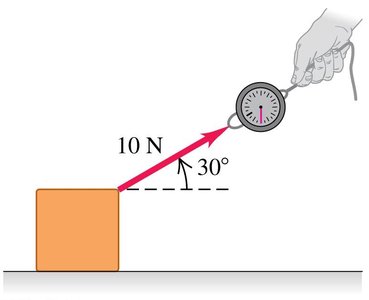
Tension Force (\( \vec{T} \)): The pulling force transmitted through a string, rope, cable, or similar object.
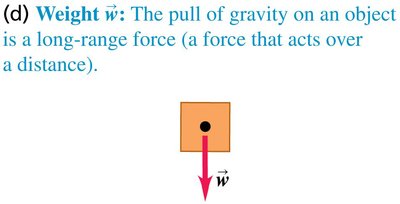
Weight (\( \vec{w} \)): The gravitational force exerted by the Earth (or another celestial body) on an object, acting downward toward the center of the Earth.
Magnitude of Forces and Units
The SI unit of force is the newton (N), defined as the force required to accelerate a 1 kg mass by 1 m/s2. Typical forces range from the weight of everyday objects to the forces between subatomic particles.
Vector Representation and Superposition of Forces
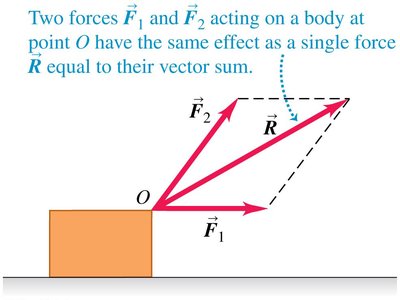
Forces are represented as vectors. The length of the arrow indicates the magnitude, and the direction shows the direction of the force. When multiple forces act on an object, their vector sum (resultant) determines the net effect.
The superposition principle states that several forces acting at a point have the same effect as their vector sum acting at that point.
Decomposing Forces into Components
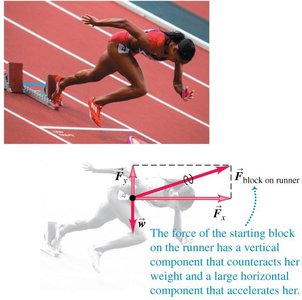
Forces can be decomposed into perpendicular components, typically along the x- and y-axes, using trigonometry. This is essential for analyzing forces acting at angles.
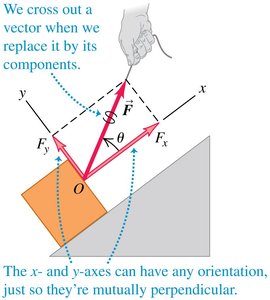
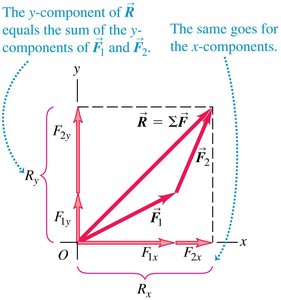
The vector sum of all forces on an object is called the net force (\( \sum \vec{F} \)).
Newton's First Law of Motion (Law of Inertia)
Statement and Equilibrium
Newton's first law states that an object at rest remains at rest, and an object in motion continues in motion with constant velocity unless acted upon by a net external force. This is the principle of inertia.
If the net force on a body is zero, the body is in equilibrium.
The mathematical expression is:

Examples of Newton's First Law
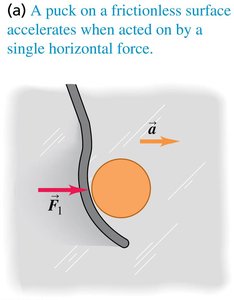
A puck on a frictionless surface accelerates when acted on by a single force.
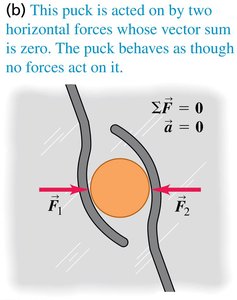
If two equal and opposite forces act, the net force is zero and the object does not accelerate.
In real-world scenarios, such as sledding, all forces (gravity, normal, friction, applied) can balance, resulting in constant velocity.

Newton's Second Law of Motion
Force, Mass, and Acceleration
Newton's second law quantifies the relationship between force, mass, and acceleration. The acceleration of an object is directly proportional to the net force acting on it and inversely proportional to its mass.
The law is mathematically expressed as:
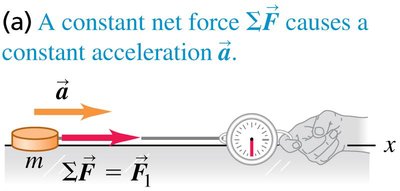
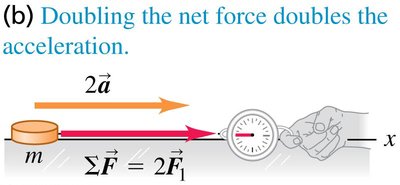
Doubling the net force doubles the acceleration for a given mass.
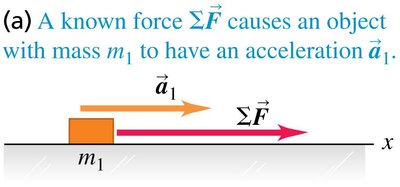
For a fixed force, increasing the mass decreases the acceleration.
Measuring Mass Using Force and Acceleration
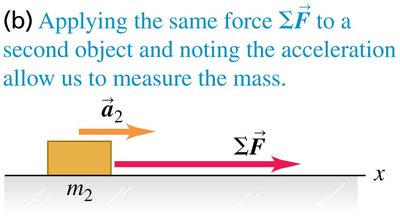
By applying the same force to different masses and measuring their accelerations, the mass of an object can be determined.

Mass and Weight
Definitions and Relationship
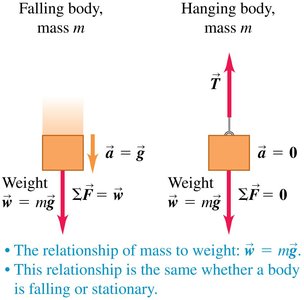
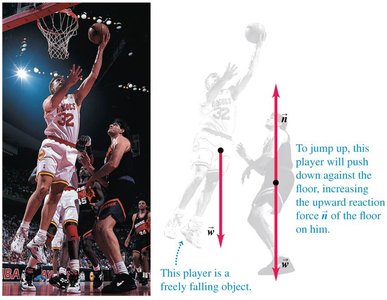
Mass is a measure of the amount of matter in an object and is independent of location. Weight is the gravitational force exerted on an object by the Earth (or another celestial body).
The relationship is given by:
Where w is weight, m is mass, and g is the acceleration due to gravity (approximately 9.8 m/s2 on Earth).

Newton's Third Law of Motion
Action and Reaction
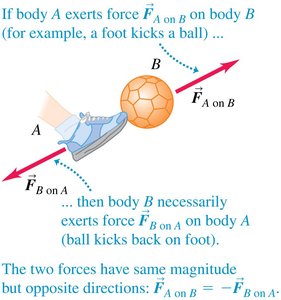
Newton's third law states that for every action, there is an equal and opposite reaction. If object A exerts a force on object B, then object B exerts a force of equal magnitude and opposite direction on object A.
Mathematically:
Free-Body Diagrams
Purpose and Construction
A free-body diagram is a graphical illustration used to visualize the forces acting on a single object. Each force is represented by an arrow pointing in the direction the force acts, with the length proportional to its magnitude.
Uniform Circular Motion and Net Force
Centripetal Force
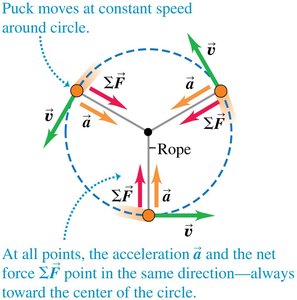
An object moving in a circle at constant speed experiences a net force directed toward the center of the circle, called the centripetal force. This force is responsible for the continuous change in the direction of the velocity vector.
Worked Example: Block Pulled by a Force at an Angle
Problem Setup
A block of mass M = 100 kg is pulled by a track force T = 500 N at an angle θ = 30° with the horizontal.
A) Draw a free-body diagram.
B) Find the acceleration.
C) Find the normal force.
Solution Outline:
Decompose the tension force into horizontal (Tcosθ) and vertical (Tsinθ) components.
Apply Newton's second law in the horizontal direction to find acceleration:
Apply Newton's second law in the vertical direction to solve for the normal force:
Example Calculation:
Horizontal component: N
Acceleration: m/s2
Vertical component: N
Normal force: N
