 Indietro
Newton's Laws of Motion: Forces and Dynamics
Guida di studio - Note intelligenti
 Appunti personalizzati basati sui tuoi materiali, ampliati con definizioni chiave, esempi e contesto.
Newton's Laws of Motion
Introduction to Forces
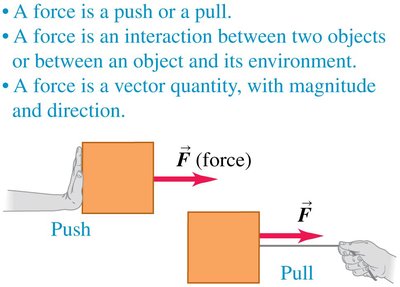
In physics, a force is a fundamental concept describing the interaction that causes a change in an object's motion. Forces are vector quantities, meaning they possess both magnitude and direction. Understanding forces is essential for analyzing the dynamics of objects.
Force: A push or a pull exerted on an object.
Interaction: Forces arise from interactions between two objects or between an object and its environment.
Vector Nature: Forces are represented as vectors, with both magnitude and direction.
Types of Forces
There are several common types of forces encountered in physics, each with distinct characteristics and effects on objects.
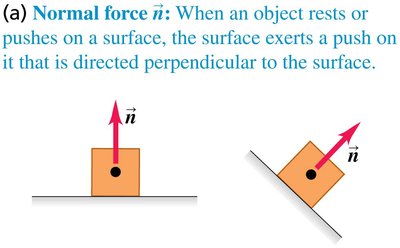
Normal Force (\vec{n}): The perpendicular contact force exerted by a surface on an object resting or pushing against it.
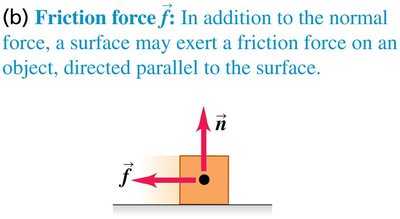
Friction Force (\vec{f}): The force exerted parallel to the surface, opposing the motion or attempted motion of an object.
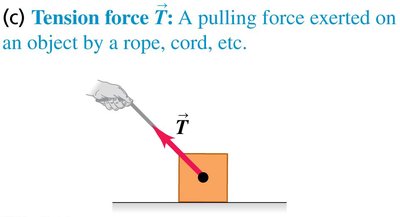
Tension Force (\vec{T}): The pulling force exerted by a rope, cord, or similar object.
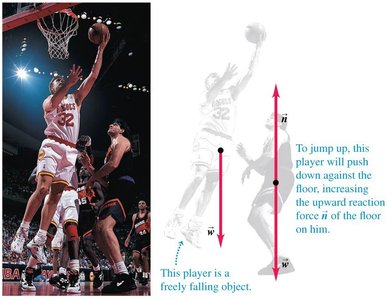
Weight (\vec{w}): The gravitational force exerted on an object by the Earth, acting downward.
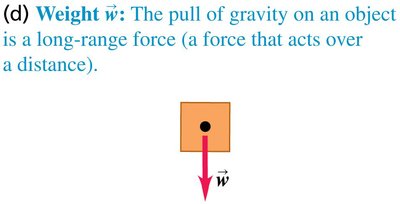
Magnitude and Measurement of Forces
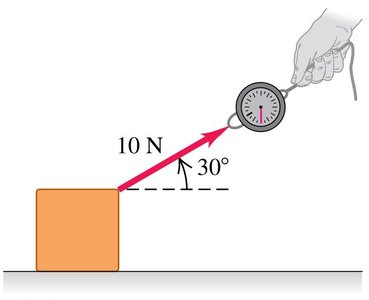
The SI unit for force is the newton (N). Forces can be measured using instruments such as spring balances, and their magnitudes can vary widely depending on the context.
Typical Force Magnitudes: Examples include the weight of a large whale (~1.9 × 10⁶ N), a medium apple (~1 N), and the electric attraction between a proton and electron (~8.2 × 10⁻⁸ N).
Force Vectors and Components
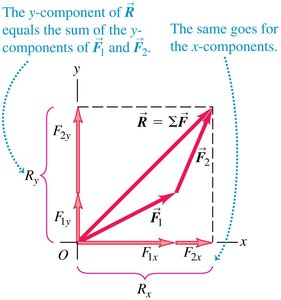
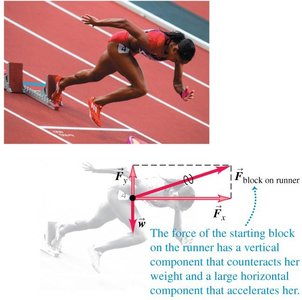
Forces are often represented as vectors. The direction and magnitude are shown by the arrow's orientation and length. Forces can be decomposed into components along chosen axes, typically x and y, using trigonometry.
Vector Representation: The length of the vector indicates the force's magnitude.
Decomposition: Any force can be split into perpendicular components, usually along the x and y axes.
Trigonometric Relations: If a force \vec{F} makes an angle θ with the x-axis, its components are:
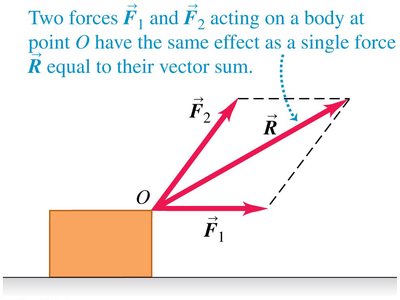
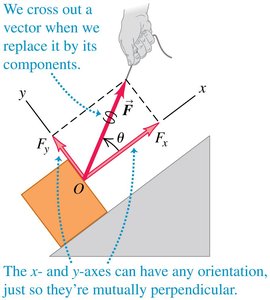
Superposition and Resultant Forces
When multiple forces act on an object, their combined effect is equivalent to a single force called the resultant or net force. The net force is the vector sum of all individual forces.
Notation: denotes the vector sum of all forces.
Resultant: The resultant force determines the object's acceleration.
Newton's First Law of Motion (Law of Inertia)
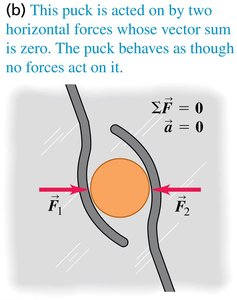
Newton's first law states that an object at rest or moving with constant velocity remains in that state unless acted upon by a net external force. This law defines the concept of equilibrium.
Equilibrium: An object is in equilibrium if the net force is zero.
Mathematical Expression:

Force and Acceleration
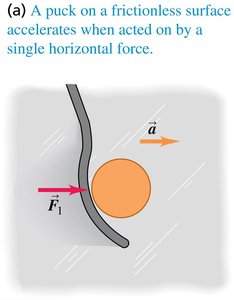
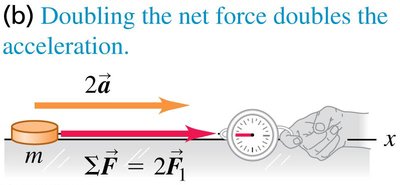
The net force acting on an object causes it to accelerate in the direction of the force. If the net force is zero, the object does not accelerate and remains in equilibrium.
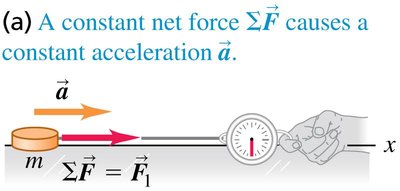
Constant Net Force: Produces constant acceleration.
Doubling Net Force: Doubles the acceleration, assuming mass is constant.

Inertial Frames of Reference
Newton's laws are valid only in inertial frames of reference, which are frames moving at constant velocity (not accelerating). Non-inertial frames, such as an accelerating bus, require additional fictitious forces for analysis.
Newton's Second Law of Motion
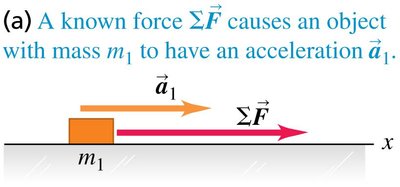
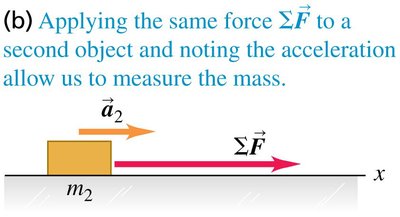
Newton's second law quantifies the relationship between force, mass, and acceleration. The acceleration of an object is directly proportional to the net force and inversely proportional to its mass.
Mathematical Expression:
SI Unit: 1 newton (N) = 1 kg·m/s2

Mass and Weight
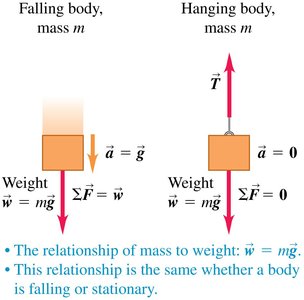
Mass is a measure of an object's inertia, while weight is the gravitational force exerted on the object by the Earth. The weight depends on the local acceleration due to gravity, which varies with altitude and planetary body.
Weight Formula:
g: Acceleration due to gravity (on Earth, m/s2)

Newton's Third Law of Motion
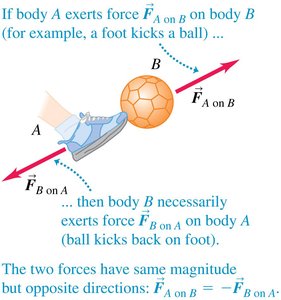
Newton's third law states that for every action, there is an equal and opposite reaction. If object A exerts a force on object B, then object B exerts an equal and opposite force on object A.
Mathematical Expression:
Implication: Forces always occur in pairs.
Free-Body Diagrams
A free-body diagram is a graphical representation used to visualize all the forces acting on a single object. It is essential for solving problems involving forces and motion.
Purpose: To identify and analyze all forces acting on an object.
Components: Each force is represented as a vector originating from the object.
Uniform Circular Motion
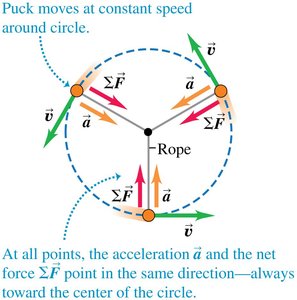
Objects moving in uniform circular motion experience a net force directed toward the center of the circle, called centripetal force. This force causes the object to accelerate toward the center, even if its speed remains constant.
Direction: Net force and acceleration always point toward the center.
Application: Examples include satellites orbiting planets and cars turning on a track.
Worked Example: Block Pulled by a Force
Consider a block of mass M = 100 kg pulled by a track force T = 500 N at an angle θ = 30° with the horizontal.
Free-Body Diagram: Draw all forces acting on the block, including tension, weight, normal force, and friction (if present).
Finding Acceleration: Use Newton's second law to calculate acceleration:
Finding the Normal Force: The normal force is given by:
Summary Table: Types of Forces
Type of Force | Direction | Nature |
|---|---|---|
Normal | Perpendicular to surface | Contact |
Friction | Parallel to surface | Contact |
Tension | Along rope/cord | Contact |
Weight | Downward (toward Earth) | Long-range |
Additional info: The notes expand on the original slides by providing full academic explanations, formulas, and context for each force type and law. All equations are presented in LaTeX format for clarity and academic rigor.
