 Indietro
One-Dimensional Kinematics: Freely Falling Objects and Constant Acceleration
Guida di studio - Note intelligenti
 Appunti personalizzati basati sui tuoi materiali, ampliati con definizioni chiave, esempi e contesto.
One-Dimensional Kinematics
Freely Falling Objects
Objects in free fall move under the influence of gravity alone, experiencing constant acceleration directed downward. This scenario is a classic example of motion with constant acceleration and is foundational in introductory physics.
Free fall begins as soon as an object is released, regardless of whether it is dropped, thrown downward, or thrown upward.
The acceleration due to gravity is denoted as g, with a standard value of 9.81 m/s2 downward near Earth's surface.
All objects in free fall (neglecting air resistance) experience the same acceleration, regardless of their mass.
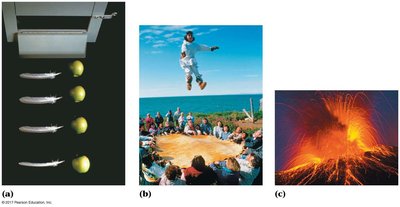
Example Applications: Dropping objects from rest, volcanic eruptions ejecting lava bombs, and objects thrown vertically upward all illustrate free fall.
Constant-Acceleration Equations of Motion
When acceleration is constant, the following equations describe the motion of objects in one dimension. These equations are essential for solving problems involving free fall and other uniformly accelerated motion.
Variables Related | Equation | Number |
|---|---|---|
velocity, time, acceleration | 2-7 | |
initial, final, and average velocity | 2-9 | |
position, time, velocity | 2-10 | |
position, time, acceleration | 2-11 | |
velocity, position, acceleration | 2-12 |
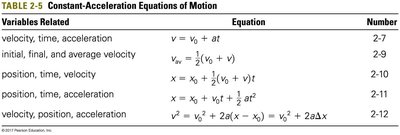
Key Terms: v = final velocity, v_0 = initial velocity, a = acceleration, t = time, x = position, x_0 = initial position.
Example: Lava Bomb Ejected from a Volcano
Consider a lava bomb projected straight upward from a volcano. If the total time for the bomb to rise and fall back to its launch height is known, we can determine its initial speed using the equations of motion.
Given: s (total flight time), m/s2, (returns to original position).
Using and solving for :
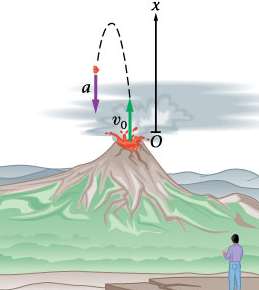
Interpretation: The initial speed is the magnitude of the initial velocity, 23.3 m/s upward.
Graphical Analysis of Free Fall
Position, velocity, and acceleration versus time graphs provide insight into the motion of objects in free fall. For the lava bomb example:
Acceleration is constant at -9.81 m/s2.
Velocity decreases linearly to zero at maximum height, then increases in magnitude (downward) as the object falls.
Position increases to a maximum, then decreases as the object returns to its starting point.
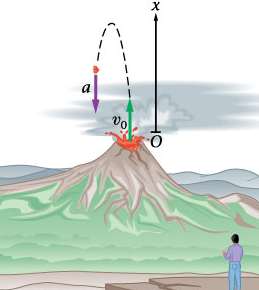
Practice: Find the maximum height reached by the bomb using the appropriate kinematic equation.
Example: Hot-Air Balloon and Falling Sandbag
A hot-air balloon rises at a constant speed. When a sandbag is released, it continues upward briefly before falling to the ground. The equations of motion allow us to determine the time to hit the ground and the maximum height reached.
Given: m/s (upward), m, m/s2.
To find the time to hit the ground, solve for with .
To find the maximum height, use with at the top of the trajectory.
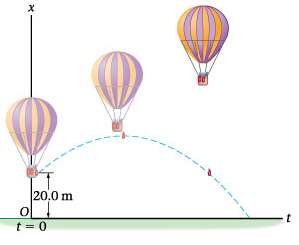
Practice: Calculate the velocity of the sandbag at a given height, or the height at which it has a specified velocity, using the kinematic equations.
Example: Arrow Shot Vertically Upward
When an arrow is shot straight upward, its motion can be analyzed using the same equations. Given the height at a certain time, we can determine the initial speed, the time to reach a specific height, and the maximum height attained.
Given: After 2.00 s, the arrow is 30.0 m above the launch point.
Use to solve for .
To find the time to reach a certain height, solve the quadratic equation for .
Maximum height is found by setting and solving for .
Additional info: The quadratic formula is often required to solve for time when both and terms are present.
Example: Model Rocket with Two-Stage Motion
A model rocket accelerates upward under its own power, then coasts upward and falls back under gravity alone. The motion is analyzed in two stages: powered ascent and free fall.
Stage 1: Use to find the speed at engine cutoff.
Stage 2: Use the same equation to find the maximum height and the speed just before hitting the ground.
Total flight time is the sum of the time for powered ascent and the time for free fall.
Key Equations Used:
Summary: The equations of motion for constant acceleration are powerful tools for analyzing a wide range of one-dimensional kinematics problems, including free fall, projectile motion, and objects launched vertically.
