 Indietro
Oscillations About Equilibrium: Examples and Applications
Guida di studio - Note intelligenti
 Appunti personalizzati basati sui tuoi materiali, ampliati con definizioni chiave, esempi e contesto.
Oscillations About Equilibrium
Simple Harmonic Motion (SHM) and Periodic Systems
Oscillatory motion occurs when an object moves back and forth about an equilibrium position due to a restoring force. The most common type is simple harmonic motion (SHM), where the restoring force is proportional to displacement and directed toward equilibrium.
Period (T): The time required for one complete cycle of motion.
Frequency (f): The number of cycles per second, .
Amplitude (A): The maximum displacement from equilibrium.
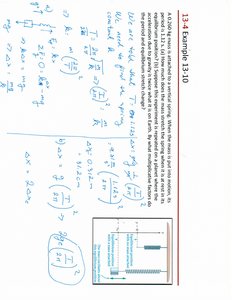
Example 13.10: Mass-Spring System and Period Calculation
This example demonstrates how to calculate the period of oscillation for a mass attached to a spring, using the formula for the period of a mass-spring system:
Period of a mass-spring system:
Variables: m is the mass, k is the spring constant.
Application: Used to determine how changing mass or spring stiffness affects oscillation period.
Example Calculation: For a given mass and spring constant, substitute values to find T.
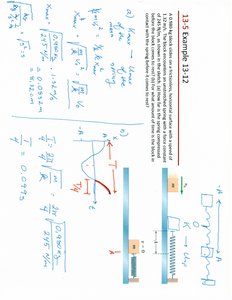
Example 13.12: Energy in SHM and Velocity at Equilibrium
This example explores the relationship between potential and kinetic energy in a mass-spring system, and how to calculate the velocity of the mass as it passes through equilibrium.
Conservation of Energy in SHM: Total mechanical energy is conserved and is the sum of kinetic and potential energies.
Maximum velocity at equilibrium:
Angular frequency:
Potential energy at maximum displacement:
Kinetic energy at equilibrium:
Application: Used to find the speed of the mass as it passes through the center position.
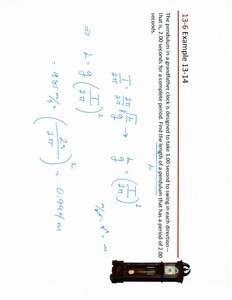
Example 13.14: Pendulum Period and Design
This example shows how to design a pendulum clock to achieve a specific period, using the formula for the period of a simple pendulum:
Period of a simple pendulum:
Variables: L is the length of the pendulum, g is the acceleration due to gravity.
Application: Used to determine the required length for a pendulum to keep accurate time (e.g., 2-second period for a clock).
Example Calculation: Rearranging the formula to solve for L given T and g.
Summary Table: Key Formulas for Oscillatory Systems
System | Period Formula | Key Variables |
|---|---|---|
Mass-Spring | m = mass, k = spring constant | |
Pendulum | L = length, g = gravity |
Additional info: These examples reinforce the importance of understanding how physical parameters affect oscillatory motion, and how energy conservation principles apply to SHM systems.
