 Indietro
Physics 1020 – Introductory Physics I: Course Overview and Structure
Guida di studio - Note intelligenti
 Appunti personalizzati basati sui tuoi materiali, ampliati con definizioni chiave, esempi e contesto.
Course Introduction
Overview of Physics 1020 – Introductory Physics I
Physics 1020 is an algebra-based introduction to Newtonian mechanics, designed for students beginning their study of physics. The course covers foundational topics in classical mechanics, including motion, forces, energy, momentum, and rotational dynamics. Prior experience with physics is helpful but not required.
Instructor: Dr. Todd Andrews
Lecture Times: Monday, Tuesday, Thursday, 1:00 – 1:50 PM
Laboratory Sessions: Multiple sections throughout the week
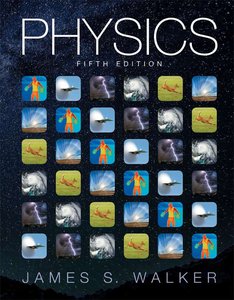
Textbook: Physics by James S. Walker (with Mastering Physics Access code)
Course Topics and Structure
Main Topics and Corresponding Textbook Chapters
The course is structured around the following major topics, each corresponding to chapters in the required textbook. These topics align with the standard curriculum for a college-level Physics with Calculus course, though this course is algebra-based.
Topic | Textbook Chapter | Sections |
|---|---|---|
Introduction to Physics | 1 | 1-8 |
One-Dimensional Kinematics | 2 | 1-7 |
Vectors – Introduction and Common Physics Vectors | 3 | 1-6 |
Two-Dimensional Kinematics | 4 | 1-5 |
Newton’s Laws – Introduction | 5 | 1-7 |
Newton’s Laws – Applications | 6 | 1-5 |
Work and Kinetic Energy | 7 | 1-4 |
Potential Energy and Conservation of Mechanical Energy | 8 | 1-5 |
Linear Momentum – Introduction and Conservation | 9 | 1-8 |
Rotational Kinematics and Energy | 10 | 1-6 |
Rotational Dynamics and Static Equilibrium | 11 | 1-4 |
Gravity (if time permits) | 12 | 1-2 |
Course Components and Evaluation
Assessment Structure
Student performance in Physics 1020 is evaluated through a combination of assignments, laboratory work, term tests, and a final examination. Each component is weighted as follows:
Course Component | Weight | Notes |
|---|---|---|
Assignments | 10% | Approximately one per chapter; completed online via Mastering Physics |
Laboratories | 18% | Attendance and participation required; minimum 50% to pass |
Term Tests | 32% | Two tests (16% each); no make-up tests |
Final Examination | 40% | Comprehensive; no supplementary exam |
Laboratory Component
Laboratory Policies and Expectations
The laboratory is an essential part of the course, providing hands-on experience with the concepts discussed in lectures. Students must attend all laboratory sessions and complete required safety courses. Laboratory work reinforces theoretical knowledge through practical experiments.
Laboratory sessions begin in the second week with an introduction.
No lab coat or safety goggles required, but safety training is mandatory.
Arrive early; late students (15+ minutes) will not be admitted.
Contact the laboratory instructor for lab-specific questions.
Course Website and Resources
Accessing Course Materials
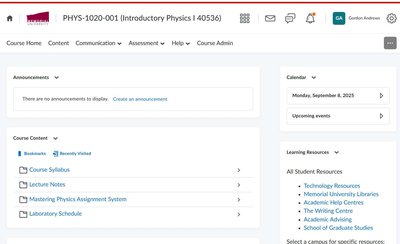
The course website (Brightspace) is the primary source for all course information, including the syllabus, lecture notes, assignment system, and laboratory schedule. Students are expected to check the website daily for updates and resources.
Policies and Support
Missed Work and Academic Integrity
Missed assignments or tests: Consult the University Calendar and contact the instructor promptly. No make-up tests are provided; missed test weight may be transferred to the final exam for valid reasons.
Deferred final exams: Apply within 48 hours via email to the department head.
Recording lectures or materials is prohibited without written permission from the instructor.
Academic integrity is strictly enforced; violations may result in severe penalties.
Use of generative AI tools (e.g., ChatGPT) is not permitted during tests or exams.
Accessibility and Student Support
Students requiring accommodations should contact Accessibility Services (Blundon Centre) as early as possible.
The Student Help Centre offers academic support, staffed by teaching assistants and students, and is open weekdays from 10:00 AM to 3:00 PM.
Summary Table: Key Course Information
Component | Details |
|---|---|
Instructor | Dr. Todd Andrews |
Textbook | Physics by James S. Walker (with Mastering Physics Access code) |
Lecture Times | Monday, Tuesday, Thursday, 1:00 – 1:50 PM |
Laboratory Instructor | Edward Hayden (ehayden@mun.ca) |
Course Website | Brightspace (my.mun.ca) |
Help Centre | C-3071, Chemistry-Physics Building, 10:00 AM – 3:00 PM, Mon–Fri |
Additional info: This course is algebra-based, but the topics and structure closely match those found in calculus-based introductory physics courses. The main difference is the mathematical rigor and use of calculus in derivations and problem-solving. Students planning to continue in physics or engineering should be aware of this distinction.
