 Indietro
Physics with Calculus: Electricity and Magnetism Study Guide
Guida di studio - Note intelligenti
 Appunti personalizzati basati sui tuoi materiali, ampliati con definizioni chiave, esempi e contesto.
Q1. For a given potential difference across a length of wire, which of the following changes would result in an increase in the amount of current flowing through the wire by a factor of 9?
Background
Topic: Ohm's Law and Resistivity
This question tests your understanding of how the physical properties of a wire (length, cross-sectional area, and material conductivity) affect the current for a fixed voltage.
Key Terms and Formulas:
Ohm's Law:
Resistance of a wire: , where is length, is cross-sectional area, and is conductivity.
Current:
Step-by-Step Guidance
Recall that for a fixed voltage, increasing the current requires decreasing the resistance.
Analyze how each option affects the resistance using .
For example, increasing the radius increases the area (), and increasing conductivity () also decreases resistance.
Calculate the factor by which resistance changes for each option, and relate that to the change in current.
Try solving on your own before revealing the answer!
Final Answer: A. Increase the radius of the cross-section of the wire by a factor of 9
Since , increasing the radius by a factor of 3 increases the area by , which decreases resistance by 9 and increases current by 9.
Q2. Three resistors and three batteries are connected as shown. Which equation is a correct application of Kirchhoff's loop rule for the left loop?
Background
Topic: Kirchhoff's Circuit Laws
This question tests your ability to apply Kirchhoff's loop rule to a multi-loop circuit, taking into account the direction of currents and the sign conventions for voltage drops and rises.
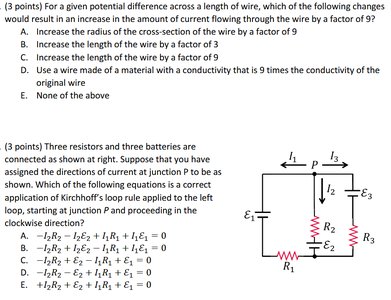
Key Terms and Formulas:
Kirchhoff's Loop Rule: The sum of the potential differences around any closed loop is zero.
Sign convention: Voltage drop across a resistor is (if following current direction), and voltage rise across a battery is (if moving from - to + terminal).
Step-by-Step Guidance
Identify the left loop and the direction (clockwise) for traversing the loop.
List the elements encountered in order: , , , .
Apply the sign convention for each element as you traverse the loop.
Write the sum of voltage changes and set equal to zero.
Try solving on your own before revealing the answer!
Final Answer:
This matches option A in the image. The correct application of the loop rule sums the voltage drops and rises as you traverse the left loop in the specified direction.
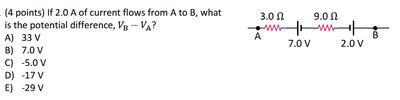
Q3. If 2.0 A of current flows from A to B, what is the potential difference, ?
Background
Topic: Circuits with Batteries and Resistors
This question tests your ability to calculate the potential difference across a circuit with resistors and batteries, using Ohm's Law and the concept of potential changes across circuit elements.
Key Terms and Formulas:
Ohm's Law:
Potential change across a resistor: (in direction of current)
Potential change across a battery: (from - to + terminal)
Step-by-Step Guidance
Identify the direction of current (A to B) and list the elements in order.
Calculate the voltage drop across each resistor using .
Account for the voltage changes across each battery (add or subtract based on direction).
Sum all the potential changes to find .
Try solving on your own before revealing the answer!
Final Answer: D) -17 V
Summing the voltage drops and rises as you move from A to B gives V.
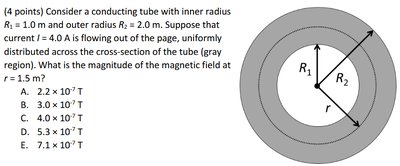
Q4. A conducting tube with inner radius m and outer radius m carries a current A out of the page. What is the magnitude of the magnetic field at m?
Background
Topic: Ampère's Law and Magnetic Fields in Cylindrical Conductors
This question tests your ability to use Ampère's Law to find the magnetic field inside a thick-walled conducting tube with a uniformly distributed current.
Key Terms and Formulas:
Ampère's Law:
Current density: , where is the cross-sectional area carrying current.
For , only the current enclosed within radius contributes to at $r$.
Step-by-Step Guidance
Calculate the current density in the tube.
Find the area enclosed by radius and use it to determine the enclosed current .
Apply Ampère's Law to a circular path of radius to solve for .
Plug in the given values for , , , and to set up the final calculation.
Try solving on your own before revealing the answer!
Final Answer: D) T
Using Ampère's Law and the correct current density, the magnetic field at m is T.
Q5. What is the absolute value of the induced emf in the inductor at s?
Background
Topic: Faraday's Law of Induction
This question tests your ability to calculate the induced emf in a solenoid with a time-varying current.
Key Terms and Formulas:
Induced emf:
Inductance of a solenoid:
Given current:
Step-by-Step Guidance
Find the inductance using the solenoid's dimensions and number of turns.
Compute at s by differentiating the given .
Plug and into the formula for .
Set up the calculation for the absolute value of the emf.
Try solving on your own before revealing the answer!
Final Answer: E) 67 V
After calculating and at s, the absolute value of the induced emf is 67 V.
Q6. At s, is the magnetic energy stored in the inductor its maximum, minimum, or somewhere in between?
Background
Topic: Magnetic Energy in Inductors
This question tests your understanding of how the energy stored in an inductor depends on the current as a function of time.
Key Terms and Formulas:
Magnetic energy:
Given , evaluate at s.
Step-by-Step Guidance
Evaluate using the given current function.
Determine if is at a maximum, minimum, or intermediate value based on the sine function.
Relate the value of to the stored energy .
Try solving on your own before revealing the answer!
Final Answer: B) Minimum
At , , so the magnetic energy stored is at its minimum (zero).
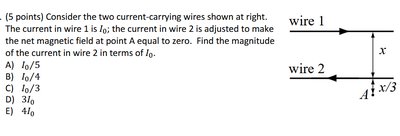
Q7. Two current-carrying wires: What is the magnitude of the current in wire 2 in terms of if the net magnetic field at point A is zero?
Background
Topic: Magnetic Field from Parallel Currents
This question tests your ability to use the Biot-Savart Law or Ampère's Law to find the magnetic field at a point due to two wires and set their fields to cancel.
Key Terms and Formulas:
Magnetic field from a long straight wire:
Superposition principle: The net field is the sum of the fields from each wire.
Step-by-Step Guidance
Write the expression for the magnetic field at point A due to each wire.
Set the sum of the fields to zero (since they must cancel).
Solve for the current in wire 2 in terms of and the given distances.
Try solving on your own before revealing the answer!
Final Answer: D)
The current in wire 2 must be to make the net magnetic field at point A zero.
Q8. A potential difference of 0.050 V is developed across a 0.10-m-long wire moving through a magnetic field at 5.0 m/s. What are the direction and strength of the magnetic field?
Background
Topic: Motional emf
This question tests your ability to use the formula for motional emf to find the magnetic field's magnitude and direction.
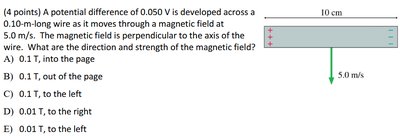
Key Terms and Formulas:
Motional emf:
Right-hand rule: Determines the direction of the induced emf and magnetic field.
Step-by-Step Guidance
Rearrange the motional emf formula to solve for .
Plug in the given values for , , and .
Use the right-hand rule to determine the direction of based on the motion and polarity.
Try solving on your own before revealing the answer!
Final Answer: A) 0.1 T, into the page
The magnitude is T, and the direction is into the page by the right-hand rule.
Q9. A circular conducting loop with resistance 0.15 Ω and radius 0.20 m is in a uniform magnetic field. The magnetic flux decreases by T·m² in 15 s. What is the time rate of change of the applied magnetic field?
Background
Topic: Faraday's Law and Magnetic Flux
This question tests your ability to relate the change in magnetic flux to the rate of change of the magnetic field.
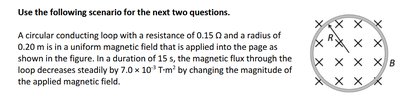
Key Terms and Formulas:
Magnetic flux:
Rate of change:
Step-by-Step Guidance
Calculate the area of the loop.
Use the change in flux and time to find .
Relate to and solve for $\frac{dB}{dt}$.
Try solving on your own before revealing the answer!
Final Answer: C) T/s
The time rate of change of the applied magnetic field is T/s.
Q10. Is there current flowing in the loop? If so, what is the current?
Background
Topic: Faraday's Law and Lenz's Law
This question tests your ability to determine the direction and magnitude of induced current in a loop due to a changing magnetic field.
Key Terms and Formulas:
Induced emf:
Ohm's Law:
Lenz's Law: The induced current opposes the change in flux.
Step-by-Step Guidance
Use the rate of change of flux to find the induced emf.
Calculate the current using Ohm's Law.
Determine the direction of the current using Lenz's Law.
Try solving on your own before revealing the answer!
Final Answer: C) A, counterclockwise
The induced current is A and flows counterclockwise to oppose the decrease in flux.
Q11. For the current flowing in the loop shown, which expression gives the magnitude of the magnetic field at P?
Background
Topic: Biot-Savart Law for Arc Segments
This question tests your ability to use the Biot-Savart Law to find the magnetic field at a point due to current in a wire bent into arcs of different radii.
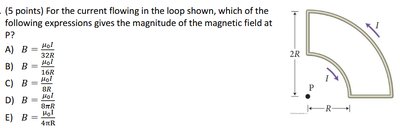
Key Terms and Formulas:
Biot-Savart Law for an arc: , where is the angle in radians and is the radius.
Superposition: Add the contributions from each arc.
Step-by-Step Guidance
Write the expression for at P due to each arc (with their respective radii and angles).
Add the contributions, considering the direction of the field from each arc.
Simplify the expression to match one of the given options.
Try solving on your own before revealing the answer!
Final Answer: C)
The correct expression for the magnetic field at P is .
Q12. A positively charged particle is moving at in the positive x-direction. Which comparison of and at S and T is correct?
Background
Topic: Electric and Magnetic Fields of Moving Charges
This question tests your understanding of the relativistic effects on electric and magnetic fields produced by a moving charge.
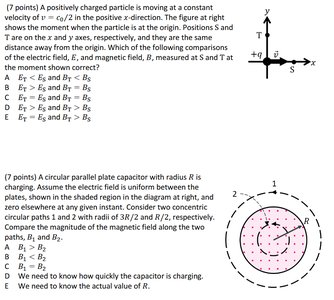
Key Terms and Formulas:
Electric field of a moving charge: is reduced along the direction of motion.
Magnetic field: is perpendicular to and .
Step-by-Step Guidance
Compare the positions S (along x-axis) and T (along y-axis) relative to the direction of motion.
Recall how and vary with angle from the velocity vector for a moving charge.
Use the field transformation rules to compare , , , and .
Try solving on your own before revealing the answer!
Final Answer: D) and
The electric and magnetic fields are both stronger at T (perpendicular to motion) than at S (along the direction of motion).
Q13. A circular parallel plate capacitor with radius is charging. Compare the magnitude of the magnetic field along two paths, 1 and 2.
Background
Topic: Displacement Current and Ampère-Maxwell Law
This question tests your understanding of the magnetic field produced by a changing electric field (displacement current) inside a charging capacitor.

Key Terms and Formulas:
Ampère-Maxwell Law:
Displacement current is proportional to the area enclosed by the path.
Step-by-Step Guidance
Compare the areas enclosed by paths 1 and 2.
Relate the area to the displacement current and thus to the magnetic field.
Determine which path encloses more displacement current and thus has a greater .
Try solving on your own before revealing the answer!
Final Answer: B)
Path 1 encloses a larger area, so the magnetic field is greater along path 1.
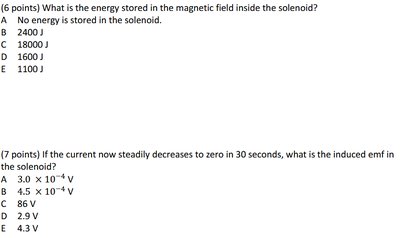
Q14. What is the energy stored in the magnetic field inside the solenoid?
Background
Topic: Energy in Magnetic Fields
This question tests your ability to calculate the energy stored in the magnetic field of a solenoid.
Key Terms and Formulas:
Energy:
Inductance of a solenoid:
Step-by-Step Guidance
Calculate the inductance using the solenoid's dimensions and number of turns.
Plug and the given current into the energy formula.
Set up the calculation for .
Try solving on your own before revealing the answer!
Final Answer: C) 18000 J
The energy stored in the solenoid's magnetic field is 18000 J.
Q15. If the current now steadily decreases to zero in 30 seconds, what is the induced emf in the solenoid?
Background
Topic: Induced emf in Inductors
This question tests your ability to calculate the average induced emf when the current in a solenoid changes over time.
Key Terms and Formulas:
Induced emf:
Use the previously calculated and the change in current over the given time interval.
Step-by-Step Guidance
Use the change in current () and time () to find .
Plug and into the formula for .
Set up the calculation for the induced emf.
Try solving on your own before revealing the answer!
Final Answer: D) 2.9 V
The induced emf is 2.9 V as the current decreases to zero in 30 seconds.
Q16. A long straight wire carries current uniformly over its cross-section with radius . What is the magnitude of the magnetic field inside the wire at a distance () from the center?
Background
Topic: Ampère's Law for Current Distributions
This question tests your ability to use Ampère's Law to find the magnetic field inside a wire with uniformly distributed current.
Key Terms and Formulas:
Ampère's Law:
Current enclosed: for
Step-by-Step Guidance
Write the expression for as a function of .
Apply Ampère's Law to a circle of radius inside the wire.
Solve for in terms of , , and .
Try solving on your own before revealing the answer!
Final Answer: A)
The magnetic field inside the wire at distance is .
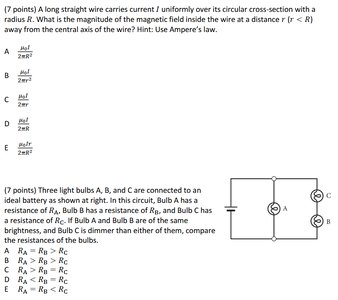
Q17. Three light bulbs A, B, and C are connected as shown. If A and B are of the same brightness, but C is dimmer, how do their resistances compare?
Background
Topic: Series and Parallel Circuits
This question tests your understanding of how current and resistance affect the brightness of bulbs in a circuit.
Key Terms and Formulas:
Brightness is proportional to power:
Series and parallel rules for current and voltage.
Step-by-Step Guidance
Analyze the circuit to determine which bulbs are in series and which are in parallel.
Relate the brightness to the current through and resistance of each bulb.
Compare the resistances based on the given brightness information.
Try solving on your own before revealing the answer!
Final Answer: D)
Bulbs A and B have equal resistance and are brighter than C, so .
