 Indietro
Physics with Calculus Exam 3 Study Guidance: Magnetism, Lorentz Force, Ampere’s Law, Faraday’s Law
Guida di studio - Note intelligenti
 Appunti personalizzati basati sui tuoi materiali, ampliati con definizioni chiave, esempi e contesto.
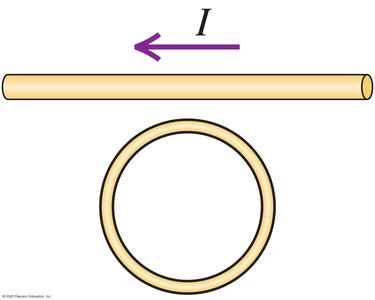
Q1d. A wire and a current loop are in the same plane (see Figure). Current is suddenly increased in the wire in the direction shown. What direction is the induced current in the loop?
Background
Topic: Electromagnetic Induction (Faraday's Law & Lenz's Law)
This question tests your understanding of how changing currents in a wire can induce currents in a nearby loop, and how to determine the direction of the induced current using Lenz's Law.
Key Terms and Formulas:
Faraday's Law:
Lenz's Law: The induced current will flow in a direction that opposes the change in magnetic flux.
Magnetic Flux:
Step-by-Step Guidance
Identify the direction of the current in the wire and how it is changing (increasing in the direction shown).
Determine the direction of the magnetic field produced by the wire at the location of the loop using the right-hand rule.
Consider how the magnetic flux through the loop changes as the current in the wire increases.
Apply Lenz's Law: The induced current in the loop will oppose the increase in magnetic flux.
Set up the direction of the induced current in the loop based on the opposition to the change in flux. (You should now be able to deduce the direction, but stop before stating it explicitly.)
Try solving on your own before revealing the answer!
Final Answer:
The induced current in the loop will flow in the direction that creates a magnetic field opposing the increase in flux caused by the wire. If the wire's current is increasing to the left, the magnetic field at the loop points out of the page. The induced current will flow in the loop in the clockwise direction (as viewed from above) to oppose this change.
This follows directly from Lenz's Law: the loop's induced current always acts to oppose the change in magnetic flux.
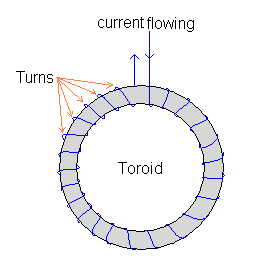
Q3a. Find the magnetic field inside a toroid of inner radius a and outer radius b with N turns carrying current I. See the Figure.
Background
Topic: Ampere's Law for Toroids
This question tests your ability to apply Ampere's Law to find the magnetic field inside a toroidal coil.
Key Terms and Formulas:
Ampere's Law:
Toroid: A coil shaped like a doughnut, with N turns and current I.
Enclosed Current: (for a path inside the toroid)
Step-by-Step Guidance
Choose an Amperian loop inside the toroid at radius r (where ).
Write Ampere's Law for this loop: .
Since the magnetic field is constant along the loop, .
Set for the total current enclosed by the loop.
Set up the equation to solve for but stop before plugging in the values or simplifying to the final expression.
Try solving on your own before revealing the answer!
Final Answer:
The magnetic field inside the toroid is:
where is the distance from the center (with ). This result comes from applying Ampere's Law to a circular path inside the toroid.
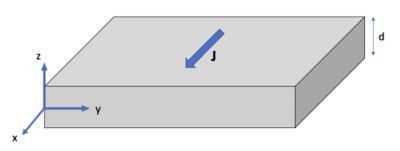
Q3c. Find the magnetic field outside both sides of the slab (|z| > d/2).
Background
Topic: Magnetic Field from Current Distributions (Ampere's Law)
This question tests your understanding of how to use Ampere's Law to find the magnetic field outside a slab of current with uniform current density.
Key Terms and Formulas:
Current Density:
Ampere's Law:
Slab: A region of finite thickness in the direction, infinite in and .
Step-by-Step Guidance
Choose an Amperian loop outside the slab, at .
Determine the total current enclosed by the loop (all current in the slab).
Write Ampere's Law: .
Assume the magnetic field is constant along the path and set up the integral.
Set up the equation for outside the slab, but stop before plugging in the values or simplifying to the final expression.
Try solving on your own before revealing the answer!
Final Answer:
The magnetic field outside the slab () is:
This result comes from applying Ampere's Law and recognizing that the field outside is constant and depends on the total current in the slab.
