 Indietro
Physics with Calculus: Forces, Friction, and Dynamics Study Guide
Guida di studio - Note intelligenti
 Appunti personalizzati basati sui tuoi materiali, ampliati con definizioni chiave, esempi e contesto.
Q1. True or False: Conceptual Questions on Forces and Motion
Background
Topic: Newton's Laws, Forces, and Motion
These questions test your understanding of fundamental concepts in Newtonian mechanics, including inertia, acceleration, friction, tension, and the effects of forces on objects.
Key Terms and Concepts:
Inertia: The tendency of an object to resist changes in its state of motion.
Acceleration: The rate of change of velocity of an object.
Friction: The force that opposes the relative motion of two surfaces in contact.
Tension: The pulling force transmitted through a string, rope, or cable.
Newton's Third Law: For every action, there is an equal and opposite reaction.
Free Fall: Motion under the influence of gravity only.
Step-by-Step Guidance
For each statement, recall the relevant physics law or definition (e.g., Newton's laws, definitions of friction, tension, etc.).
Think about whether the statement matches what you know from class or your textbook. For example, does inertia depend on speed, or only on mass?
For statements about forces (like tension or friction), consider drawing a simple free-body diagram to visualize the forces involved.
For each, decide if the statement is consistent with physical principles or if it contradicts them.
Mark each as True or False based on your reasoning, but double-check your logic before finalizing your choice.
Try solving on your own before revealing the answer!
Final Answers:
a. False (Inertia depends on mass, not speed.)
b. False (Acceleration depends on force and mass: .)
c. False (Changing direction means acceleration is present, even if speed is constant.)
d. False (A free-falling object is acted on by gravity.)
e. True (Tension depends on the angle of the rope.)
f. True (Static friction acts only when the object is at rest; once moving, kinetic friction applies.)
g. False (Newton's Third Law: the forces are equal and opposite.)
h. False (Tension balances friction, not weight, for horizontal motion at constant velocity.)
i. False (After contact, with no friction, the puck moves at constant velocity, not accelerating.)
j. True (Kinetic friction depends on the normal force and the surfaces in contact.)
Each answer is based on Newtonian mechanics and the definitions of the forces involved.
Q2. Two-Block System with Pulley: Finding the Coefficient of Kinetic Friction
Background
Topic: Dynamics of Connected Objects, Friction, Kinematics
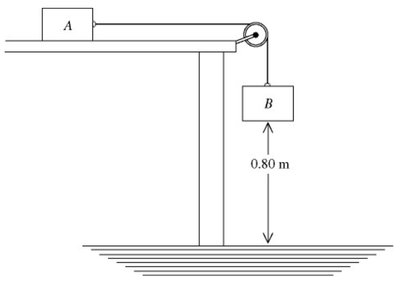
This problem involves two blocks connected by a string over a pulley, with one block sliding on a table and the other hanging. You are asked to find the coefficient of kinetic friction between the table and the sliding block, given the masses, distance fallen, and time.
Key Terms and Formulas:
Kinematic equation:
Newton's Second Law:
Friction force:
Normal force (horizontal surface):
Step-by-Step Guidance
Use the kinematic equation to solve for the acceleration of the system, knowing the distance (0.80 m), initial velocity (0), and time (2.5 s).
Draw free-body diagrams for both blocks. For the hanging block, consider gravity and tension; for the sliding block, consider tension, friction, and normal force.
Write Newton's Second Law for each block:
Hanging block:
Sliding block:
Express the friction force as and substitute into the equation for the sliding block.
Combine the equations to eliminate and solve for , but stop before plugging in the final numbers.
Try solving on your own before revealing the answer!
Final Answer:
The coefficient of kinetic friction is .
We found the acceleration using kinematics, set up Newton's laws for both blocks, and solved for using the system of equations.
Q3. Forces on a Block: Net Force, Acceleration, and Normal Force
Background
Topic: Newton's Second Law, Vector Components, Forces on a Block
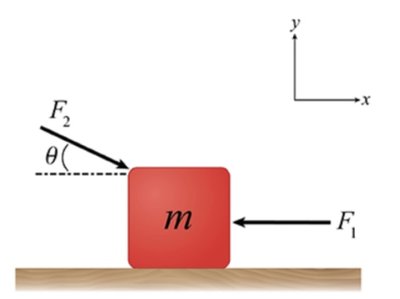
This problem involves a block on a frictionless surface with two forces acting on it: one horizontally and one at an angle. You are asked to find the net force in the x-direction, the acceleration, and the normal force.
Key Terms and Formulas:
Newton's Second Law:
Force components: ,
Normal force: (if is downward)
Step-by-Step Guidance
Resolve into its x and y components using the given angle.
Sum the forces in the x-direction: (be careful with signs).
Use Newton's Second Law to relate the net force in the x-direction to the acceleration: .
Sum the forces in the y-direction to find the normal force: (since the surface is frictionless and acts downward).
Set up the expressions for each quantity, but stop before substituting the final values.
Try solving on your own before revealing the answer!
Final Answers:
a. (to the left)
b. (to the left)
c.
We resolved the forces into components, summed them, and applied Newton's Second Law to find the requested quantities.
Q4. Traffic Light Supported by Two Cables: Free-Body Diagram and Tensions
Background
Topic: Static Equilibrium, Tension, Free-Body Diagrams
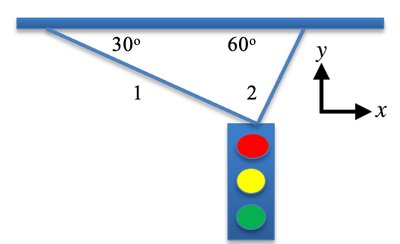
This problem involves a traffic light suspended by two cables at different angles. You are asked to draw a free-body diagram and find the tensions in each cable.
Key Terms and Formulas:
Static equilibrium: ,
Tension components: , , etc.
Weight:
Step-by-Step Guidance
Draw a free-body diagram showing the weight of the traffic light and the tensions in both cables at their respective angles.
Write equations for equilibrium in the x-direction (horizontal): .
Write equations for equilibrium in the y-direction (vertical): .
Express in terms of the mass and .
Set up the system of equations to solve for and , but stop before calculating the final values.
Try solving on your own before revealing the answer!
Final Answers:
a) Free-body diagram: Shows weight downward, up and left at , up and right at .
b)
c)
We used equilibrium conditions and resolved the tensions into components to solve for their magnitudes.
Q5. Crate on a Frictionless Incline: Free-Body Diagram, Normal Force, and Applied Force
Background
Topic: Inclined Planes, Forces, Newton's Second Law
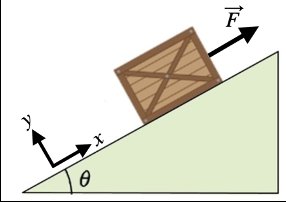
This problem involves a crate on a frictionless incline, with a force applied parallel to the incline. You are asked to draw a free-body diagram, find the normal force, and determine the applied force needed for a given acceleration.
Key Terms and Formulas:
Normal force on an incline:
Newton's Second Law along the incline:
Weight components: (parallel), (perpendicular)
Step-by-Step Guidance
Draw a free-body diagram showing the weight, normal force, and applied force acting parallel to the incline.
Resolve the weight into components parallel and perpendicular to the incline.
Write the equation for the normal force using the perpendicular component: .
Write Newton's Second Law along the incline: .
Set up the expressions for and , but stop before substituting the final values.
Try solving on your own before revealing the answer!
Final Answers:
a) Free-body diagram: Shows downward, perpendicular to the incline, up the incline.
b)
c)
We resolved the forces, applied Newton's Second Law, and solved for the normal and applied forces.
