 Indietro
Physics with Calculus: Foundations, Kinematics, and Vectors
Guida di studio - Note intelligenti
 Appunti personalizzati basati sui tuoi materiali, ampliati con definizioni chiave, esempi e contesto.
Chapter 1: Introduction to Physics
Physics and the Laws of Nature
Physics is the natural science that studies matter, its motion and behavior through space and time, and the related entities of energy and force. The discipline is built upon a small number of fundamental laws and principles that describe the universe.
Matter: Anything that has mass and occupies space.
Energy: The capacity to do work or produce change.
Force: A push or pull acting upon an object.
Units of Length, Mass, and Time
Physics relies on precise measurements, which require both a magnitude and a unit. The International System of Units (SI) is used for consistency and reproducibility.
Base units: meter (m) for length, kilogram (kg) for mass, second (s) for time.
Older units (e.g., foot, stone) are not used due to lack of reproducibility and dependence on arbitrary standards.
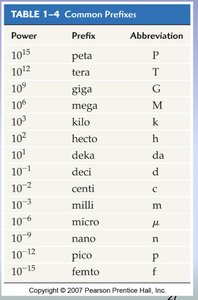
Table Purpose: This table lists common metric prefixes, their powers of ten, and abbreviations, which are essential for expressing measurements in physics.
Dimensional Analysis, Scientific Notation, and Converting Units
Dimensional analysis ensures equations are physically meaningful by checking the consistency of units. Scientific notation is used to express very large or small numbers efficiently.
Base dimensions: Length [L], Mass [M], Time [T]
Example: Velocity has dimensions [L][T]-1 and units m/s.
Example: Force has dimensions [M][L][T]-2 and units N (newton).
Problem Solving in Physics
Effective problem solving in physics involves a systematic approach:
Read the problem carefully.
Sketch the system.
Visualize the physical process.
Strategize and develop a plan.
Identify appropriate equations.
Solve the equations.
Check your answer for reasonableness and correct units.
Explore limits and special cases.
Chapter 2: One-Dimensional Kinematics
Position, Distance, and Displacement
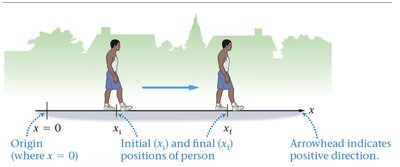
Describing motion begins with defining position relative to a coordinate system. Distance is the total length traveled (a scalar), while displacement is the change in position (a vector).
Position (x): Location relative to an origin.
Distance: Total path length traveled, always positive.
Displacement (Δx): Change in position, can be positive or negative.

Average Speed and Velocity
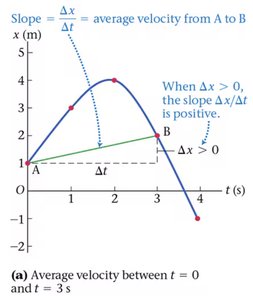
Speed is the rate of change of distance, while velocity is the rate of change of displacement. Velocity is a vector; speed is a scalar.
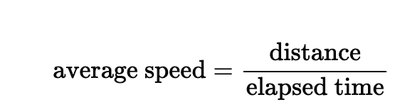
Average speed:
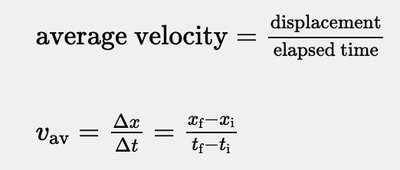
Average velocity:
Instantaneous Velocity
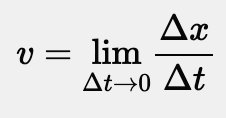
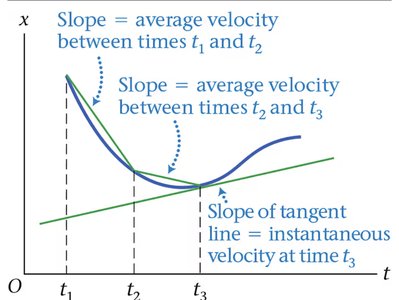
Instantaneous velocity is the velocity at a specific moment, defined as the limit of average velocity as the time interval approaches zero.
The magnitude of instantaneous velocity is called instantaneous speed.
Acceleration
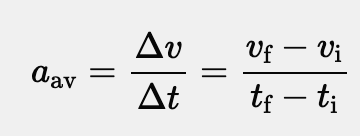
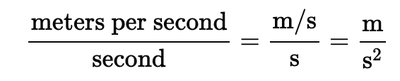
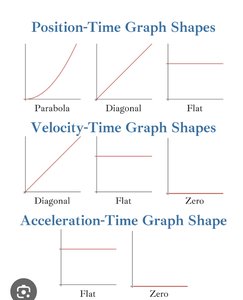
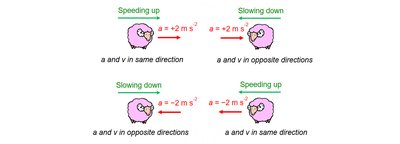
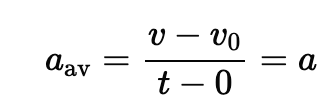
Acceleration is the rate of change of velocity with respect to time. It is a vector quantity, measured in meters per second squared (m/s2).
Average acceleration:
Units:
Equations of Motion for Constant Acceleration
When acceleration is constant, the following kinematic equations describe motion:
Variables Related | Equation |
|---|---|
velocity, time, acceleration | |
initial, final, and average velocity | |
position, time, velocity | |
position, time, acceleration | |
velocity, position, acceleration |
Chapter 3: Vectors in Physics
Scalars vs. Vectors
Scalars are quantities with magnitude only (e.g., mass, temperature), while vectors have both magnitude and direction (e.g., displacement, velocity, acceleration).
Components of a Vector
Vectors can be broken into components along perpendicular axes, simplifying calculations.
X-component:
Y-component:
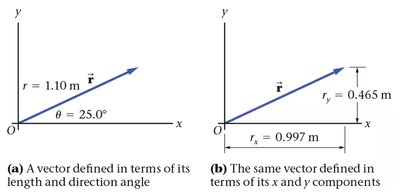
Magnitude from components:
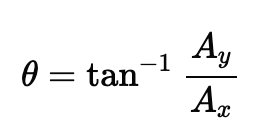
Direction angle:
Adding and Subtracting Vectors
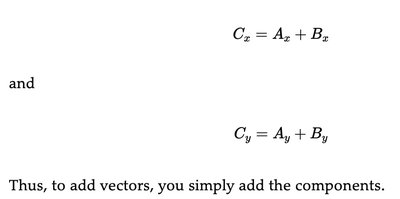
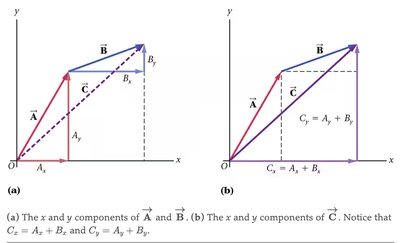
Vectors are added by summing their components:
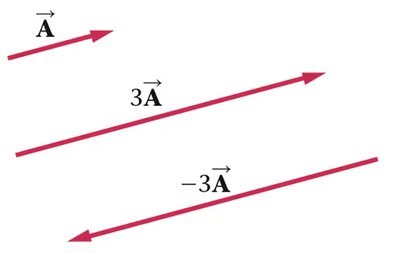
Multiplying a vector by a scalar changes its magnitude but not its direction (unless the scalar is negative, which reverses the direction).
Unit Vectors
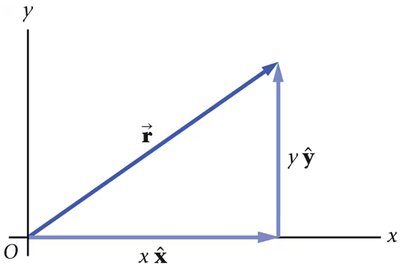
Unit vectors have a magnitude of 1 and indicate direction along coordinate axes. Common unit vectors are î (x-direction), ĵ (y-direction), and k̂ (z-direction).
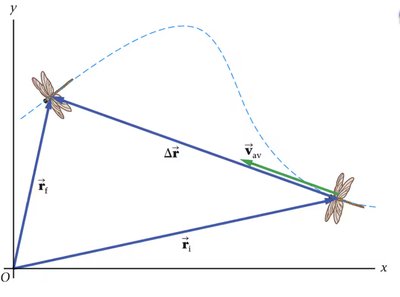
Position, Displacement, Velocity, and Acceleration Vectors
Position vector: points from the origin to the object's location.
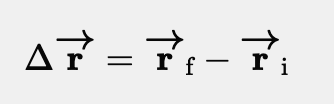
Displacement vector:
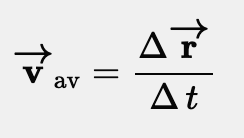
Average velocity vector:
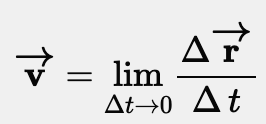
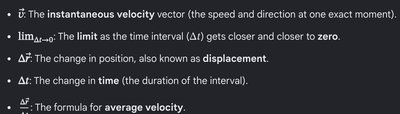
Instantaneous velocity:
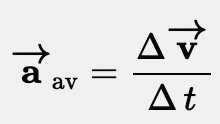
Average acceleration:
Relative Motion
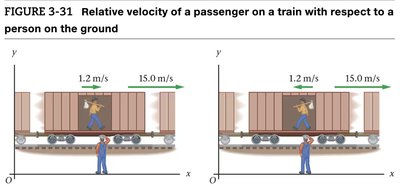
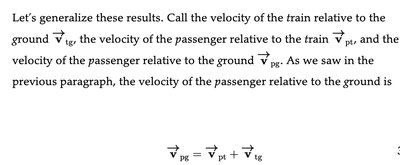
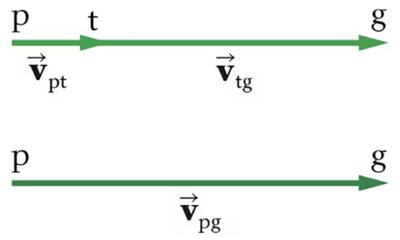
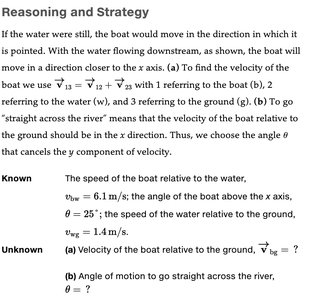
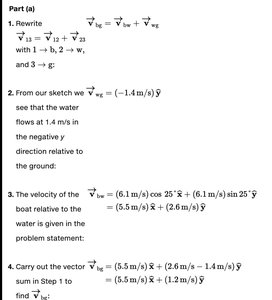
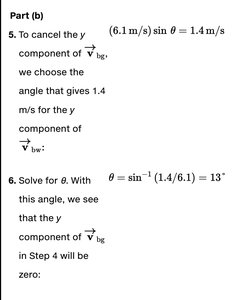
Relative motion describes how the velocity of an object appears different depending on the observer's frame of reference. The velocities add vectorially:
Chapter 4: Two-Dimensional Kinematics
Motion in Two Dimensions
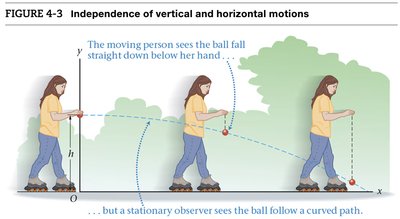
Two-dimensional motion consists of independent horizontal (x) and vertical (y) components. The kinematic equations apply separately to each direction.
Constant velocity: ,
Constant acceleration: ,
Projectile Motion
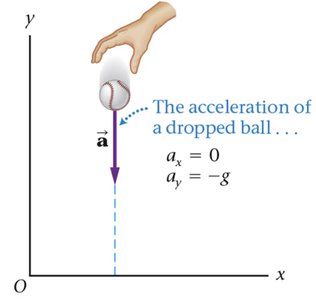
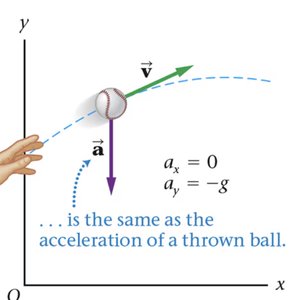
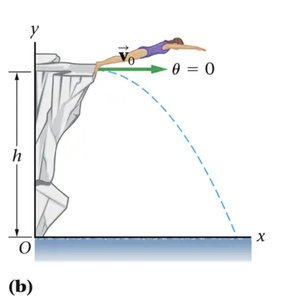
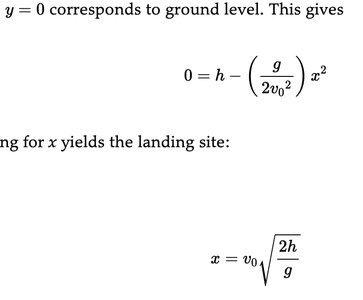
A projectile is an object launched into motion and influenced only by gravity (assuming air resistance is negligible). The horizontal and vertical motions are independent.
Horizontal motion: , ,
Vertical motion: , ,
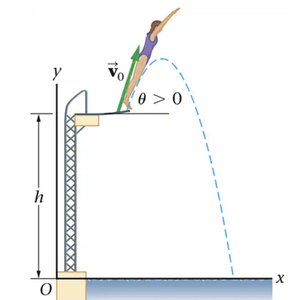
General Launch Angle

Key Characteristics of Projectile Motion
Range (R): The horizontal distance traveled before landing. For launch and landing at the same height:
Maximum height:
Time of flight:
Maximum range occurs at a launch angle of 45°.


Summary Table: Common Metric Prefixes
Power | Prefix | Abbreviation |
|---|---|---|
1015 | peta | P |
1012 | tera | T |
109 | giga | G |
106 | mega | M |
103 | kilo | k |
102 | hecto | h |
101 | deka | da |
10-1 | deci | d |
10-2 | centi | c |
10-3 | milli | m |
10-6 | micro | μ |
10-9 | nano | n |
10-12 | pico | p |
10-15 | femto | f |
Additional info: This guide covers the foundational concepts of physics with calculus, including units, kinematics, vectors, and projectile motion, with relevant equations, definitions, and graphical representations to support student understanding.
