 Indietro
Physics with Calculus: Kinematics, Coordinate Systems, and Motion Analysis
Guida di studio - Note intelligenti
 Appunti personalizzati basati sui tuoi materiali, ampliati con definizioni chiave, esempi e contesto.
Dimensional Analysis and Units
Dimensional Analysis
Dimensional analysis is a fundamental tool in physics for verifying the consistency of equations and understanding the relationships between physical quantities.
Dimensions can be treated as algebraic quantities. For example, length (L), mass (M), and time (T) are the basic dimensions in mechanics.
The dimensions on both sides of a physical equation must be the same, ensuring the equation is dimensionally consistent.
Dimensional analysis can check the correctness of equations but cannot determine numerical constants (e.g., 1/2, π).
Example: To check if an equation for distance in terms of velocity and time is correct, ensure both sides have dimensions of length (L).
Key Equations:
Velocity:
Acceleration:
Displacement:
Coordinate Systems and Trigonometry
Coordinate Systems
Coordinate systems are essential for specifying locations in space and describing vector quantities.
A coordinate system consists of a fixed reference point (origin), specified axes, and instructions for labeling points relative to the origin and axes.
Two common two-dimensional coordinate systems are Cartesian (rectangular) and Plane Polar coordinates.

Cartesian and Plane Polar Coordinates
Cartesian coordinates specify a point as (x, y).
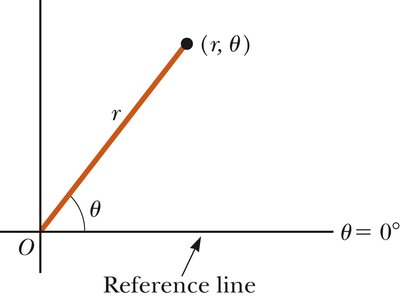
Plane polar coordinates specify a point by its distance from the origin (r) and the angle (θ) from a reference line.
Trigonometry Review
Trigonometry is used to relate the sides and angles of right triangles, which is essential for resolving vectors.
Pythagorean theorem:
Trigonometric ratios:
One-Dimensional Kinematics
Displacement
Displacement is the change in position of an object along a straight line.
Defined as
Displacement is a vector: it has both magnitude and direction.
Positive displacement: movement in the positive x direction; negative displacement: movement in the negative x direction.

Velocity and Speed
Velocity and speed describe how fast an object moves, but velocity also includes direction.
Speed is a scalar:
Velocity is a vector:
Units: meters per second (m/s)
Example: If a person drives 250 km to a city and back in 5.00 h, the average speed is , but the average velocity is zero because the displacement is zero.
Graphical Interpretation of Velocity
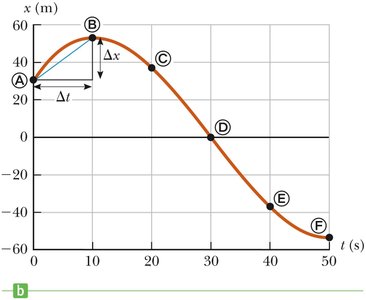
The slope of a position vs. time graph gives the average velocity.
For a straight line, the slope is constant and equals the velocity.
For a curve, the slope of the tangent at a point gives the instantaneous velocity.

Instantaneous Velocity
Instantaneous velocity is the velocity at a specific instant, defined as the limit of average velocity as the time interval approaches zero.
The magnitude of instantaneous velocity is called instantaneous speed.
Acceleration
Acceleration is the rate at which velocity changes with time.
Average acceleration:
Instantaneous acceleration:
Acceleration is a vector and points in the direction of the change in velocity.
Motion with Constant Acceleration
Many physical situations can be approximated as motion with constant acceleration, such as free fall or objects under constant net force.
For constant acceleration, average and instantaneous accelerations are equal.
Key equations for one-dimensional motion with constant acceleration:
Example: A motorcycle accelerates from rest at and overtakes a car moving at . To find when and where they meet, set their positions equal and solve for time.
Motion Diagrams and Graphs
Motion diagrams, including displacement vs. time, velocity vs. time, and acceleration vs. time graphs, provide qualitative and quantitative descriptions of motion.
The area under a velocity vs. time graph gives the displacement.
The slope of a velocity vs. time graph gives the acceleration.
Summary Table: Kinematic Quantities
Quantity | Definition | Vector/Scalar | SI Unit |
|---|---|---|---|
Displacement () | Vector | m | |
Velocity () | Vector | m/s | |
Speed | Scalar | m/s | |
Acceleration () | Vector | m/s2 |
Additional info: This guide covers the foundational concepts of kinematics, including dimensional analysis, coordinate systems, trigonometry, displacement, velocity, acceleration, and motion with constant acceleration, as outlined in the Physics with Calculus curriculum.
