 Indietro
Physics with Calculus Midterm Study Guide: Electric Forces, Fields, Circuits, and Capacitance
Guida di studio - Note intelligenti
 Appunti personalizzati basati sui tuoi materiali, ampliati con definizioni chiave, esempi e contesto.
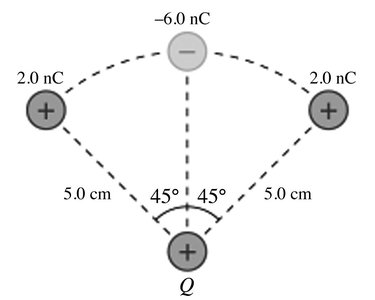
Q5. Coulomb's law: The point charge at the bottom of the figure is Q = +17 nC, and the curve is a circular arc. What is the magnitude of the force on the charge Q due to the other point charges shown? (k = 1/4\pi\epsilon_0 = 8.99 \times 10^9 \text{ N} \cdot \text{m}^2/\text{C}^2)
Background
Topic: Coulomb's Law and Vector Addition
This question tests your ability to calculate the net electric force on a point charge due to multiple other point charges, using Coulomb's law and vector addition.
Key Terms and Formulas
Coulomb's Law:
Vector Addition: Forces from each charge must be added as vectors, considering both magnitude and direction.
Superposition Principle: The net force is the vector sum of the individual forces.
Step-by-Step Guidance
Identify the charges and their positions: Q = +17 nC at the bottom, two +2.0 nC charges at 5.0 cm and 45° angles, and a -6.0 nC charge at the top.
Calculate the force between Q and each of the other charges using Coulomb's law. For each pair, use , where is the distance between the charges.
Determine the direction of each force: Repulsive for like charges, attractive for opposite charges. Draw vectors for each force acting on Q.
Resolve the forces from the two +2.0 nC charges into their x and y components using trigonometry (since they are at 45° angles).
Set up the vector sum for all forces acting on Q. Add the x and y components to find the net force vector.
Try solving on your own before revealing the answer!
Final Answer: 1.6 × 10⁻⁴ N
Using Coulomb's law for each charge and vector addition, the net force on Q is approximately N.
The calculation involves summing the forces from each charge, considering their directions and using trigonometric components for the two charges at 45° angles.
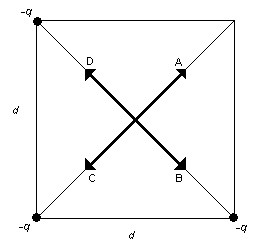
Q10. Electric field of multiple point-charges: Three equal negative point charges are placed at three of the corners of a square of side d as shown in the figure. Which of the arrows represents the direction of the net electric field at the center of the square?
Background
Topic: Electric Field Superposition
This question tests your understanding of how to determine the direction of the net electric field at a point due to multiple point charges, using vector addition.
Key Terms and Formulas
Electric Field due to a Point Charge:
Superposition Principle: The net electric field is the vector sum of the fields from each charge.
Step-by-Step Guidance
Identify the positions of the three negative charges and the center of the square.
For each charge, determine the direction of the electric field at the center: negative charges produce fields pointing toward themselves.
Draw the electric field vectors from each charge to the center, considering their symmetry.
Use vector addition to combine the three field vectors. Consider the geometry of the square and the relative angles.
Compare the resultant direction to the arrows labeled A, B, C, D in the diagram.
Try solving on your own before revealing the answer!
Final Answer: B
The net electric field at the center points along arrow B, which is diagonally toward the empty corner of the square.
This is due to the vector sum of the fields from the three negative charges.
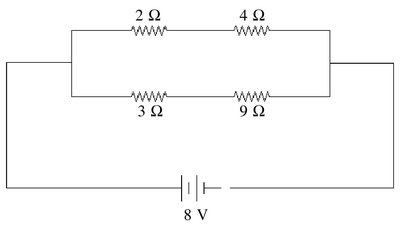
Q11. Resistors in combination: Four resistors are connected across an 8-V battery as shown in the figure. The current through the battery is closest to:
Background
Topic: Series and Parallel Circuits, Ohm's Law
This question tests your ability to find the equivalent resistance of a circuit with both series and parallel resistors, and then use Ohm's law to find the total current.
Key Terms and Formulas
Ohm's Law:
Resistors in Series:
Resistors in Parallel:
Step-by-Step Guidance
Identify which resistors are in parallel and which are in series based on the circuit diagram.
Calculate the equivalent resistance for each parallel branch: , .
Add the two parallel branch resistances together to get the total equivalent resistance.
Use Ohm's law to set up the calculation for the total current: .
Try solving on your own before revealing the answer!
Final Answer: 1 A
The equivalent resistance is 8 Ω, so the current through the battery is .
This result comes from correctly combining the parallel resistors and applying Ohm's law.
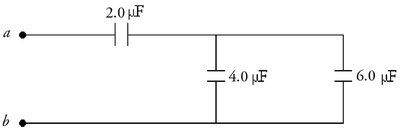
Q12. Capacitors in combination: Three capacitors are connected as shown in the figure. What is the equivalent capacitance between points a and b?
Background
Topic: Series and Parallel Capacitors
This question tests your ability to find the equivalent capacitance for a combination of capacitors in series and parallel.
Key Terms and Formulas
Capacitors in Series:
Capacitors in Parallel:
Step-by-Step Guidance
Identify which capacitors are in parallel and which are in series based on the circuit diagram.
Calculate the equivalent capacitance for the parallel branch: .
Combine the result with the series capacitor: .
Set up the calculation for , but stop before the final computation.
Try solving on your own before revealing the answer!
Final Answer: 1.7 μF
The equivalent capacitance between points a and b is .
This is found by combining the parallel capacitors and then using the series formula.
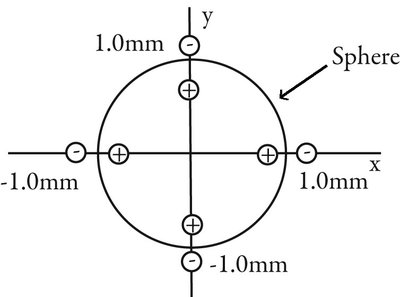
Q14. Gauss's law: Four dipoles, each consisting of a +10-μC charge and a -10-μC charge, are located in the xy-plane with their centers 1.0 mm from the origin, as shown. A sphere passes through the dipoles, as shown in the figure. What is the electric flux through the sphere due to these dipoles? (ε0 = 8.85 × 10⁻¹² C2/N·m2)
Background
Topic: Gauss's Law and Electric Flux
This question tests your understanding of Gauss's law and how the net charge enclosed by a surface affects the electric flux through that surface.
Key Terms and Formulas
Gauss's Law:
Electric Flux:
Dipole: A pair of equal and opposite charges.
Step-by-Step Guidance
Identify the charges inside the sphere: Each dipole consists of a +10 μC and a -10 μC charge.
Calculate the net charge enclosed by the sphere: Add up all the positive and negative charges inside.
Apply Gauss's law: .
Set up the calculation for the electric flux, but stop before the final computation.
Try solving on your own before revealing the answer!
Final Answer: 0.00 N·m2/C
The net charge enclosed by the sphere is zero, so the electric flux through the sphere is zero.
This is a direct consequence of Gauss's law: only net charge inside the surface contributes to the flux.
