 Indietro
Physics with Calculus: Newton's Laws, Friction, Circular Motion, and Proportional Reasoning
Guida di studio - Note intelligenti
 Appunti personalizzati basati sui tuoi materiali, ampliati con definizioni chiave, esempi e contesto.
Q1. What is the greatest possible value of the static friction force?
Background
Topic: Static Friction
This question tests your understanding of the limits of static friction and how it is determined by the coefficient of static friction and the normal force.
Key Terms and Formulas
Static friction force (): The force that resists the initiation of sliding motion between two surfaces.
Coefficient of static friction (): A dimensionless constant that characterizes the interaction between two surfaces.
Normal force (): The perpendicular force exerted by a surface on an object in contact with it.
Key formula:
Step-by-Step Guidance
Recall that static friction adjusts to match the applied force up to a maximum value.
The maximum value of static friction is given by multiplying the coefficient of static friction by the normal force: .
Understand that the actual static friction force can be any value from zero up to this maximum, depending on the applied force.
Try solving on your own before revealing the answer!
Final Answer:
The greatest possible value of the static friction force is . This means static friction can have any value between zero and $\mu_s N$, depending on the situation.
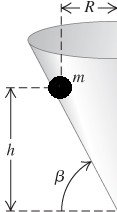
Q2. For a block inside a rotating cone, what is the correct free-body diagram?
Background
Topic: Forces in Non-Equilibrium (Uniform Circular Motion)
This question is about drawing the correct free-body diagram for a mass inside a rotating cone, which is a classic example of circular motion with friction and normal forces.
Key Terms and Formulas
Normal force (): Perpendicular to the cone's surface.
Friction force (): Acts parallel to the cone's surface, direction depends on whether the block tends to slide up or down.
Weight (): Acts vertically downward.
Step-by-Step Guidance
Identify all forces acting on the block: gravity (downward), normal force (perpendicular to the surface), and friction (parallel to the surface).
Draw the weight vector () pointing straight down from the block.
Draw the normal force perpendicular to the cone's surface at the point of contact.
Draw the friction force tangent to the cone's surface, in the direction that opposes the block's tendency to slide (up or down the cone, depending on the rotation speed).
Try solving on your own before revealing the answer!
Final Answer:
The correct free-body diagram includes three forces: the weight () vertically downward, the normal force perpendicular to the cone's surface, and the friction force tangent to the surface (direction depends on the block's tendency to slide). These vectors should all originate from the block's center.
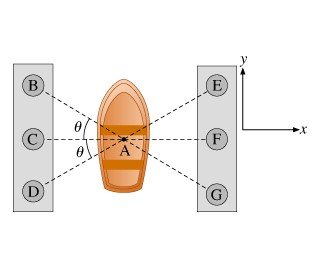
Q3. In the boat docking problem, how do you find the x-component of the force from a rope at an angle ?
Background
Topic: Vector Components and Equilibrium
This question involves resolving forces into components and using equilibrium conditions to solve for unknowns.
Key Terms and Formulas
Force vector (): Can be broken into x and y components using trigonometry.
Equilibrium: The sum of forces in each direction must be zero for a stationary object.
Step-by-Step Guidance
Identify the angle between the rope and the x-axis.
Recall that the x-component of a force at angle is .
Set up the equilibrium equation for the x-direction, summing all x-components of the forces from the ropes.
Try solving on your own before revealing the answer!
Final Answer:
The x-component of the force from a rope at angle is . Use this to write the equilibrium equation for the x-direction and solve for the unknown force.
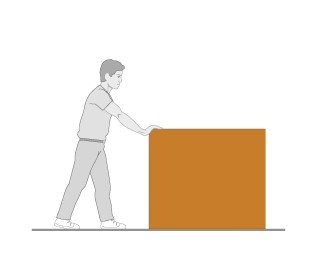
Q4. For a box pushed at an angle, how do you set up the free-body diagram and choose the coordinate system?
Background
Topic: Newton's First Law and Free-Body Diagrams
This question is about choosing an appropriate coordinate system and drawing a free-body diagram for a box being pushed at an angle.
Key Terms and Formulas
Free-body diagram: A diagram showing all forces acting on an object.
Coordinate system: Typically, align the x-axis with the direction of the applied force or motion.
Step-by-Step Guidance
Choose the x-axis to be in the direction of the applied force (usually to the right), and the y-axis to be vertical (upward).
Draw the weight () acting downward from the box.
Draw the normal force () acting upward from the box.
Draw the applied force at the given angle, and resolve it into x and y components.
Draw the friction force acting opposite to the direction of intended motion, along the surface.
Try solving on your own before revealing the answer!
Final Answer:
The positive x-axis should be to the right, and the positive y-axis should be upward. The free-body diagram should include weight (down), normal force (up), friction (left), and the applied force split into x and y components at the specified angle.
Q5. What is the correct interpretation of the force of static friction as the pulling force increases?
Background
Topic: Static Friction and Force Matching
This question tests your understanding of how static friction responds to an increasing applied force, up to its maximum value.
Key Terms and Formulas
Static friction (): Adjusts to match the applied force up to .
Step-by-Step Guidance
As the pulling force increases, static friction increases to match it, keeping the object stationary.
Once the pulling force exceeds , the object begins to move and kinetic friction takes over.
Try solving on your own before revealing the answer!
Final Answer:
Until the pulling force exceeds , the force of static friction is exactly equal in magnitude to the pulling force.
Q6. What are the key characteristics of kinetic friction?
Background
Topic: Kinetic Friction
This question is about understanding the properties and direction of kinetic friction when an object is sliding.
Key Terms and Formulas
Kinetic friction (): The frictional force acting on a moving object.
Coefficient of kinetic friction (): A constant for a given pair of surfaces.
Normal force (): The perpendicular force from the surface.
Key formula:
Step-by-Step Guidance
Kinetic friction acts only when there is relative motion between surfaces.
It always opposes the direction of motion and is parallel to the surface.
The magnitude is constant for a given normal force and coefficient: .
Try solving on your own before revealing the answer!
Final Answer:
Kinetic friction acts only when sliding occurs, is always parallel and opposite to motion, and has magnitude .
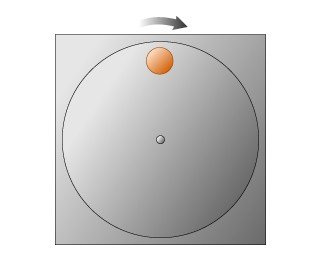
Q7. For a mass on a turntable, what is the direction of velocity, acceleration, and net force?
Background
Topic: Circular Motion and Centripetal Force
This question is about identifying the correct directions of velocity, acceleration, and net force for an object in uniform circular motion.
Key Terms and Formulas
Velocity (): Tangent to the circle at any point.
Acceleration (): Points toward the center of the circle (centripetal).
Net force (): Also points toward the center (provides centripetal acceleration).
Step-by-Step Guidance
Draw the velocity vector tangent to the circle at the object's position.
Draw the acceleration vector pointing directly toward the center of the circle.
Draw the net force vector in the same direction as the acceleration (toward the center).
Try solving on your own before revealing the answer!
Final Answer:
For uniform circular motion, the velocity is tangent to the path, while both acceleration and net force point toward the center of the circle.
Q8. Which statements about centripetal acceleration are true or false?
Background
Topic: Centripetal Acceleration and Misconceptions
This question asks you to identify correct and incorrect statements about centripetal acceleration and the forces involved in circular motion.
Key Terms and Formulas
Centripetal acceleration (): , always points toward the center of the circle.
Centrifugal force: Not a real force in an inertial frame; it's a fictitious force in a rotating (non-inertial) frame.
Step-by-Step Guidance
Review each statement and compare it to the definition and direction of centripetal acceleration.
Recall that the force you "feel" outward in a car turning is not a real force but a result of inertia.
Check which statements correctly describe the vector nature and magnitude of centripetal acceleration.
Try solving on your own before revealing the answer!
Final Answer:
The false statements are those that misattribute the direction or cause of centripetal acceleration, or that confuse real and fictitious forces. Specifically, statements b and e are false.
Q9. How does the speed of two cars of different masses compare when rounding a curve with the same acceleration?
Background
Topic: Proportional Reasoning in Circular Motion
This question is about using proportional reasoning to compare the speeds of two cars of different masses traveling around a curve with the same acceleration.
Key Terms and Formulas
Centripetal acceleration:
For the same and , speed is independent of mass.
Step-by-Step Guidance
Write the equation for centripetal acceleration for each car: .
Set the accelerations equal for both cars and solve for the relationship between their speeds.
Notice that mass cancels out, so the speeds must be the same for the same and .
Try solving on your own before revealing the answer!
Final Answer:
The speeds of the two cars are equal when they have the same acceleration and travel around a curve of the same radius, regardless of their masses.
