 Indietro
Physics with Calculus: Sample Final Exam Guidance
Guida di studio - Note intelligenti
 Appunti personalizzati basati sui tuoi materiali, ampliati con definizioni chiave, esempi e contesto.
Q8. In the figure, determine the character of the collision. The masses of the blocks, and the velocities before and after are given. The collision is:
Background
Topic: Collisions and Conservation Laws
This question tests your understanding of the types of collisions (elastic, inelastic, perfectly inelastic) and the application of conservation of momentum and kinetic energy.
Key Terms and Formulas
Momentum ():
Kinetic Energy ():
Elastic Collision: Both momentum and kinetic energy are conserved.
Inelastic Collision: Momentum is conserved, but kinetic energy is not.
Perfectly Inelastic Collision: Objects stick together after collision.
Step-by-Step Guidance
Calculate the total momentum before the collision using .
Calculate the total momentum after the collision using .
Compare and to check if momentum is conserved.
Calculate the total kinetic energy before and after the collision using for both before and after.
Compare the kinetic energies to determine if the collision is elastic or inelastic. If kinetic energy is conserved, the collision is elastic; if not, it is inelastic.
Try solving on your own before revealing the answer!
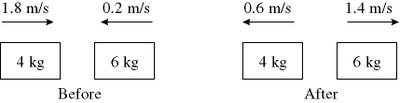
Final Answer: a) perfectly elastic
Both momentum and kinetic energy are conserved in this collision, so it is classified as perfectly elastic.
Q10. A 2.0 kg mass is moving along the x-axis. The potential energy curve as a function of position is shown in the figure. The kinetic energy of the object at the origin is 12 J. The system is conservative, and there is no friction. (a) What will be the kinetic energy at 2.0 m along the +x-axis? (b) What will be the speed of the object at 6.0 m along the +x-axis?
Background
Topic: Conservation of Energy
This question tests your ability to use the conservation of mechanical energy in a system with a potential energy curve.
Key Terms and Formulas
Mechanical Energy:
Conservation of Energy:
Kinetic Energy:
Potential Energy: Read values from the graph at specific positions.
Step-by-Step Guidance
Identify the initial kinetic energy () and initial potential energy () at the origin.
Read the potential energy () at 2.0 m and 6.0 m from the graph.
Apply conservation of energy: to solve for at each position.
For part (b), use to solve for the speed at 6.0 m.
Set up the equations for the final steps, but stop before plugging in the numbers for the final calculation.
Try solving on your own before revealing the answer!
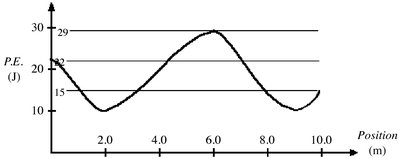
Final Answer:
(a) The kinetic energy at 2.0 m is 24 J. (b) The speed of the object at 6.0 m is 2.2 m/s.
We used conservation of energy and the values from the graph to find the answers.
