 Indietro
Physics with Calculus Study Guidance: Energy, Work, Thermodynamics, and Fluid Mechanics
Guida di studio - Note intelligenti
 Appunti personalizzati basati sui tuoi materiali, ampliati con definizioni chiave, esempi e contesto.
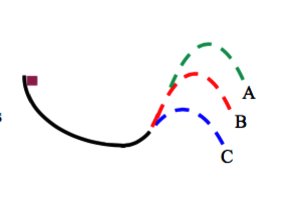
Q4. If a box is released from rest and slides down a frictionless surface, which path (A, B, or C) is most reasonable if there is no air resistance?
Background
Topic: Conservation of Energy and Motion on Frictionless Surfaces
This question tests your understanding of how objects move under the influence of gravity on frictionless surfaces, and how energy conservation determines the path taken.
Key Terms and Concepts:
Frictionless surface: No energy is lost to heat, so mechanical energy is conserved.
Conservation of energy: The sum of kinetic and potential energy remains constant.
Path of motion: The trajectory depends on initial conditions and forces acting on the box.
Step-by-Step Guidance
Consider the forces acting on the box: gravity acts downward, and the normal force acts perpendicular to the surface.
Since the surface is frictionless, the only force causing the box to accelerate is the component of gravity parallel to the surface.
Think about the initial velocity: the box is released from rest, so its initial velocity is zero.
Analyze the possible paths: Which path would result from the box simply following the slope under gravity, without any sideways force or initial velocity?
Try solving on your own before revealing the answer!
Final Answer: Path B is most reasonable.
Path B represents the box sliding straight down the slope, following the direction of the surface and gravity. Paths A and C would require additional forces or initial velocities not present in this scenario.
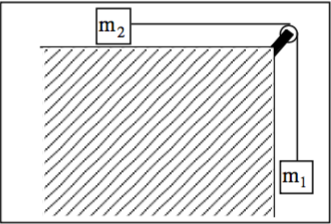
Q9. Is friction significant in the system where mass m1 falls and pulls mass m2 horizontally? Support your answer quantitatively.
Background
Topic: Energy Conservation and Friction in Pulley Systems
This question tests your ability to analyze energy changes and determine the significance of friction in a system involving masses, a pulley, and horizontal motion.
Key Terms and Formulas:
Conservation of energy:
Kinetic energy:
Potential energy:
Work done by friction:
Step-by-Step Guidance
Calculate the initial potential energy of mass m1 before it falls:
Calculate the kinetic energy of both masses after m1 has fallen:
Compare the change in potential energy to the sum of kinetic energies. If there is a difference, it may be due to friction.
Set up the energy conservation equation and solve for the work done by friction, if any.
Try solving on your own before revealing the answer!
Final Answer: Friction is not significant.
When you calculate the energy lost and compare it to the expected kinetic energy, the values are very close, indicating negligible friction. The system's energy is mostly conserved.
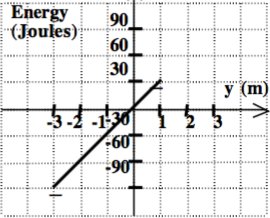
Q10. Where did the person who made the graph put y = 0? Based on the graph, determine the total energy (ETotal) and kinetic energy (KE) of the flowerpot when y = -2 m.
Background
Topic: Gravitational Potential Energy and Energy Conservation
This question tests your ability to interpret energy graphs and apply energy conservation principles to falling objects.
Key Terms and Formulas:
Gravitational potential energy:
Kinetic energy:
Total energy:
Step-by-Step Guidance
Examine the graph to determine where is set. Look for the point where .
Identify the total energy line on the graph. Is it constant or changing?
At m, use the graph to find the value of and .
Use energy conservation to find at m: .
Try solving on your own before revealing the answer!
Final Answer:
The person set at ground level. is constant at 120 J. At m, J, so J.
This shows energy conservation: as the flowerpot falls, potential energy decreases and kinetic energy increases.
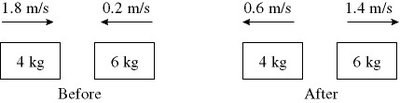
Q14. Examine the figure and determine whether the collision is perfectly elastic, inelastic, or neither. Prove your answer.
Background
Topic: Collisions and Conservation Laws
This question tests your understanding of momentum and energy conservation in collisions.
Key Terms and Formulas:
Elastic collision: Both momentum and kinetic energy are conserved.
Inelastic collision: Momentum is conserved, but kinetic energy is not.
Momentum:
Kinetic energy:
Step-by-Step Guidance
Calculate the total momentum before the collision:
Calculate the total momentum after the collision:
Compare the total kinetic energy before and after the collision.
Determine if both momentum and kinetic energy are conserved, or only momentum.
Try solving on your own before revealing the answer!
Final Answer: The collision is perfectly elastic.
Both momentum and kinetic energy are conserved in this collision, as shown by the calculations.
Q20. The cylinder of gas shown has a piston that can float up and down. You can lock or unlock the piston, add or remove masses, or place the cylinder in a hot or cold liquid. Answer the following:
Background
Topic: Thermodynamics and Gas Laws
This question tests your understanding of thermodynamic processes, including constant volume and constant pressure changes, and the application of the ideal gas law.
Key Terms and Formulas:
Ideal gas law:
Heat capacity at constant volume:
Work done by gas:
Change in internal energy:
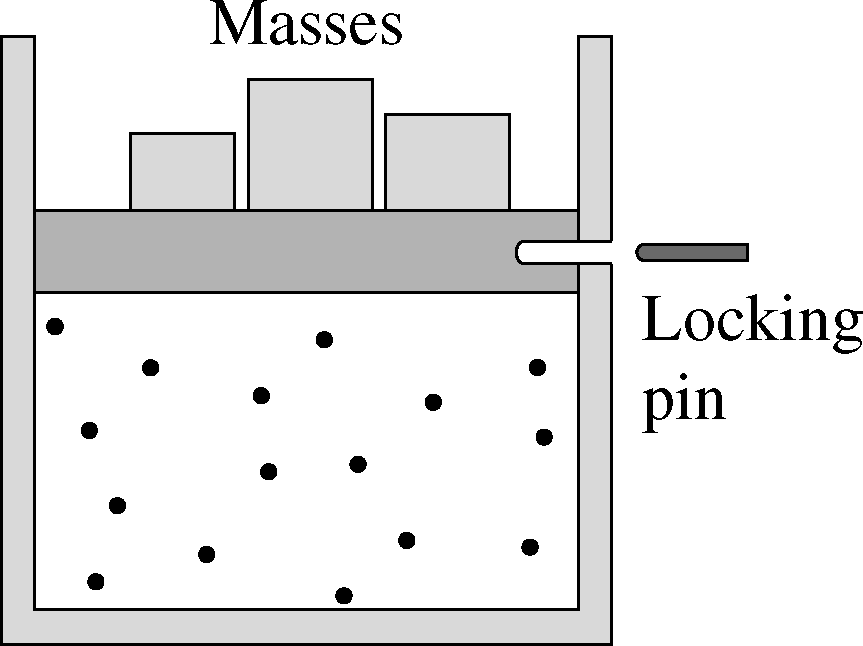
Step-by-Step Guidance
For the first step (constant volume), use since .
Calculate the final pressure using the ideal gas law, given the added heat and constant volume.
For the second step (constant temperature), use to find the new volume.
For the third step (compression at constant pressure), calculate the work done: .
Try solving on your own before revealing the answer!
Final Answer:
Each step involves applying the ideal gas law and thermodynamic formulas. The final pressure, volume, work, and heat transfer can be calculated using the provided values and equations.
Q15. The potential energy between two atoms at a distance r in the liquid phase is shown. Calculate the approximate bond energy of six moles of liquid made up of these atoms. Would the heat of vaporization be the same, less, or more compared to your calculation? Explain why.
Background
Topic: Molecular Potential Energy and Phase Changes
This question tests your understanding of molecular interactions, bond energy, and the relationship to heat of vaporization.
Key Terms and Formulas:
Bond energy: Energy required to break bonds between atoms.
Heat of vaporization: Energy required to convert liquid to gas.
Potential energy curve: Shows energy as a function of atomic separation.
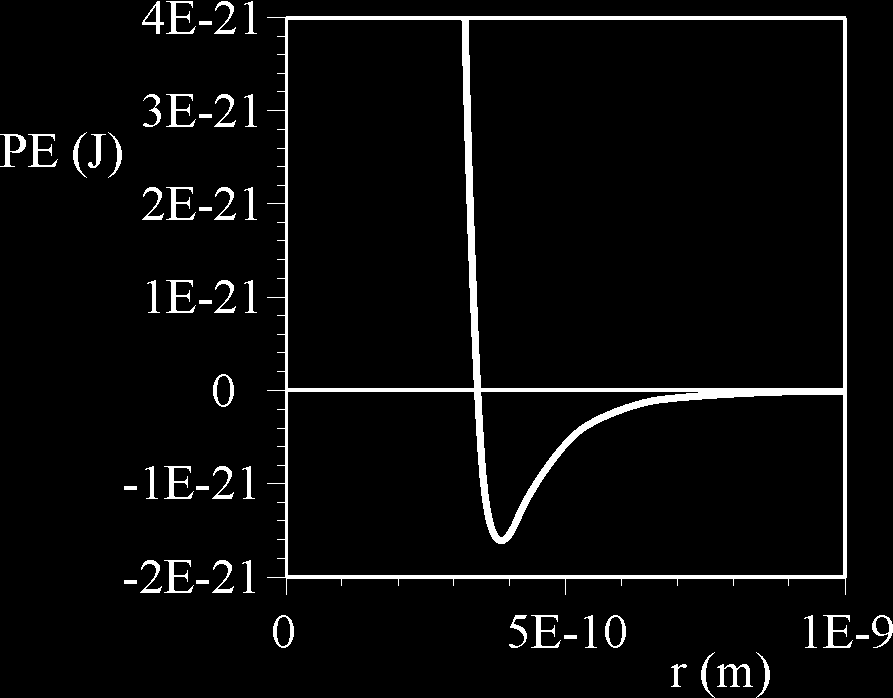
Step-by-Step Guidance
Identify the minimum value of the potential energy curve, which represents the bond energy per pair.
Calculate the total bond energy for six moles, using Avogadro's number and the minimum energy per pair.
Compare the calculated bond energy to the expected heat of vaporization, considering additional energy needed to overcome intermolecular forces.
Explain why the heat of vaporization may differ from the calculated bond energy.
Try solving on your own before revealing the answer!
Final Answer:
The bond energy for six moles is calculated using the minimum of the potential energy curve and Avogadro's number. The heat of vaporization is typically more than the bond energy because it includes energy to overcome all intermolecular forces, not just breaking bonds.
Q31. A container of gas has enough pressure to hold a 1200 kg elephant on a 2 m2 plank. If you use a barometer of liquid water and place it into the gas, how high will the water rise? Is this realistic?
Background
Topic: Fluid Statics and Pressure Measurement
This question tests your understanding of pressure, barometers, and the relationship between force, area, and fluid height.
Key Terms and Formulas:
Pressure:
Barometer: Measures atmospheric pressure using fluid height.
Hydrostatic pressure:
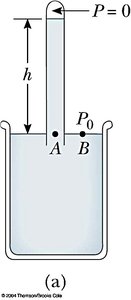
Step-by-Step Guidance
Calculate the pressure exerted by the elephant:
Set up the hydrostatic pressure equation for the barometer:
Rearrange to solve for :
Plug in the values for water density and gravity to find the height.
Try solving on your own before revealing the answer!
Final Answer:
The water will rise to a height calculated using the pressure and water density. The result may be unrealistic if the pressure is very high, leading to an impractically tall column of water.
