 Indietro
Physics with Calculus: Thermodynamics and Ideal Gas Law Study Guide
Guida di studio - Note intelligenti
 Appunti personalizzati basati sui tuoi materiali, ampliati con definizioni chiave, esempi e contesto.
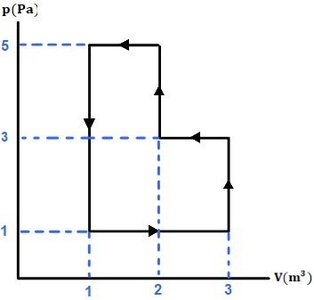
Q1. What is the coefficient of performance of cooling, , for the heat pump used as a refrigerator illustrated on the pV diagram below? The gas is diatomic.
Background
Topic: Thermodynamics – Heat Pumps and Refrigerators
This question tests your understanding of the coefficient of performance (COP) for refrigerators, which measures how efficiently a refrigerator moves heat from a cold reservoir to a hot reservoir.
Key Terms and Formulas:
(Coefficient of Performance for cooling):
= heat removed from the cold reservoir
= work input to the refrigerator
Step-by-Step Guidance
Identify the heat removed from the cold reservoir () and the work input () from the pV diagram and the thermodynamic cycle.
Recall that for a refrigerator, , where is the heat extracted from the cold side and is the net work done.
Analyze the cycle on the pV diagram to determine which segments correspond to heat extraction and work input.
Set up the expressions for and using the first law of thermodynamics and properties of diatomic gases.
Try solving on your own before revealing the answer!
Final Answer: 5
The coefficient of performance for cooling, , is 5. This means the refrigerator removes 5 units of heat from the cold reservoir for every unit of work input.
Q2. What is the pressure of 2 mol of ideal gas in a volume of 5 m3 and with a temperature of 800 K? Use J/mol·K.
Background
Topic: Ideal Gas Law
This question tests your ability to use the ideal gas law to calculate the pressure of a gas given the number of moles, volume, and temperature.
Key Terms and Formulas:
Ideal Gas Law:
= pressure (Pa)
= volume (m3)
= number of moles
= gas constant (J/mol·K)
= temperature (K)
Step-by-Step Guidance
Write down the known values: mol, m3, K, J/mol·K.
Plug these values into the ideal gas law: .
Rearrange the formula to solve for pressure: .
Set up the calculation for using the values above.
Try solving on your own before revealing the answer!
Final Answer: 3200 Pa
Pa. The pressure of the gas is 3200 Pa.
Q3. Suppose two identical blocks have the following initial thermal energies: J and J. The blocks are thermally connected so that they can exchange heat. Once the blocks reach thermal equilibrium (in an isolated chamber), what is the final energy of block A, , and the amount of heat exchanged, , respectively?
Background
Topic: Thermal Equilibrium and Heat Exchange
This question tests your understanding of energy conservation and heat transfer between two objects reaching thermal equilibrium.
Key Terms and Formulas:
Thermal equilibrium: Both blocks reach the same final energy.
Conservation of energy: Total energy before = total energy after.
Heat exchanged:
Step-by-Step Guidance
Calculate the total initial energy: .
Since the blocks are identical and isolated, the final energies will be equal: .
Set up the equation: .
Express the heat exchanged as the difference between initial and final energy for block A.
Try solving on your own before revealing the answer!
Final Answer: J, J
Each block ends up with 43 J of energy, and 11 J of heat is exchanged from block B to block A.
Q4. A bicycle tire is inflated to a gauge pressure of 11 atm at a temperature of 300 K. While a man rides the bicycle, the temperature lowers to 250 K. Assuming the volume does not change, find the gauge pressure of the air in the tire at this lower temperature. Use atmospheric pressure of atm.
Background
Topic: Ideal Gas Law – Pressure and Temperature Relationship
This question tests your understanding of how gas pressure changes with temperature at constant volume.
Key Terms and Formulas:
Ideal Gas Law:
At constant volume:
Gauge pressure:
Step-by-Step Guidance
Write down the initial and final temperatures: K, K.
Write down the initial gauge pressure: atm.
Calculate the initial total pressure: .
Set up the ratio and solve for .
Subtract atmospheric pressure to find the new gauge pressure.
Try solving on your own before revealing the answer!
Final Answer: 9 atm
The gauge pressure at 250 K is 9 atm. The pressure decreases as the temperature drops, assuming constant volume.
Q5. What is the change in internal (thermal) energy of mol of monatomic ideal gas when its temperature is decreased by 12 K? Use J/mol·K.
Background
Topic: Internal Energy of Ideal Gases
This question tests your understanding of how the internal energy of a monatomic ideal gas changes with temperature.
Key Terms and Formulas:
Internal energy change:
For monatomic ideal gas:
= number of moles
= gas constant
= change in temperature
Step-by-Step Guidance
Write down the values: mol, J/mol·K, K (since temperature decreases).
Calculate for a monatomic gas: .
Set up the formula: .
Plug in the values to set up the calculation.
Try solving on your own before revealing the answer!
Final Answer: -900 J
The internal energy decreases by 900 J. The negative sign indicates a loss of thermal energy.
Q6. What is a non-zero quantity?
Background
Topic: Thermodynamic Processes
This question tests your understanding of which quantities are non-zero for different thermodynamic processes (cycle, adiabatic, isochoric, isothermal).
Key Terms and Formulas:
Cycle: for a complete cycle
Adiabatic:
Isochoric:
Isothermal: ,
Step-by-Step Guidance
Review the definitions of each process and what quantities change.
Recall that heat () is non-zero for an isothermal process.
Compare each option to the properties of the processes listed.
Try solving on your own before revealing the answer!
Final Answer: Q for an isothermal process
Heat () is non-zero for an isothermal process, since energy is transferred as heat while temperature remains constant.
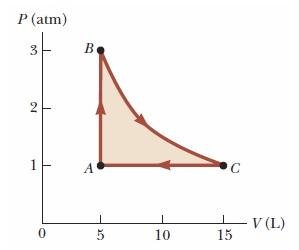
Q7. Which process on the pV diagram below has a heat of L-atm? The gas is monatomic.
Background
Topic: Thermodynamics – Heat Transfer in Cyclic Processes
This question tests your ability to interpret a pV diagram and identify which process corresponds to a specific heat transfer.
Key Terms and Formulas:
Heat (): Energy transferred to/from the system
Monatomic gas: Use and as needed
pV diagram: Visual representation of processes
Step-by-Step Guidance
Examine the pV diagram and identify the direction and type of each process (A to B, B to C, C to A).
Recall that heat transfer depends on the process (isothermal, isobaric, adiabatic, etc.).
Determine which process involves a heat transfer of 15 L-atm.
Set up the calculation for heat transfer for each process using the appropriate formula.
Try solving on your own before revealing the answer!
Final Answer: Process B to C
The process from B to C on the pV diagram corresponds to a heat transfer of 15 L-atm.
Q8. mol of monatomic ideal gas expands slowly and adiabatically at an initial pressure of 5 atm from 10 L to 20 L. What is the final pressure of the gas?
Background
Topic: Adiabatic Expansion of Ideal Gases
This question tests your understanding of adiabatic processes and how pressure changes when volume changes for a monatomic ideal gas.
Key Terms and Formulas:
Adiabatic process:
For monatomic gas:
= initial pressure and volume
= final pressure and volume
Step-by-Step Guidance
Write down the initial and final values: atm, L, L.
Recall the adiabatic relation: .
Rearrange to solve for : .
Set up the calculation for using .
Try solving on your own before revealing the answer!
Final Answer: 1.58 atm
The final pressure after adiabatic expansion is 1.58 atm. The pressure drops as the volume increases.
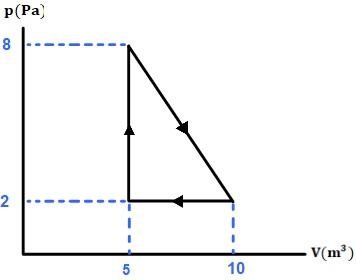
Q9. What is the heat for the diagonal line process illustrated on the pV diagram below? The gas is monatomic.
Background
Topic: Thermodynamics – Heat Transfer in pV Processes
This question tests your ability to calculate heat transfer for a process shown as a diagonal line on a pV diagram.
Key Terms and Formulas:
First Law of Thermodynamics:
Work (): Area under the curve in pV diagram
Monatomic gas:
Step-by-Step Guidance
Identify the initial and final states on the pV diagram.
Calculate the change in internal energy using .
Calculate the work done using the area under the process curve.
Set up the equation for heat: .
Try solving on your own before revealing the answer!
Final Answer: 15 J
The heat transferred during the diagonal process is 15 J.
Q10. Suppose an ideal gas increases its temperature by 36°F. What is this temperature change in Celsius?
Background
Topic: Temperature Conversion
This question tests your ability to convert a temperature change from Fahrenheit to Celsius.
Key Terms and Formulas:
Temperature change conversion:
= change in Fahrenheit
= change in Celsius
Step-by-Step Guidance
Write down the temperature change in Fahrenheit: °F.
Use the conversion formula: .
Set up the calculation for .
Try solving on your own before revealing the answer!
Final Answer: 20°C
A temperature change of 36°F corresponds to a change of 20°C.
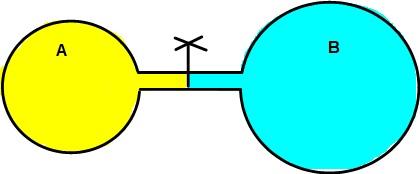
Q11. Two chambers of ideal gas A and B at the same temperature are separated by a pipe as illustrated in the image below. Chamber A has a volume m3 with mol of gas. Chamber B has a volume m3 with mol of ideal gas. What is a correct statement when the valve is opened?
Background
Topic: Gas Flow and Pressure Differences
This question tests your understanding of how gas flows between chambers based on pressure differences, given equal temperature.
Key Terms and Formulas:
Ideal Gas Law:
Gas flows from high pressure to low pressure
Step-by-Step Guidance
Calculate the pressure in each chamber using .
Compare the pressures to determine the direction of gas flow.
Recall that gas flows from higher to lower pressure.
Try solving on your own before revealing the answer!
Final Answer: Gas flows from A to B
Since chamber A has higher pressure, gas will flow from A to B when the valve is opened.
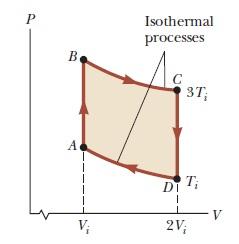
Q12. For the Stirling engine illustrated in the pV diagram below, what is the fuel heat per cycle, ? The gas is monatomic.
Background
Topic: Heat Engines – Stirling Cycle
This question tests your understanding of the Stirling engine and how to calculate the heat input per cycle.
Key Terms and Formulas:
Stirling cycle: Consists of isothermal and isochoric processes
Heat input (): Occurs during the isothermal expansion
For isothermal process:
Step-by-Step Guidance
Identify the isothermal expansion segment on the pV diagram.
Set up the formula for heat input during isothermal expansion.
Plug in the values for , , , and the volume ratio.
Try solving on your own before revealing the answer!
Final Answer:
The heat input per cycle for the Stirling engine is , where is the initial temperature.
Q13. A heat engine has a thermal efficiency of . If the waste heat per cycle is J, what is the work done by the engine per cycle, ?
Background
Topic: Heat Engines – Efficiency and Work
This question tests your understanding of the relationship between efficiency, heat input, waste heat, and work output in a heat engine.
Key Terms and Formulas:
Efficiency:
Waste heat:
First law:
Step-by-Step Guidance
Write down the efficiency formula: .
Express in terms of and .
Set up the equations and solve for .
Try solving on your own before revealing the answer!
Final Answer: 10 J
The work done by the engine per cycle is 10 J.
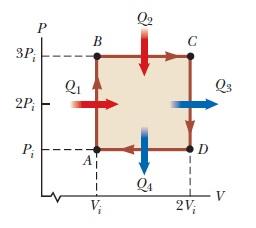
Q14. The closed loop process on the pV diagram illustrated below best represents what type of device?
Background
Topic: Thermodynamic Cycles and Devices
This question tests your ability to identify the type of device represented by a closed loop on a pV diagram.
Key Terms and Formulas:
Closed loop: Indicates a cyclic process
Heat engine: Converts heat to work
Carnot engine: Idealized heat engine
Heat pump: Moves heat from cold to hot reservoir
Step-by-Step Guidance
Examine the direction of the cycle on the pV diagram.
Recall the characteristics of heat engines, Carnot engines, and heat pumps.
Determine which device matches the process shown.
Try solving on your own before revealing the answer!
Final Answer: Heat engine
The closed loop process represents a heat engine, which converts heat into work in a cyclic process.
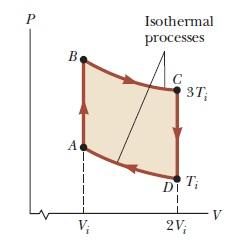
Q15. Suppose we replace the isochoric processes in the Stirling engine below with adiabatic processes so that we have a Carnot engine. What would be its Carnot efficiency?
Background
Topic: Carnot Engine Efficiency
This question tests your understanding of the Carnot efficiency formula and how it applies to idealized heat engines.
Key Terms and Formulas:
Carnot efficiency:
= temperature of hot reservoir
= temperature of cold reservoir
Step-by-Step Guidance
Identify the temperatures of the hot and cold reservoirs from the pV diagram.
Set up the Carnot efficiency formula: .
Plug in the values for and .
Try solving on your own before revealing the answer!
Final Answer: 1/2
The Carnot efficiency for this engine is 1/2, meaning it converts 50% of the heat input into work.
