 Indietro
Physics with Calculus: Units, Physical Quantities, and Vectors
Guida di studio - Note intelligenti
 Appunti personalizzati basati sui tuoi materiali, ampliati con definizioni chiave, esempi e contesto.
Units, Physical Quantities, and Vectors
Significant Figures
Significant figures are the digits in a measurement or calculation that are meaningful and contribute to its precision. Understanding how to count and use significant figures is essential for reporting scientific results accurately.
Definition: All non-zero digits are significant; leading zeros are not.
Scientific Notation: All digits in the coefficient are significant. For example, in , there are 2 significant figures.
Multiplication/Division: The result should have no more significant figures than the term with the fewest significant figures.
Addition/Subtraction: The result is limited by the term with the largest uncertainty (fewest digits to the right of the decimal point).
Examples:
41.2 → 3 significant figures
0.0032 → 2 significant figures
3.20 → 3 significant figures
13.8 m × 2.05 m × 0.062 m = 1.8 m3 (rounded)
13.8 m + 2.05 m - 0.062 m = 15.8 m (rounded)
Order of Magnitude Calculations and Estimates
Order of magnitude calculations are rough estimates used to quickly approximate values using powers of ten. They are useful for checking the plausibility of answers and for making quick decisions in physics.
Example: Estimating the time to eat a chain of French fries from Earth to Moon, one fry per second.
Steps:
Average length of a French fry: 0.08 m
Earth to Moon distance: miles × m/mile ≈ m
Number of fries needed: m / 0.08 m ≈ fries
Seconds in a year: s
Years to eat: fries / s/year ≈ 200 years
Application: Useful for quick checks and scientific reasoning.
Vectors and Vector Operations
Definition and Properties of Vectors
A vector is a mathematical object with both magnitude and direction. Vectors are used to represent physical quantities such as displacement, velocity, and acceleration.
Notation: Boldface (A) or arrow notation ().
Magnitude: denotes the length of the vector.
Units: Vectors include units (e.g., m, m/s).
Equality: Two vectors are equal if their magnitudes, directions, and units match.
Scalars vs. Vectors
Scalars have only magnitude (can be positive or negative) and are represented by regular letters. The product of a vector and a scalar is a vector in the same direction but with modified magnitude.
Examples: Mass (kg), temperature (K) are scalars; displacement, velocity are vectors.
Vector Addition and Subtraction
Vectors can be added or subtracted using geometric or algebraic methods. The sum or difference of two vectors is another vector.
Tail-to-Tip Method: Place the tail of one vector at the tip of another to find the resultant.
Subtraction:
Resultant: The vector sum or difference has a new direction and magnitude.
Coordinate Systems
Vectors can be represented in different coordinate systems depending on the problem's dimensionality.
1D: Linear coordinates (x)
2D: Cartesian (x, y), Polar (r, )
3D: Cartesian (x, y, z), Cylindrical (r, , z), Spherical (r, , )
Unit Vectors
Unit vectors have a magnitude of 1 and no units. They define direction and are often denoted with a hat (e.g., , , for x, y, z axes).
Component Representation:
Application: Useful for breaking vectors into components.
Vector Addition Using Components
Vectors can be added algebraically by summing their components.
2D:
3D:
Magnitude:
Converting Between Coordinate Systems
Vectors can be converted between Cartesian and polar coordinates using trigonometric relationships.
,
Products of Vectors
Scalar (Dot) Product
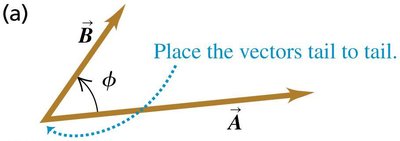
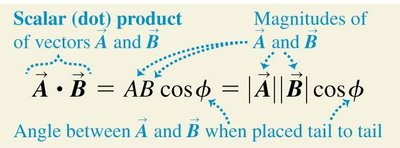
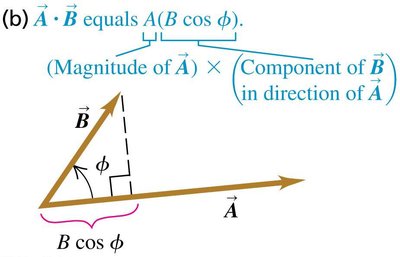
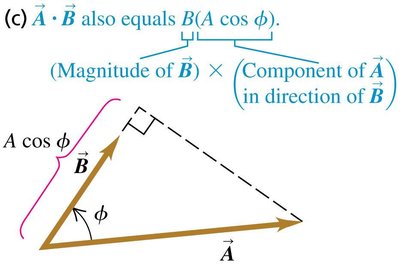
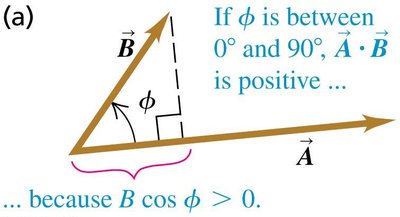
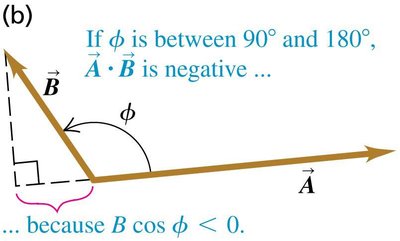
The scalar product (dot product) of two vectors results in a scalar and is defined as:
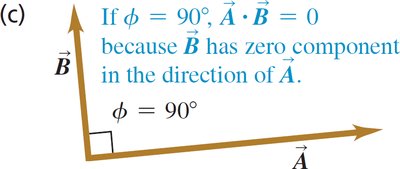
Where is the angle between and when placed tail to tail.
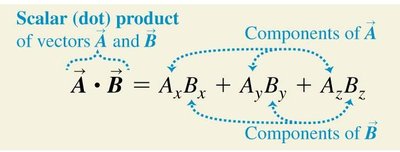
In component form:
Properties: Commutative ()
Sign: Positive if is between 0° and 90°, negative if between 90° and 180°, zero if .
Vector (Cross) Product
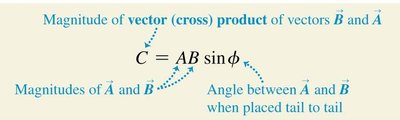
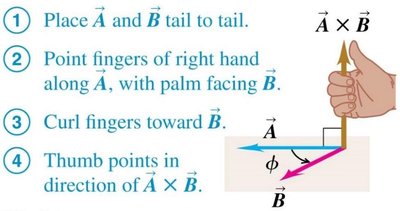
The vector product (cross product) of two vectors results in a vector perpendicular to both original vectors. The magnitude is given by:
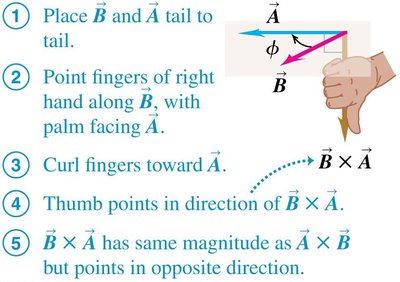
Direction is determined by the right-hand rule.
Properties: Anticommutative ()
Practice with Unit Vectors
Unit vectors are used to simplify vector calculations. Their dot and cross products follow specific rules:
, ,
, ,
, ,
, ,
Cross products are anticommutative:
Summary Table:
Operation | Result |
|---|---|
1 | |
0 | |
0 |
Additional info: These rules are foundational for vector algebra and are used extensively in physics calculations involving forces, motion, and fields.
