 Indietro
Physics with Calculus: Units, Physical Quantities, and Vectors – Step-by-Step Study Guidance
Guida di studio - Note intelligenti
 Appunti personalizzati basati sui tuoi materiali, ampliati con definizioni chiave, esempi e contesto.
Q1. In classical mechanics, there are three base dimensions. Length is one of them. What are the other two?
Background
Topic: Physical Quantities and Dimensions
This question tests your understanding of the fundamental dimensions used in classical mechanics, which are the building blocks for expressing all physical quantities.
Key Terms:
Dimension: A physical property that can be measured (e.g., length, mass, time).
SI Base Units: The standard units for the fundamental dimensions (meter, kilogram, second).
Step-by-Step Guidance
Recall that in the SI (International System) or MKS (meter-kilogram-second) system, all physical quantities in mechanics can be expressed using three base dimensions.
Length is one of these base dimensions, typically measured in meters (m).
Think about what other fundamental properties are needed to describe mechanical systems (e.g., what is needed to describe motion, inertia, etc.).
Consider the units for mass and time, and how they are used in equations like Newton's second law ().
Try solving on your own before revealing the answer!
Final Answer:
The other two base dimensions in classical mechanics are mass and time.
All mechanical quantities can be expressed in terms of length (L), mass (M), and time (T).
Q2. Find the dimensions of volume in terms of length (L), mass (M), and time (T).
Background
Topic: Dimensional Analysis
This question is about expressing derived quantities (like volume) in terms of the fundamental dimensions.
Key Terms and Formula:
Volume: The amount of space an object occupies.
For a cube, , where is the length of a side.
Step-by-Step Guidance
Recall the formula for the volume of a cube: .
Identify the dimension of (side length), which is length (L).
Express the dimension of volume as the cube of the dimension of length.
Write the dimensional formula for volume using only L, M, and T.
Try solving on your own before revealing the answer!
Final Answer:
The dimension of volume is (length cubed). It does not depend on mass or time.
Q3. Find the dimensions of speed in terms of length (L), mass (M), and time (T).
Background
Topic: Dimensional Analysis
This question tests your ability to express speed as a combination of the base dimensions.
Key Terms and Formula:
Speed: The rate at which an object covers distance.
Formula: , where is distance (length) and is time.
Step-by-Step Guidance
Recall the formula for speed: .
Identify the dimension of distance () as length (L).
Identify the dimension of time () as time (T).
Express the dimension of speed as a ratio of length to time.
Try solving on your own before revealing the answer!
Final Answer:
The dimension of speed is (length per unit time).
Q4. Find the dimensions of acceleration in terms of length (L), mass (M), and time (T).
Background
Topic: Dimensional Analysis
This question asks you to express acceleration using the base dimensions.
Key Terms and Formula:
Acceleration: The rate of change of velocity with respect to time.
Formula: , where is velocity and is time.
Step-by-Step Guidance
Recall the formula for acceleration: .
Recall from the previous question that velocity (or speed) has the dimension .
Express the dimension of acceleration as the ratio of velocity to time.
Write the dimensional formula for acceleration using only L, M, and T.
Try solving on your own before revealing the answer!
Final Answer:
The dimension of acceleration is (length per time squared).
Q5. What is the approximate height of the average adult in centimeters?
Background
Topic: SI Units and Estimation
This question tests your ability to estimate and convert between units of length, specifically from feet/inches to centimeters.
Key Terms and Conversion:
Centimeter (cm): 1 cm = 0.01 m
Conversion: 1 inch = 2.54 cm; 1 foot = 30.48 cm
Step-by-Step Guidance
Recall the average adult height in feet and inches (about 5 ft 6 in to 6 ft 4 in).
Convert feet and inches to centimeters using the conversion factors above.
Add the converted values to get the total height in centimeters.
Try solving on your own before revealing the answer!
Final Answer:
The average adult height is approximately 170 cm (ranges from about 150 cm to 190 cm depending on the population).
Q6. Approximately what is the mass of the average adult in kilograms?
Background
Topic: SI Units and Estimation
This question tests your ability to estimate and convert between units of mass, specifically from pounds to kilograms.
Key Terms and Conversion:
Kilogram (kg): The SI unit of mass.
Conversion: 1 pound ≈ 0.454 kg
Step-by-Step Guidance
Recall the average adult mass in pounds (typically 120–200 lbs).
Use the conversion factor to convert pounds to kilograms.
Multiply the number of pounds by 0.454 to get the mass in kilograms.
Try solving on your own before revealing the answer!
Final Answer:
The average adult mass is approximately 70 kg (ranges from about 55 kg to 90 kg depending on the population).
Q7. For three forces acting on an object, how many total (nonzero) components of the forces are there if two forces are at angles and one is along an axis?
Background
Topic: Vector Components
This question tests your understanding of how to break forces into components along coordinate axes.
Key Terms:
Vector Components: The projections of a vector along the coordinate axes.
Nonzero Component: A component that is not zero, i.e., the force has a part along that axis.
Step-by-Step Guidance
Identify which forces are aligned with the axes and which are at angles.
For each force at an angle, break it into x and y components using trigonometry.
Count the total number of nonzero components for all three forces.
Try solving on your own before revealing the answer!

Final Answer:
There are four nonzero components: each angled force has two components, and the force along the axis has one (the other is zero).
Q8. After rotating the axes so that one force lines up with the new x' axis, how many total (nonzero) components are there for the three forces?
Background
Topic: Rotated Coordinate Systems
This question tests your understanding of how rotating axes can simplify the component analysis of vectors.
Key Terms:
Rotated Axes: A new set of axes chosen to align with a particular vector or surface.
Component: The part of a vector along a given axis.
Step-by-Step Guidance
Visualize the new axes and how the forces are oriented relative to them.
Determine which forces now align with the new axes and which need to be broken into components.
Count the total number of nonzero components for all three forces in the new system.
Try solving on your own before revealing the answer!

Final Answer:
There are three nonzero components: each force now has only one nonzero component along the new axes.
Q9. For a block sliding down a ramp inclined at angle θ, what is the net force along the x' axis (down the ramp) in the inclined coordinate system?
Background
Topic: Forces on an Inclined Plane
This question tests your ability to resolve forces into components along axes that are not horizontal or vertical.
Key Terms and Formula:
Inclined Plane: A flat surface tilted at an angle θ to the horizontal.
Forces: Gravity (), normal force (), friction ().
Component of Gravity Down the Ramp:
Step-by-Step Guidance
Draw a free-body diagram showing all forces acting on the block.
Resolve the gravitational force into components parallel and perpendicular to the ramp.
Write the expression for the net force along the x' axis (down the ramp), considering friction if present.
Be careful with the signs (positive down the ramp, negative up the ramp).
Try solving on your own before revealing the answer!
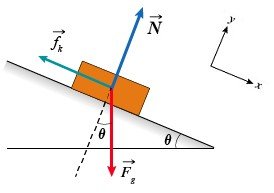
Final Answer:
The net force along the x' axis is (where is the kinetic friction force).
Q10. For the same block on the ramp, what is the net force along the y' axis (perpendicular to the ramp) in the inclined coordinate system?
Background
Topic: Forces on an Inclined Plane
This question tests your ability to resolve forces perpendicular to the surface of the ramp.
Key Terms and Formula:
Normal Force (): The force perpendicular to the surface.
Component of Gravity Perpendicular to Ramp:
Step-by-Step Guidance
Draw the free-body diagram and identify the forces perpendicular to the ramp.
Resolve the gravitational force into its perpendicular component.
Write the expression for the net force along the y' axis, considering the normal force and the perpendicular component of gravity.
Set up the equation for equilibrium if the block is not accelerating perpendicular to the ramp.
Try solving on your own before revealing the answer!
Final Answer:
The net force along the y' axis is (should be zero if the block is not leaving the surface).
