 Indietro
Planes, Cylinders, and Quadric Surfaces in Physics with Calculus
Guida di studio - Note intelligenti
 Appunti personalizzati basati sui tuoi materiali, ampliati con definizioni chiave, esempi e contesto.
Parallel and Intersecting Planes
Finding the Line of Intersection for Two Planes
When two nonparallel planes intersect in three-dimensional space, their intersection forms a straight line. To find the equation of this line, solve the system of equations representing the two planes.
Parametric Equations: Express the coordinates (x, y, z) in terms of a parameter t.
Symmetric Equations: Eliminate the parameter to relate x, y, and z directly.
Example: For the planes x + y + z = 0 and 2x - y + z = 0, solve simultaneously to find the intersection line.
Finding the Angle Between Two Planes
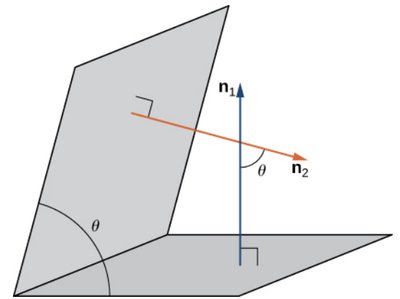
The angle between two planes is defined as the angle between their normal vectors. If n1 and n2 are the normal vectors, the angle θ is given by:
Formula:
Interpretation: If θ = 0°, the planes are parallel; if θ = 90°, they are orthogonal.
Classifying Pairs of Planes
To determine if two planes are parallel, orthogonal, or neither, compare their normal vectors:
Parallel: Normal vectors are scalar multiples.
Orthogonal: Normal vectors are perpendicular (dot product is zero).
Neither: Otherwise.
Example:
x + 2y - z = 8 and 2x + 4y - 2z = 10 are parallel.
2x - 3y + 2z = 3 and 6x + 2y - 3z = 1 are orthogonal.
x + y + z = 4 and x - 3y + 5z = 1 are neither.
Finding the Distance Between Parallel Planes
The distance between two parallel planes can be found using the formula for the distance from a point to a plane. For planes of the form ax + by + cz + d = 0, the distance is:
Formula:
Example: For 2x + y - z = 2 and 2x + y - z = 8, the distance is .
Theorem: Distance from a Point to a Plane
Given a point P(x0, y0, z0) and a plane ax + by + cz + k = 0, the distance from the point to the plane is:

Quadric Surfaces
Identifying Cylinders
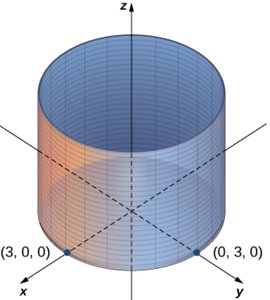
A cylindrical surface (or cylinder) is formed by a set of lines (called rulings) parallel to a given line and passing through a given curve. The equation of a cylinder typically involves only two variables, with the third variable free.

Example: The equation describes a cylinder along the y-axis.
Types of Quadric Surfaces
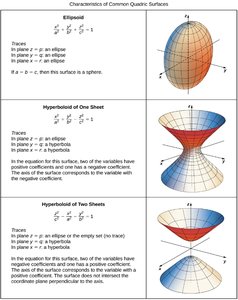
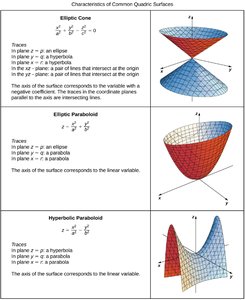
Quadric surfaces are the graphs of second-degree equations in three variables. Common types include ellipsoids, hyperboloids, paraboloids, and cones. Each has a characteristic equation and geometric shape.
Ellipsoid:
Hyperboloid of One Sheet:
Hyperboloid of Two Sheets:
Elliptic Cone:
Elliptic Paraboloid:
Hyperbolic Paraboloid:
Examples of Quadric Surfaces
16x2 + 9y2 + 16z2 = 144: This is an ellipsoid.
9x2 - 18x + 4y2 + 16y - 36z + 25 = 0: Completing the square reveals this is an elliptic paraboloid.
9x2 + y2 - z2 + 2z - 10 = 0: This is a hyperboloid of one sheet.
Additional info: Quadric surfaces are important in physics for describing equipotential surfaces, wavefronts, and more. Understanding their equations and shapes is essential for visualizing solutions to physical problems in three dimensions.
