Indietro
Principle of Relativity and Interactions: Study Notes for Physics with Calculus
Guida di studio - Note intelligenti
 Appunti personalizzati basati sui tuoi materiali, ampliati con definizioni chiave, esempi e contesto.
Chapter 6: Principle of Relativity
Relativity of Motion
The principle of relativity states that the laws of physics are the same in all inertial reference frames. This means that observers moving at constant velocity relative to each other will measure the same physical quantities, such as mass and momentum, for an object.
Inertia: The property of an object to resist changes in its state of motion.
Momentum: Defined as , where is mass and is velocity.
Zero-momentum reference frame: A frame in which the total momentum of a system is zero.
Center of Mass
The center of mass of a system is the weighted average position of all the masses in the system. It is useful for analyzing motion and interactions.
Position of center of mass:
Velocity of center of mass:
Chapter 7: Interactions
The Effects of Interactions
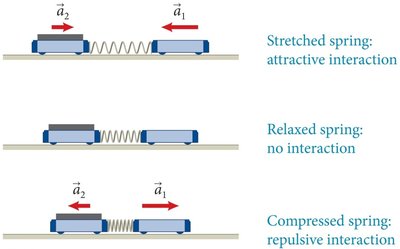
Interactions are mutual influences between two objects that produce changes in motion or physical state. These can be attractive or repulsive, depending on the nature of the interaction.
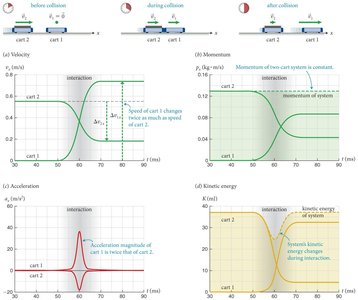
Momentum Conservation: The momentum of an isolated system remains constant before, during, and after an interaction.
Relative Speeds: In elastic collisions, the relative speeds before and after the interaction are the same.
Acceleration Ratio: The ratio of the x-component of the accelerations of two interacting objects is the negative inverse of the ratio of their inertias:
Energy Changes During Interactions
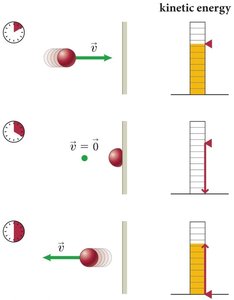
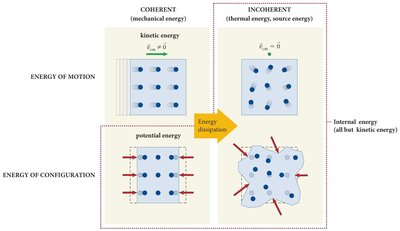
During interactions, kinetic energy may be temporarily converted to internal energy, such as potential energy or thermal energy. In elastic collisions, all converted energy reappears as kinetic energy; in inelastic collisions, some energy is dissipated.
Kinetic Energy:
Potential Energy: Energy stored due to reversible changes in configuration.
Internal Energy: Includes potential energy and thermal energy.
Potential Energy
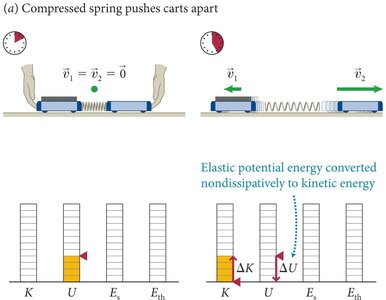
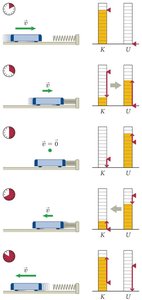
Potential energy is the part of internal energy that can be converted back to kinetic energy after an interaction. It is associated with reversible changes in the configuration of a system.
Elastic Potential Energy: Stored in deformed springs or objects.
Gravitational Potential Energy: near Earth's surface.
Energy Dissipation
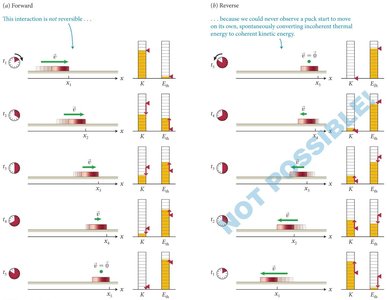
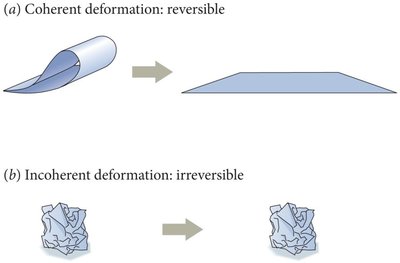
Energy dissipation occurs when part of the converted kinetic energy does not reappear after an inelastic collision. Dissipated energy is often converted to thermal energy, which is associated with irreversible changes.
Coherent Deformation: Reversible, such as gently bending paper.
Incoherent Deformation: Irreversible, such as crumpling paper.
Classification of Energy
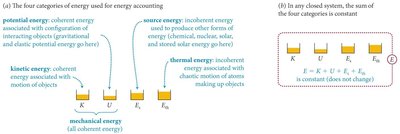
Energy in a system can be classified as mechanical (coherent) or incoherent. Mechanical energy includes kinetic and potential energy, while incoherent energy includes thermal and source energy.
Mechanical Energy:
Thermal Energy: Associated with random motion of atoms.
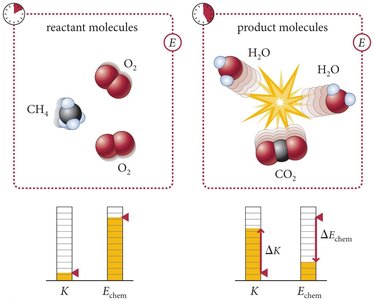
Source Energy: Energy from fuels, radiation, etc.
Energy Conversion Processes
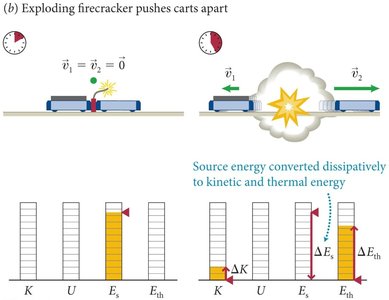
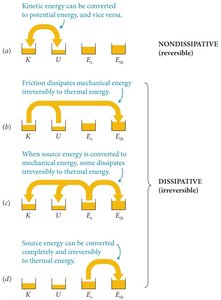
Energy can be converted between different forms. Nondissipative conversions are reversible, while dissipative conversions are irreversible and involve thermal energy.
Energy Conservation: (closed system)
Nondissipative:
Dissipative:
Interaction Range
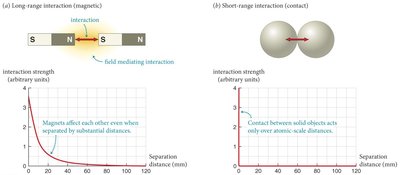
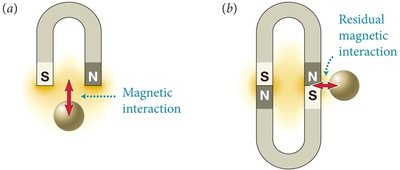
The strength of an interaction depends on the distance between objects. Long-range interactions, such as magnetic or electric, can act over large distances, while short-range interactions require contact.
Field Model: Interactions are mediated by fields, such as electric or magnetic fields.
Gauge Particle Model: Interactions are explained by exchange of fundamental particles.
Fundamental Interactions
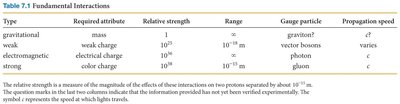
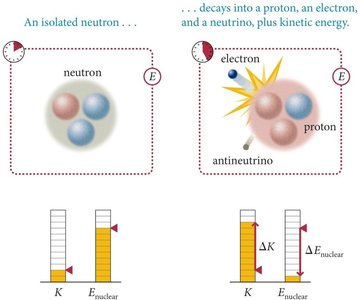
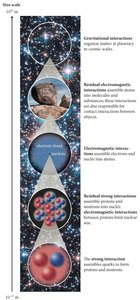
There are four fundamental interactions in the universe: gravitational, electromagnetic, weak nuclear, and strong nuclear. Each is characterized by its range, strength, and mediating gauge particle.
Gravitational: Acts on mass, mediated by graviton (undetected), long-range.
Electromagnetic: Acts on electric charge, mediated by photon, long-range.
Weak Nuclear: Acts on weak charge, mediated by vector bosons, short-range.
Strong Nuclear: Acts on color charge, mediated by gluons, very short-range.
Type | Required Attribute | Relative Strength | Range | Gauge Particle | Propagation Speed |
|---|---|---|---|---|---|
Gravitational | Mass | 1 | ∞ | Graviton? | c |
Weak | Weak charge | 10−7 | 10−17 m | Vector bosons | Varies |
Electromagnetic | Electric charge | 1036 | ∞ | Photon | c |
Strong | Color charge | 1038 | 10−15 m | Gluon | c |
Interactions and Accelerations
Momentum conservation in an isolated two-object system leads to a relationship between the accelerations and inertias of the objects:
Acceleration Relationship:
Ratio:
Nondissipative Interactions
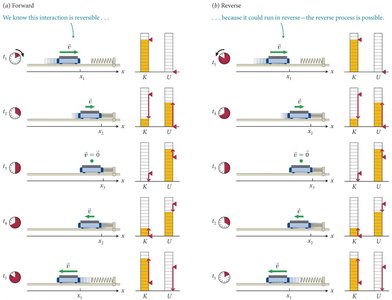
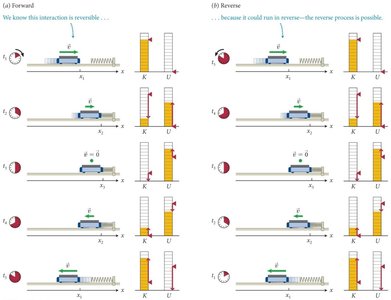
Nondissipative interactions are reversible and conserve mechanical energy. The change in kinetic energy is equal and opposite to the change in potential energy.
Energy Conservation:
Potential Energy Function:
System Tendency: Systems accelerate in the direction that lowers potential energy.
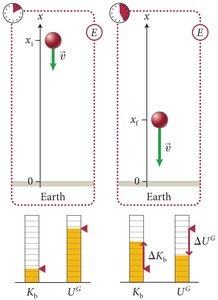
Potential Energy Near Earth's Surface
For objects near Earth's surface, gravitational potential energy is given by . Energy conservation relates changes in kinetic and potential energy during free fall.
Acceleration:
Energy Conservation:
Change in Potential Energy:
Dissipative Interactions
Dissipative interactions are irreversible and involve conversion of mechanical energy to thermal energy. In these interactions, incoherent thermal energy cannot spontaneously convert back to coherent kinetic energy.
Energy Conservation:
Elastic Collisions:
Irreversible Explosive Separation: