Indietro
Principle of Relativity and Interactions: Study Notes for Physics with Calculus
Guida di studio - Note intelligenti
 Appunti personalizzati basati sui tuoi materiali, ampliati con definizioni chiave, esempi e contesto.
Chapter 6: Principle of Relativity
Relativity of Motion
The principle of relativity states that the laws of physics are the same in all inertial reference frames. This means that observers moving at constant velocity relative to each other will measure the same physical properties, such as mass and momentum, for an object.
Inertia: The mass of an object is measured to be the same by all inertial observers.
Momentum: The momentum of an object depends on its velocity relative to the observer.
Zero-momentum reference frame: A frame in which the total momentum of a system is zero.
Equation for momentum in different frames:
If , then B is the zero-momentum reference frame.
Center of Mass
The center of mass of a system is the weighted average position of all the masses in the system. It is useful for analyzing motion and interactions.
Position of center of mass:
Velocity of center of mass:
The velocity of the zero-momentum frame is the velocity of the center of mass measured in the Earth frame.
Chapter 7: Interactions
The Effects of Interactions
Interactions are mutual influences between two objects that produce changes in motion or physical state. Examples include collisions, spring forces, and gravitational attraction.
Momentum Conservation: The momentum of an isolated system remains constant before, during, and after an interaction.
Relative Speeds: In elastic collisions, the relative speeds before and after the interaction are the same.
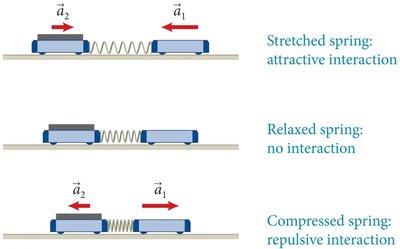
Acceleration Ratio: The ratio of the x-component of the accelerations of two interacting objects is the negative inverse of their inertias.
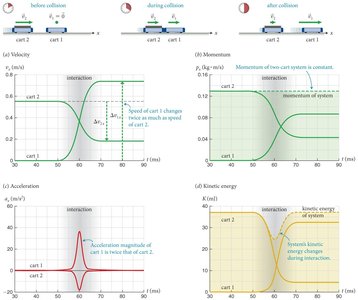
Energy Changes During Interactions
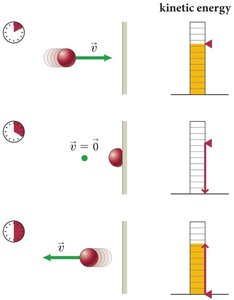
Kinetic energy may change during an interaction, even if momentum is conserved. In elastic collisions, kinetic energy is temporarily converted to internal energy and then restored.
Elastic Collisions: Kinetic energy is conserved overall, but not necessarily during the interaction.
Internal Energy: Temporary conversion of kinetic energy to internal energy (e.g., deformation).
Potential Energy
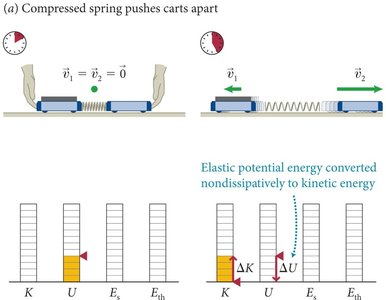
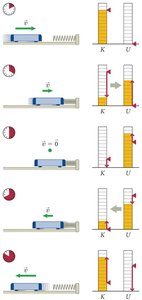
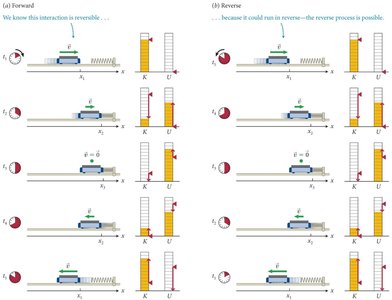
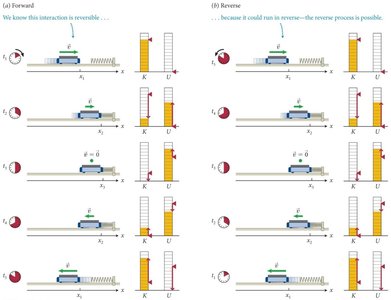
Potential energy is the internal energy stored in reversible changes in the configuration of a system. It can be converted back to kinetic energy.
Elastic Potential Energy: Stored in deformed springs or objects.
Gravitational Potential Energy: Stored in the spatial arrangement of masses.
General Form: , where is position.
Energy Dissipation
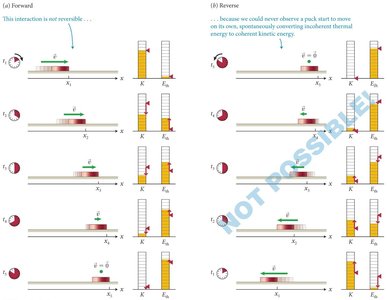
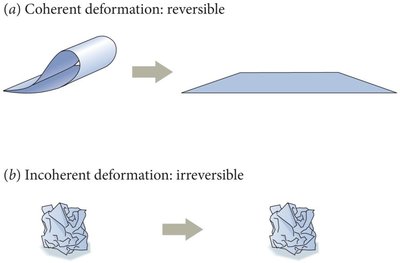
Energy dissipation occurs when part of the converted kinetic energy does not reappear after an inelastic collision. Dissipated energy is associated with irreversible changes, such as crumpling paper or friction.
Coherent Deformation: Reversible, returns to original shape.
Incoherent Deformation: Irreversible, does not return to original shape.
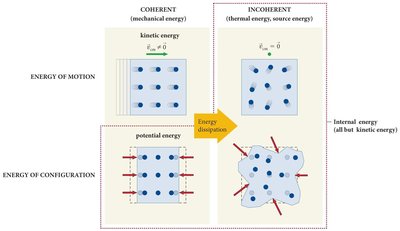
Classification of Energy
Energy in a system can be classified as mechanical (coherent) or incoherent (internal, including thermal and source energy).
Mechanical Energy: Sum of kinetic and potential energy.
Thermal Energy: Associated with incoherent motion of atoms.
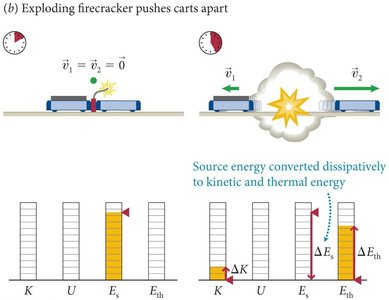
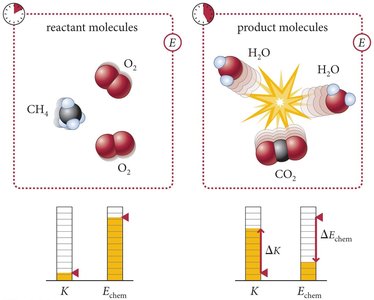
Source Energy: Energy from fuels, nuclear, solar, etc.
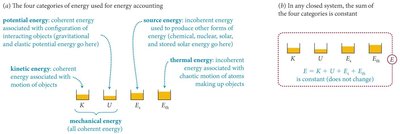
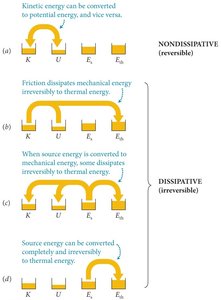
Energy Conversion Processes
Energy can be converted between different forms, such as kinetic, potential, source, and thermal energy. Some conversions are reversible (nondissipative), while others are irreversible (dissipative).
Nondissipative: Kinetic and potential energy can be interconverted.
Dissipative: Mechanical or source energy is converted irreversibly to thermal energy.
Interaction Range
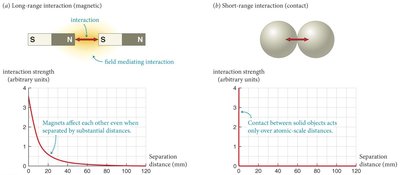
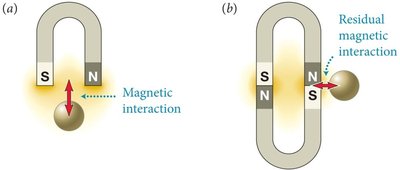
The strength of an interaction depends on the distance between objects. Interactions can be long-range (e.g., magnetic, electric) or short-range (e.g., contact forces).
Long-range: Magnets interact over large distances via fields.
Short-range: Contact forces act only when objects are touching.
Models of Interactions
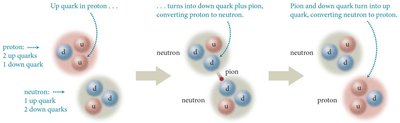
Interactions can be modeled as fields (e.g., electric, magnetic) or as exchanges of fundamental particles (gauge particles).
Field Model: Interactions are mediated by fields.
Particle Exchange Model: Interactions are mediated by gauge particles.
Fundamental Interactions
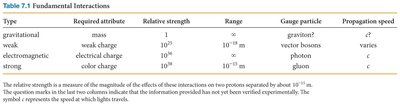
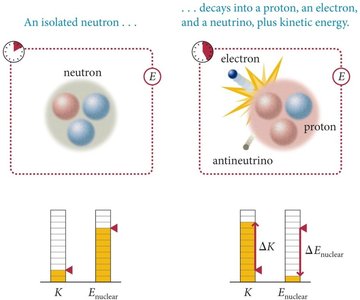
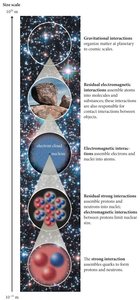
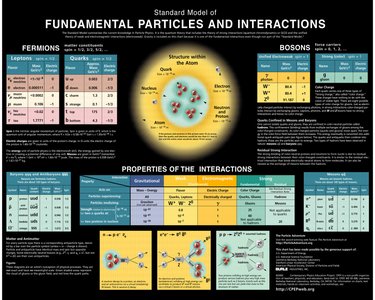
There are four fundamental interactions in nature: gravitational, electromagnetic, weak nuclear, and strong nuclear. Each is characterized by its range, strength, and mediating particle.
Gravitational: Acts on mass, mediated by graviton (undetected), long-range.
Electromagnetic: Acts on electric charge, mediated by photon, long-range.
Weak Nuclear: Acts on weak charge, mediated by vector bosons, short-range.
Strong Nuclear: Acts on color charge, mediated by gluons, very short-range.
Type | Required Attribute | Relative Strength | Range | Gauge Particle | Propagation Speed |
|---|---|---|---|---|---|
Gravitational | Mass | 1 | ∞ | Graviton* | c |
Weak | Weak charge | 10−7 | 10−17 m | Vector bosons | Varies |
Electromagnetic | Electric charge | 1036 | ∞ | Photon | c |
Strong | Color charge | 1038 | 10−15 m | Gluon | c |
Interactions and Accelerations
Momentum conservation in an isolated two-object system leads to a relationship between the accelerations and inertias of the objects:
Acceleration Relationship:
Ratio:
Energy Conservation in Interactions
For any closed system, the sum of all energy changes is zero:
Nondissipative: ,
Mechanical Energy Conservation:
Potential Energy Near Earth's Surface
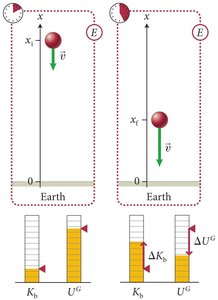
Near Earth's surface, gravitational potential energy is given by:
Energy Conservation:
Change in Potential Energy:
Dissipative Interactions
Dissipative interactions are irreversible and involve conversion of kinetic energy to thermal energy, such as friction.
Energy Conservation:
Elastic Collisions: ,
Irreversible Explosive Separation: