 Indietro
Projectile Motion and Relative Velocity: Physics with Calculus Study Notes
Guida di studio - Note intelligenti
 Appunti personalizzati basati sui tuoi materiali, ampliati con definizioni chiave, esempi e contesto.
Projectile Motion
Definition and Examples
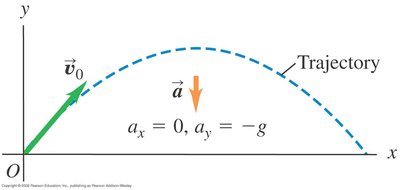
Projectile motion describes the motion of an object that is launched into the air and moves under the influence of gravity (and possibly air resistance). The path followed by such an object is called its trajectory. Common examples include a baseball, football, or a fired cannonball.
Projectile: Any object given an initial velocity and allowed to move under gravity alone.
Trajectory: The path followed by a projectile.
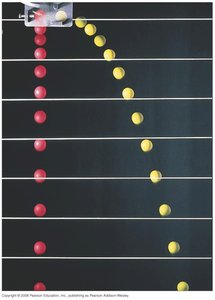
Gravity acts downward, affecting only the vertical component of motion.

Characteristics of Projectile Motion
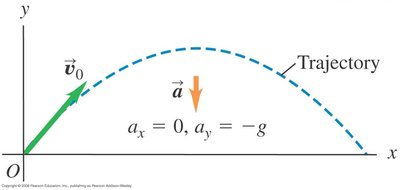
Projectile motion is typically a two-dimensional problem, where the horizontal (x) and vertical (y) motions are analyzed separately. The acceleration in the x-direction is zero, while in the y-direction it is constant and equal to –g (acceleration due to gravity).
X-direction: (no horizontal acceleration)
Y-direction: (constant downward acceleration)
The equations of motion for constant acceleration can be applied separately to each direction.
Equations of Motion for Projectiles
For a projectile launched from the origin (, ) with initial speed at angle :
Horizontal velocity:
Vertical velocity:
Horizontal position:
Vertical position:
The total displacement from the origin at any time is:
The speed at any time is:
The angle of the velocity vector with respect to the horizontal is:
Shape of the Trajectory
The trajectory of a projectile is a parabola. This can be shown by eliminating time from the position equations:
Solving for from the equation and substituting into gives:
This is the equation of a parabola.
Maximum Height of a Projectile
The maximum height is reached when the vertical velocity becomes zero ():
Time to reach maximum height:
Maximum height:
Range of a Projectile
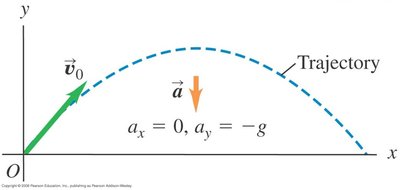
The range is the horizontal distance traveled when the projectile returns to its original vertical position ():
Time of flight:
Range:
The range is maximized when .
Relative Velocity
Frames of Reference
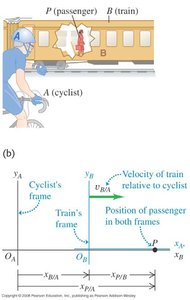
Relative velocity describes how the velocity of an object appears different depending on the observer's frame of reference. For example, a person walking inside a moving train has a velocity relative to the train and a different velocity relative to the ground.
Notation: means "position of P with respect to A".
The velocity of P relative to A:
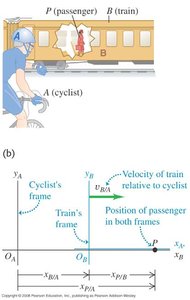
Relative Velocity in One and Two Dimensions
The general formula for relative velocity is:
This formula applies to both one-dimensional and two-dimensional motion. It is essential for analyzing situations where multiple frames of reference are involved, such as moving vehicles or flowing fluids.
Solved Example: Baseball Projectile
Given:
Initial speed: m/s
Initial angle:
Acceleration due to gravity: m/s
A) Position at s
B) Maximum Height
C) Range
D) Equation of the Trajectory
(a parabola)
Additional info: These equations are foundational for analyzing projectile motion in physics with calculus, and are widely applicable in engineering, sports, and natural sciences.
