 Indietro
Projectile Motion and Uniform Circular Motion: Study Notes for Physics with Calculus
Guida di studio - Note intelligenti
 Appunti personalizzati basati sui tuoi materiali, ampliati con definizioni chiave, esempi e contesto.
Projectile Motion
Introduction to Projectile Motion
Projectile motion describes the two-dimensional motion of an object under the influence of gravity, assuming air resistance is negligible. The motion can be analyzed by separating it into horizontal and vertical components, each governed by different equations of motion.
Horizontal motion: Constant velocity, as there is no horizontal acceleration (if air resistance is neglected).
Vertical motion: Constant acceleration due to gravity, typically taken as downward.
Key Equations:
Initial velocity components: ,
Solving Projectile Motion Problems
Draw and label a diagram: Indicate the initial position, velocity, and angle of projection.
List known and unknown variables: Identify initial velocity, angle, height, and what is to be found (e.g., range, time of flight).
Resolve initial velocity: Use trigonometric functions to find and .
Find time to maximum height: Set and solve for .
Calculate maximum height: Use at .
Determine total time in air: Set (or ground level) and solve for .
Find horizontal range:
Velocity upon impact: Find and at impact, then combine for total velocity and speed.
Example: An arrow is launched from a platform above the ground with initial velocity at angle . Find the time of flight, maximum height, range, and velocity upon impact using the above steps.
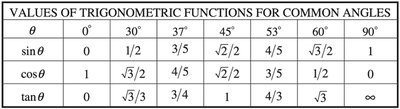
Trigonometric Values: For common angles, use the following table for quick reference in calculations.
\( \theta \) | 0° | 30° | 37° | 45° | 53° | 60° | 90° |
|---|---|---|---|---|---|---|---|
\( \sin \theta \) | 0 | 1/2 | 3/5 | \( \sqrt{2}/2 \) | 4/5 | \( \sqrt{3}/2 \) | 1 |
\( \cos \theta \) | 1 | \( \sqrt{3}/2 \) | 4/5 | \( \sqrt{2}/2 \) | 3/5 | 1/2 | 0 |
\( \tan \theta \) | 0 | \( \sqrt{3}/3 \) | 3/4 | 1 | 4/3 | \( \sqrt{3} \) | ∞ |
Uniform Circular Motion (UCM)
Definition and Characteristics
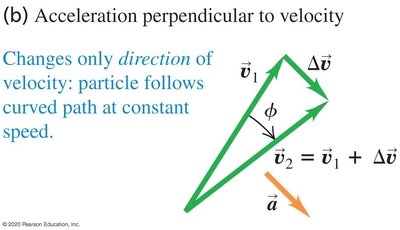
Uniform circular motion refers to the motion of an object traveling at constant speed along a circular path. Although the speed is constant, the velocity is not, because the direction of motion continuously changes. This change in direction means the object experiences a continuous acceleration directed toward the center of the circle, called centripetal acceleration.
Centripetal acceleration: , always points toward the center of the circle.
Centripetal force: , the net force required to keep an object moving in a circle.
Period (T): The time to complete one revolution, .
Angular velocity (\( \omega \)): , relates to linear speed by .
Example: A car travels around a circular track of radius at speed . If the radius is doubled and the speed is doubled, the centripetal acceleration becomes , i.e., twice the original acceleration.
Equations of Motion in Circular Paths
The position, velocity, and acceleration vectors for a particle in uniform circular motion can be expressed as:
Position vector:
Velocity vector:
Acceleration vector:
These equations show that the acceleration is always directed toward the center of the circle (centripetal).
Components of Acceleration in Two Dimensions
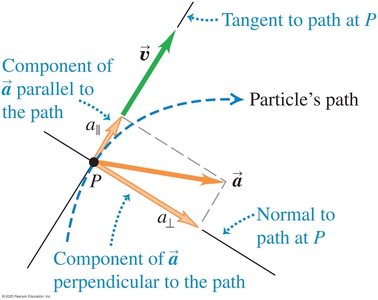
In general two-dimensional motion, the acceleration vector can be decomposed into two components:
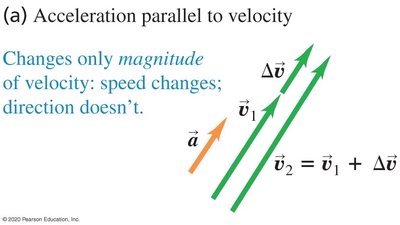
Parallel to velocity (tangential): Changes the magnitude (speed) of the velocity.
Perpendicular to velocity (normal): Changes the direction of the velocity, responsible for circular motion.
Key Concepts and Problem-Solving Tips
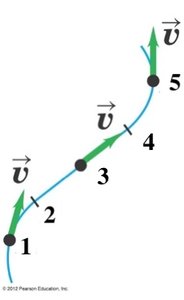
At any instant, the velocity vector is tangent to the path of the object.
The acceleration vector points toward the center of the circle in uniform circular motion.
For non-uniform circular motion, there is also a tangential acceleration component if the speed changes.
Always resolve vectors into components when solving problems.
Relative Velocity
Concept of Relative Velocity
Relative velocity describes the velocity of an object as observed from a particular reference frame. It is especially important in two-dimensional motion when analyzing the motion of objects from different perspectives.
Relative velocity equation:
Where is the velocity of A relative to B.
Example: If a boat moves east at 5 m/s relative to the water, and the water flows north at 3 m/s relative to the ground, the velocity of the boat relative to the ground is found by vector addition.
Mathematical Tools and Physical Constants
Useful Trigonometric Values
For quick calculations in projectile and circular motion problems, refer to the following table of trigonometric values for common angles:
\( \theta \) | 0° | 30° | 37° | 45° | 53° | 60° | 90° |
|---|---|---|---|---|---|---|---|
\( \sin \theta \) | 0 | 1/2 | 3/5 | \( \sqrt{2}/2 \) | 4/5 | \( \sqrt{3}/2 \) | 1 |
\( \cos \theta \) | 1 | \( \sqrt{3}/2 \) | 4/5 | \( \sqrt{2}/2 \) | 3/5 | 1/2 | 0 |
\( \tan \theta \) | 0 | \( \sqrt{3}/3 \) | 3/4 | 1 | 4/3 | \( \sqrt{3} \) | ∞ |
Physical Constants:
Acceleration due to gravity:
Universal gravitational constant:
Mathematical Approximations: , , , , , ,
Summary Table: Key Quantities in Kinematics and Dynamics
Symbol | Quantity |
|---|---|
a | Acceleration |
\( \alpha \) | Angular acceleration |
E | Energy |
f | Frequency |
F | Force |
I | Rotational inertia |
J | Impulse |
K | Kinetic energy |
k | Spring constant |
l | Length |
L | Angular momentum |
m | Mass |
\( \omega \) | Angular velocity |
\( \mu \) | Coefficient of friction |
P | Power |
p | Momentum |
r | Radius or distance |
t | Time |
T | Period |
\( \theta \) | Angle |
U | Potential energy |
v | Velocity or speed |
W | Work |
x, y | Position |
Additional info: For further practice, students are encouraged to use online simulations (e.g., PhET) to visualize projectile and circular motion, and to consult their textbook for more examples and exercises.
