 Indietro
Relative Motion and Vector Addition in Physics
Guida di studio - Note intelligenti
 Appunti personalizzati basati sui tuoi materiali, ampliati con definizioni chiave, esempi e contesto.
Vectors in Physics
Introduction to Vectors and Relative Motion
Vectors are quantities that have both magnitude and direction, and they are fundamental in describing motion in physics. Relative motion refers to the observation that the velocity of an object depends on the frame of reference of the observer. Understanding how to add and subtract vectors is essential for solving problems involving relative motion.
Relative Motion
Concept of Relative Velocity
Relative velocity describes how the velocity of one object appears from the reference frame of another object. The velocity of an object A relative to object B is denoted as \( \vec{v}_{AB} \). The general equation for relative velocity is:
General Equation:
Subscript Convention: The 'inside' subscripts must match for the addition to be valid.
Negative Relationship:
This means the velocity of object 1 relative to object 3 is the sum of the velocity of object 1 relative to object 2 and the velocity of object 2 relative to object 3.
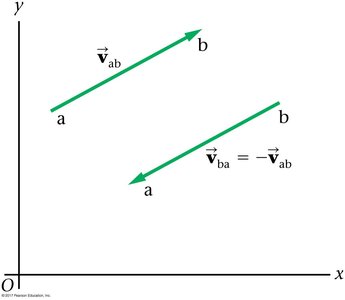
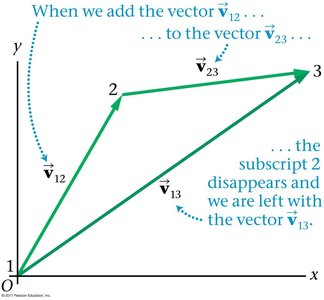
Relative Motion: Train and Person Example
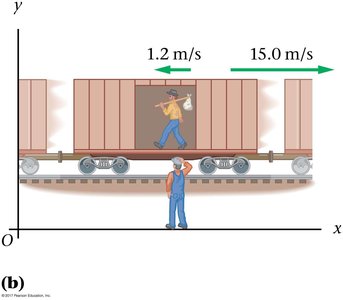
Consider a person walking inside a train. The velocity of the person relative to the ground depends on both the velocity of the person relative to the train and the velocity of the train relative to the ground. Two cases are considered:
Case 1: Person walks in the same direction as the train's motion.
Case 2: Person walks in the opposite direction to the train's motion.
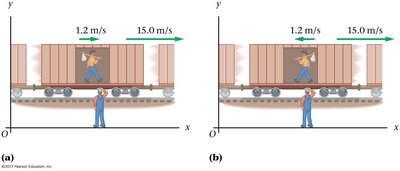
The equations for each case are:
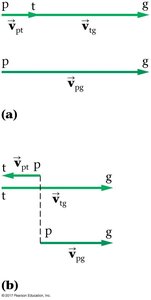
Same direction:
Opposite direction:
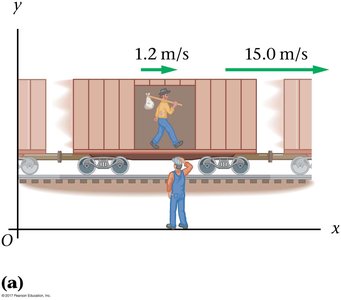
Generalization of Relative Motion Equations
The pattern of subscripts in the relative velocity equation is consistent for any set of objects. For example, the velocity of object 1 relative to object 3 is always the sum of the velocity of object 1 relative to object 2 and the velocity of object 2 relative to object 3. This can be visualized using vector diagrams.
Solving Relative Motion Problems
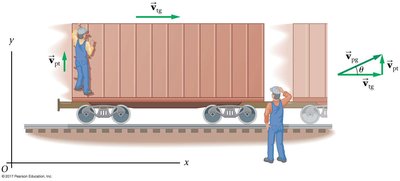
Example: Person Climbing a Ladder on a Moving Train
Suppose a person climbs a vertical ladder at 0.24 m/s on a train moving at 0.68 m/s. To find the person's velocity relative to the ground, use vector addition:
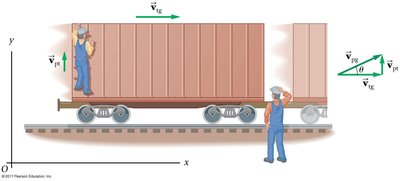
The magnitude and direction are:
Magnitude:
Direction:
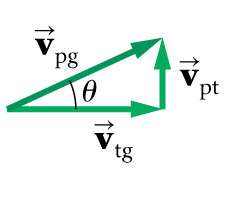
Example: Boat Crossing a River
Consider a boat moving with velocity relative to the water of 6.1 m/s at an angle of 25° upstream, while the river flows at 1.4 m/s. To find the boat's velocity relative to the ground:
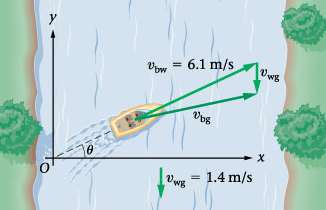
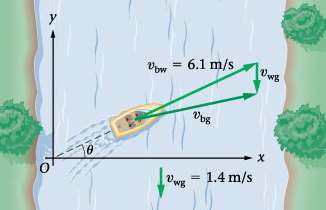
To move straight across the river, the angle required is:
Solving for Required Velocity and Direction
If the boat must move directly across the river (in the x-direction) with a speed of 5.0 m/s, the required velocity relative to the water is:
Magnitude:
Direction:
Summary Table: Relative Velocity Equations
Equation | Description |
|---|---|
General relative velocity equation | |
Negative relationship between relative velocities | |
Magnitude of velocity vector | |
Direction of velocity vector |
Additional info: These examples illustrate the importance of vector addition and the choice of reference frames in analyzing motion. Mastery of these concepts is essential for solving more advanced problems in kinematics and dynamics.
