 Indietro
Relative Velocity and 2-Dimensional Kinematics: Study Notes for Physics with Calculus
Guida di studio - Note intelligenti
 Appunti personalizzati basati sui tuoi materiali, ampliati con definizioni chiave, esempi e contesto.
Relative Velocity
Frames of Reference
In physics, a frame of reference is a coordinate system or set of axes within which to measure the position, velocity, and other properties of objects. Each observer may have their own frame, often denoted with its own axes and origin.
Definition: The surroundings that appear to be at rest with respect to the observer.
Notation: Frames are often labeled (e.g., G for ground, T for train).
Importance: The velocity of an object can differ depending on the observer's frame.
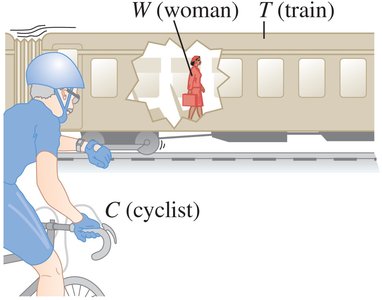
Galilean Relativity and Relative Velocity
Galilean relativity states that the laws of motion are the same in all inertial frames. The velocity of an object relative to a particular frame can be found by vector addition:
Formula:
Compact Notation:
Reversing Frames:
Applicability: This vector addition holds in 1-D, 2-D, and 3-D.
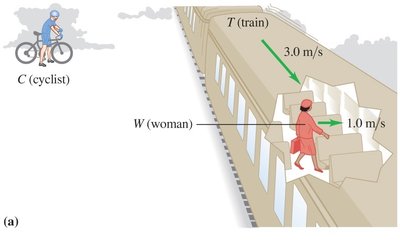
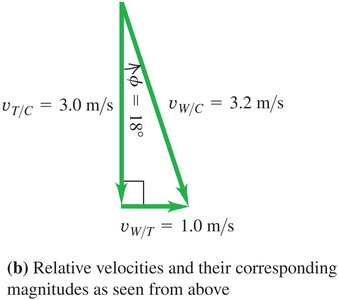
Relative Velocity in Two Dimensions
Relative velocity calculations extend naturally to two and three dimensions. Vector addition is used to combine velocities from different frames.
Formula:
Applications: Used in problems involving cross-winds, cross-currents, and navigation.
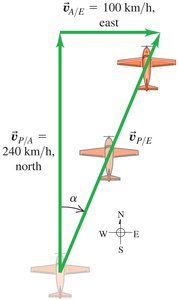
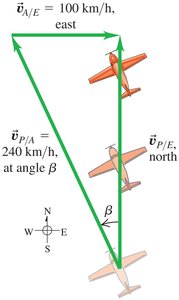
2-Dimensional Kinematics
Position, Velocity, and Acceleration Vectors
In two-dimensional kinematics, vectors are used to describe position, velocity, and acceleration. For 2-D problems, z-components are omitted.
Position Vector:
Velocity Vector:
Acceleration Vector:
Instantaneous Speed: (magnitude of velocity)
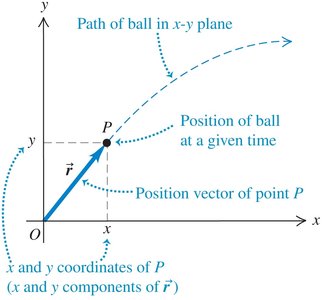
Displacement, Average Velocity, and Average Acceleration
Displacement is the change in position vector, while average velocity and average acceleration are defined over a time interval.
Displacement:
Average Velocity:
Average Acceleration:
Average Speed:
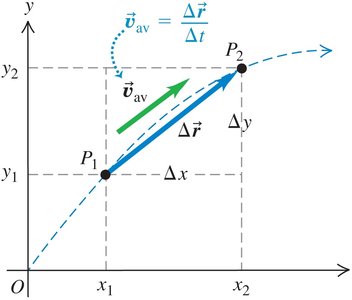
Instantaneous Velocity and Its Direction
The instantaneous velocity vector is always tangent to the object's path in the x-y plane. Its components are and .
Formula:
Direction: The angle can be found using
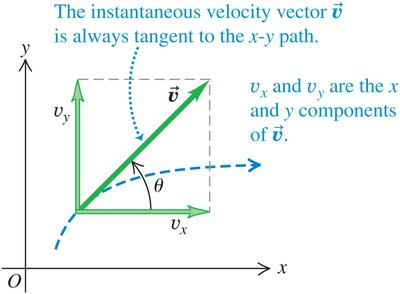
Summary Table: Key Kinematic Quantities in 2-D
Quantity | Vector Form | Scalar Form |
|---|---|---|
Position | x, y | |
Velocity | Speed | |
Acceleration | Magnitude | |
Displacement | Distance |
Example: A ball thrown in the air follows a curved path in the x-y plane. Its position, velocity, and acceleration can be described using the above vector quantities.
Additional info: Academic context and expanded explanations were added to ensure completeness and clarity for exam preparation.
