 Indietro
Rigid Body Rotation and Rolling Motion: Physics with Calculus Study Guide
Guida di studio - Note intelligenti
 Appunti personalizzati basati sui tuoi materiali, ampliati con definizioni chiave, esempi e contesto.
Rigid Bodies: Center of Mass and Rotational Motion
Center of Mass
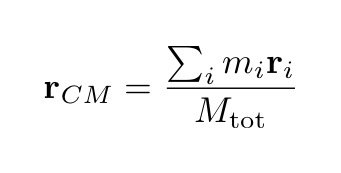
The center of mass (CM) of a rigid body is the point where the mass of the body can be considered to be concentrated for translational motion analysis. It is crucial for understanding both linear and rotational dynamics.
Definition: The CM is calculated as the weighted average of the positions of all mass elements in the object.
Formula:
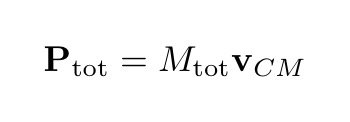
Total Momentum:
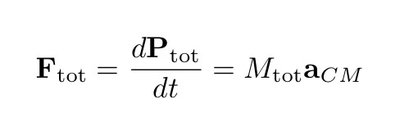
Total Force:
Application: Used to analyze the motion of composite systems and solve problems involving multiple interacting bodies.
Torque and Rotational Variables
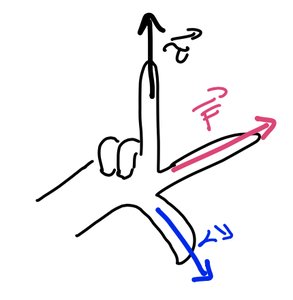
Torque is the rotational equivalent of force and is responsible for causing angular acceleration in a rigid body. The direction and sign of torque are determined by the right-hand rule and the choice of coordinate system.
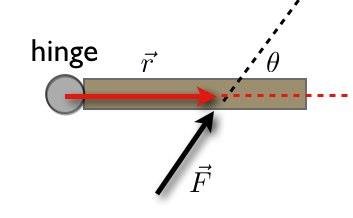
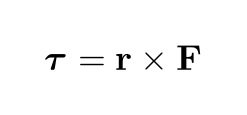
Definition: Torque is the cross product of the position vector and the force vector.
Formula:
Right-Hand Rule: Used to determine the direction of the torque vector.
Sign Convention: Counterclockwise (ccw) is positive (out of the page), clockwise (cw) is negative (into the page).
Example: Applying a force at a distance from a hinge creates a torque that rotates the object.
Moment of Inertia
The moment of inertia quantifies an object's resistance to rotational acceleration about an axis. It depends on the mass distribution relative to the axis of rotation.
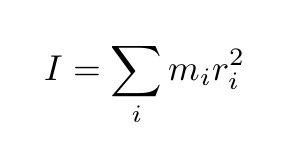
Definition: Moment of inertia is the sum of each mass element times the square of its distance from the axis.
Formula:
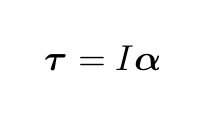
Rotational Equation:
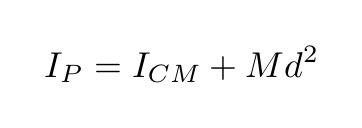
Parallel Axis Theorem: Used to find the moment of inertia about any axis parallel to the CM axis.
Example: Calculating the moment of inertia for a disk, sphere, or hoop.
Rolling Motion and Constraints
Rolling Without Slipping
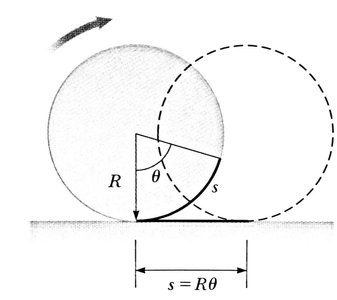
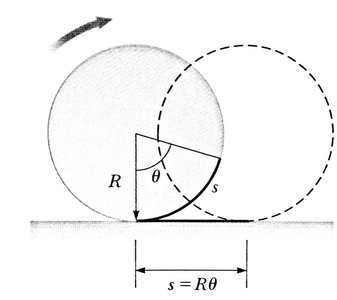
When a rigid body such as a wheel or sphere rolls without slipping, there is a constraint between its translational and rotational motion. The point of contact with the ground is momentarily at rest.
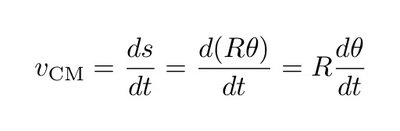
Constraint: The linear velocity of the center of mass is related to the angular velocity by .
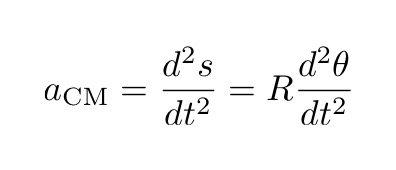
Distance Relation: As the wheel rotates through an angle , its center moves a distance .
Acceleration Relation:
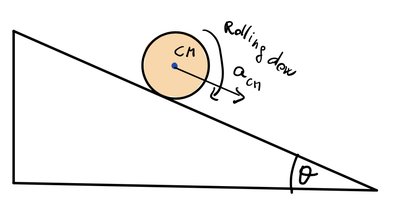
Example: Analyzing the motion of a sphere rolling down an incline.
Force and Torque Analysis for Rolling Objects
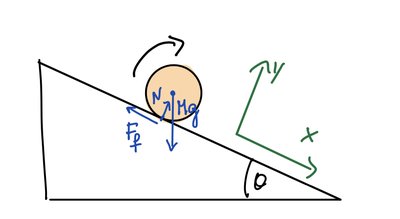
To solve for the acceleration of a rolling object, analyze the forces and torques acting on it, and apply the rolling constraint.
Forces: Gravity, normal force, and friction.
Torques: Only friction produces a torque about the center of mass for rolling without slipping.
Constraint: Relates linear and angular acceleration.
Formula for Acceleration:
Example: Sphere, disk, and hoop rolling down an incline.
Moment of Inertia for Common Shapes
The moment of inertia varies for different shapes, affecting their acceleration when rolling.
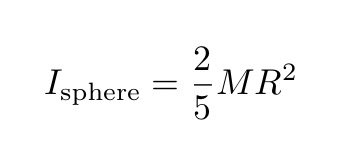
Solid Sphere:
Solid Cylinder/Disk:
Hollow Cylinder/Hoop:
Application: Used to predict which object will reach the bottom of an incline first.

Work-Energy Theorem for Rigid Bodies
Kinetic Energy of Rotation
The total kinetic energy of a rigid body is the sum of translational and rotational kinetic energies.
Translational Kinetic Energy:
Rotational Kinetic Energy:
Total Kinetic Energy:
Application: Used in energy conservation problems involving rolling objects.
Generalized Work-Energy Theorem
The work-energy theorem for rigid bodies describes the change in total mechanical energy, including both kinetic and potential energies, and accounts for work done by external forces.
Formula:
Potential Energy: Use the location of the center of mass for calculations.
Example: Comparing a rolling sphere and a sliding block down an incline.
Comparative Analysis: Rolling vs. Sliding
Race Down an Incline
Objects with different moments of inertia roll down an incline at different rates. The distribution of mass affects the rotational inertia and thus the acceleration.
Solid Sphere: Arrives first due to lowest moment of inertia.
Solid Disk: Arrives second.
Hollow Cylinder: Arrives last due to highest moment of inertia.
Sliding Block: Arrives faster than any rolling object if frictionless.
Summary Table: Moment of Inertia for Common Shapes
Object | Moment of Inertia (about center) |
|---|---|
Solid Sphere | |
Solid Cylinder/Disk | |
Hollow Cylinder/Hoop |
Key Takeaways
Rigid body rotation involves both translational and rotational motion.
Moment of inertia is crucial for predicting rotational behavior.
Rolling without slipping imposes a constraint linking linear and angular variables.
Work-energy theorem applies to both translational and rotational kinetic energies.
Objects with lower moment of inertia roll down inclines faster.
