 Indietro
Rotational Dynamics: Torque, Angular Acceleration, and Moment of Inertia
Guida di studio - Note intelligenti
 Appunti personalizzati basati sui tuoi materiali, ampliati con definizioni chiave, esempi e contesto.
Rotational Dynamics
Introduction to Rotational Dynamics
Rotational dynamics is a fundamental topic in Physics with Calculus, focusing on the motion of objects that rotate about an axis. This lab explores the relationship between torque, angular acceleration, and moment of inertia using experimental setups with a rotary motion sensor.
Torque is the rotational equivalent of force, causing objects to rotate.
Angular acceleration describes how quickly an object's rotational speed changes.
Moment of inertia quantifies an object's resistance to changes in rotational motion.
Experimental Objectives
Collect angular acceleration data for objects subjected to a torque.
Determine expressions for torque and moment of inertia.
Relate linear and angular acceleration.
Analyze the relationship between torque and angular acceleration.
Torque and Angular Acceleration
Definitions and Key Concepts
Torque (\( \tau \)): The measure of the force causing an object to rotate, defined as \( \tau = rF \sin \theta \), where r is the lever arm, F is the force, and \theta is the angle between them.
Angular acceleration (\( \alpha \)): The rate of change of angular velocity, measured in rad/s².
Moment of inertia (\( I \)): The rotational analog of mass, dependent on the mass distribution relative to the axis of rotation.
Newton’s Second Law for Rotation: \( \tau_{\text{net}} = I \alpha \)
Experimental Setup
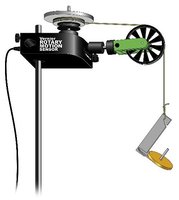
The experiment uses a Vernier Rotary Motion Sensor with either a solid disk or a rod with masses at its ends. A string wound around a pulley transmits force to the rotating object via a hanging mass. 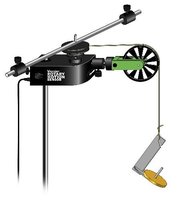
Data Collection and Analysis
Calculating Linear and Angular Quantities
Linear acceleration (\( a \)): Determined from the distance fallen and time of fall.
Tension in the string (\( T \)):
Torque (\( \tau \)): where \( r_p \) is the radius of the pulley.
Relationship Between Torque and Angular Acceleration
Plotting angular acceleration vs. torque yields a linear relationship.
The slope of the graph corresponds to the inverse of the moment of inertia.
The y-intercept may indicate systematic errors or frictional effects.
Moment of Inertia Calculations
Solid Disk
Experimental moment of inertia:
Theoretical moment of inertia:
Percent difference:
Rod with Masses
Experimental moment of inertia:
Theoretical moment of inertia:
Percent difference:
Predict and Calculate
Properties of Moment of Inertia
Depends on mass and its distribution relative to the axis.
Greater distance from axis increases moment of inertia.
Sample Calculations
Disk about edge: Use parallel-axis theorem.
Rod–mass system about one mass: Sum contributions from rod and masses.
Bicycle wheel: *Additional info: This formula sums the moments of inertia for each spoke and the rim.*
Conclusions and Key Equations
Definitions
Vector product: Mathematical operation used to define torque.
Torque: Rotational force, .
Angular acceleration: Change in angular velocity per unit time.
Moment of inertia: Resistance to rotational acceleration.
Newton’s second law for rotation: .
Parallel-axis theorem:
Key Equations
Torque:
Angular kinematics:
Relationship between angular and linear quantities:
Moment of inertia for discrete masses:
Moment of inertia for continuous distributions:
Discussion of Errors
Friction in the pulley and sensor
Measurement uncertainties in mass, radius, and time
Assumptions of ideal conditions (e.g., negligible air resistance)
Textbook Correlation
This experiment directly relates to chapters on rotational motion, torque, angular acceleration, and moment of inertia.
