 Indietro
Rotational Motion: Physics with Calculus Study Notes
Guida di studio - Note intelligenti
 Appunti personalizzati basati sui tuoi materiali, ampliati con definizioni chiave, esempi e contesto.
Chapter 8: Rotational Motion
Circular Motion
Circular motion occurs when an object turns about an internal axis, resulting in rotation. This motion is characterized by two distinct types of speed: tangential (linear) speed and rotational (angular) speed.
Tangential Speed
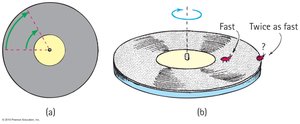
Tangential speed (symbol v) is the distance traveled by a point on the rotating object divided by the time taken to travel that distance. Points closer to the circumference of a rotating object have a higher tangential speed than points closer to the center.
Definition: Tangential speed is the linear speed of a point located at a certain radius from the axis of rotation.
Formula:
Example: On a spinning disk, points at the edge move faster than those near the center.
Rotational Speed
Rotational speed (symbol \omega) is the number of rotations or revolutions per unit of time. All parts of a rigid rotating object complete a rotation in the same amount of time, so they share the same rotational speed.
Definition: Rotational speed is the angular velocity, typically measured in revolutions per minute (RPM) or radians per second.
Relationship: Tangential speed increases with distance from the axis, while rotational speed remains constant for all points on a rigid object.
Rotational Inertia
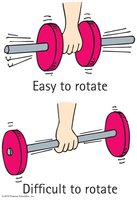
Rotational inertia (symbol I) is the property of an object to resist changes in its rotational state of motion. It depends on both the mass of the object and the distribution of mass relative to the axis of rotation.
Definition: Rotational inertia quantifies how difficult it is to change an object's rotational speed.
Factors: Greater mass and greater distance from the axis increase rotational inertia.
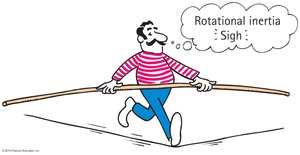
Example: A tightrope walker uses a long pole with high rotational inertia for stability.
Dependence on Axis of Rotation
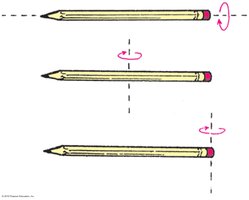
The rotational inertia of an object varies depending on the axis about which it rotates. For example, a pencil is easier to rotate about its length than about a vertical axis through its center or end.
Dependence on Shape and Mass Distribution
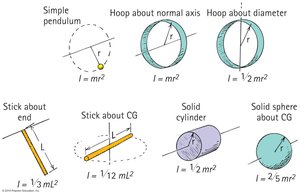
The shape of the object and the location of the axis of rotation affect rotational inertia. Different shapes and axes yield different formulas for I.
Examples:
Hoop about normal axis:
Solid cylinder about CG:
Solid sphere about CG:
Rotational Inertia in Motion
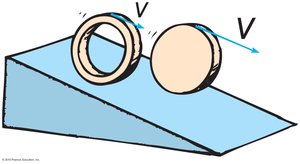
Objects with lower rotational inertia accelerate more quickly when rolling down an incline. For example, a disk will reach the bottom faster than a hoop due to its lower rotational inertia.
Torque
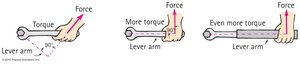
Torque is the tendency of a force to cause rotation. It depends on the magnitude of the force, the direction in which it acts, and the point of application (lever arm).
Definition: Torque is a measure of the rotational force applied to an object.
Formula:
Lever Arm: The perpendicular distance from the axis of rotation to the line of action of the force.
Example: Using a wrench, the torque increases as the lever arm increases or as the force is applied more perpendicular to the lever arm.
Center of Mass and Center of Gravity
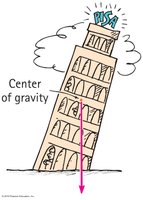
The center of mass is the average position of all the mass in an object, while the center of gravity is the average position of weight distribution. For most objects, these points coincide.
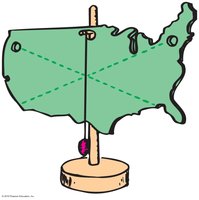
Determining Center of Gravity: Suspend the object from two different points and draw vertical lines from each suspension point. The intersection is the center of gravity.
Stability and Center of Gravity
The location of the center of gravity is crucial for stability. If the vertical line from the center of gravity falls within the base, the object is stable; if it falls outside, the object is unstable.
Centripetal Force
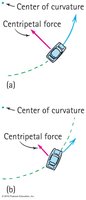
Centripetal force is any force directed toward a fixed center, keeping an object moving in a circular path. It is essential for maintaining circular motion.
Definition: Centripetal means "center-seeking." The force acts perpendicular to the velocity of the object.
Example: Whirling a tin can on a string requires a centripetal force to keep the can moving in a circle.

Centripetal Force Formula
The magnitude of centripetal force depends on the mass, tangential speed, and radius of the circle:
Formula:

Centripetal Force in Everyday Life
When a car rounds a curve, the centripetal force prevents it from skidding. If the force is insufficient (e.g., due to high speed or slippery road), the car will skid outward.
Centrifugal Force
Centrifugal force is the apparent outward force experienced by an occupant inside a rotating system. It is not a real force, but rather a result of inertia in a rotating reference frame.
Definition: Centrifugal means "center-fleeing." It is perceived in a rotating frame but does not act on the object in an inertial frame.
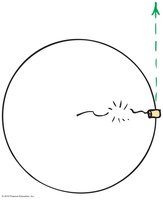
Common Misconception: If the string holding a rotating object breaks, the object moves tangentially, not radially outward, due to Newton's first law.
Additional info: These notes cover all major aspects of rotational motion relevant to a Physics with Calculus course, including definitions, formulas, examples, and applications. Images are included only where they directly reinforce the explanation.
