 Indietro
Sources of Magnetic Field: Physics with Calculus Study Notes
Guida di studio - Note intelligenti
 Appunti personalizzati basati sui tuoi materiali, ampliati con definizioni chiave, esempi e contesto.
Chapter 28: Sources of Magnetic Field
Introduction to Magnetic Field Sources
This chapter explores the origins of magnetic fields, focusing on how moving charges and electric currents generate these fields. Understanding the sources of magnetic fields is essential for analyzing phenomena in electromagnetism, including the operation of electromagnets and permanent magnets.
Magnetic fields are produced by moving charges, not by stationary ones.
Both permanent magnets and electric currents in conductors act as sources of magnetic fields.
Magnetic fields exert forces only on moving charges, unlike electric fields which act on all charges.
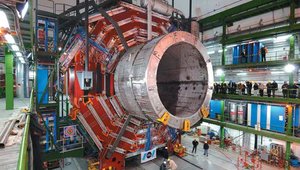
Example: The image above shows a large current-carrying solenoid at CERN, used to generate a uniform magnetic field for experimental purposes. Solenoids are practical applications of magnetic field generation by electric currents.
28.1 Magnetic Field from a Single Moving Charged Particle
A single moving charge creates a magnetic field in the space around it. The direction and magnitude of this field depend on the velocity of the charge and its position relative to the observation point.
Key formula: The magnetic field B at a point due to a moving charge is given by:
Where q is the charge, v is its velocity, r is the vector from the charge to the observation point, and μ₀ is the permeability of free space.
28.2 Magnetic Field from a Current-Carrying Conductor Element
A small segment of a current-carrying wire produces a magnetic field, which can be calculated using the Biot-Savart law. This law is fundamental for determining the magnetic field from arbitrary current distributions.
Biot-Savart Law:
Where I is the current, d𝑙 is the length element, and r is the position vector.
28.3 Magnetic Field from a Long, Straight Wire
The magnetic field produced by a long, straight, current-carrying wire is a classic result in electromagnetism. The field forms concentric circles around the wire.
Formula:
Where I is the current and r is the distance from the wire.
28.4 Interaction Between Parallel Current-Carrying Wires
Wires carrying current in the same direction attract each other, while wires with opposing currents repel. This is a direct consequence of the magnetic fields generated by each wire.
Force per unit length:
Where I₁ and I₂ are the currents, and d is the separation between wires.
28.5 Magnetic Field from a Circular Current Loop
A current-carrying wire bent into a circle produces a magnetic field at its center, which is stronger than that from a straight wire.
Field at the center:
Where I is the current and R is the radius of the loop.
28.6 Ampere’s Law
Ampere’s law relates the magnetic field around a closed loop to the total current passing through the loop. It is analogous to Gauss’s law in electrostatics and is especially useful for symmetric current distributions.
Ampere’s Law:
Where Ienc is the enclosed current.
28.7 Using Ampere’s Law for Symmetric Current Distributions
Ampere’s law is most effective when applied to systems with high symmetry, such as solenoids and toroids, allowing for straightforward calculation of magnetic fields.
For a solenoid, the magnetic field inside is:
Where n is the number of turns per unit length and I is the current.
28.8 Magnetic Properties of Materials
Microscopic currents within materials, such as those from electrons orbiting nuclei, give rise to magnetic properties. These properties explain why materials like iron can act as permanent magnets or intensify magnetic fields.
Ferromagnetic materials (e.g., iron) have strong, permanent magnetic properties.
Paramagnetic and diamagnetic materials respond differently to external magnetic fields.
Summary Table: Key Magnetic Field Formulas
Source | Magnetic Field Formula | Notes |
|---|---|---|
Moving Point Charge | Direction given by right-hand rule | |
Long Straight Wire | Field circles wire | |
Circular Loop | Field at center | |
Solenoid | Uniform field inside | |
Ampere’s Law | General law for symmetry |
Additional info: Review of angular momentum, Coulomb’s law, electric field calculations, and Gauss’s law is recommended for full understanding of magnetic field sources.
