Indietro
Standing Waves, Harmonics, and Resonance in Physics with Calculus
Guida di studio - Note intelligenti
 Appunti personalizzati basati sui tuoi materiali, ampliati con definizioni chiave, esempi e contesto.
Standing Waves and Harmonics
Standing Waves on Strings
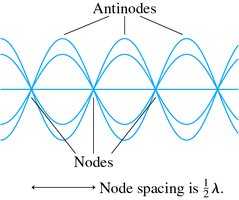
Standing waves occur when two identical waves travel in opposite directions and interfere, creating nodes (points of zero displacement) and antinodes (points of maximum displacement). The boundary conditions (fixed ends) determine the allowed modes and frequencies.
Node: Point where the wave amplitude is always zero.
Antinode: Point where the wave amplitude reaches its maximum.
Harmonic: A mode of vibration with a frequency that is an integer multiple of the fundamental frequency.
Example: A string of length 2.50 m vibrates as a standing wave with nodes at 1.00 m and 1.50 m from one end. The mode number is determined by counting antinodes; here, it is the fifth harmonic (). 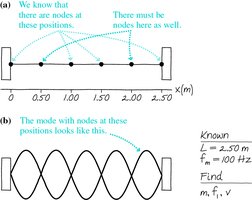
Calculating Harmonics and Fundamental Frequency
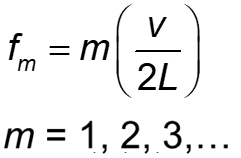
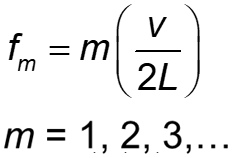
The frequencies of harmonics for a string fixed at both ends are given by: where is the mode number, is the wave speed, and is the string length. The fundamental frequency () is:
Wavelength of the fundamental mode:
Wave speed:
Example: For m and Hz, the wavelength of the fifth mode is m. 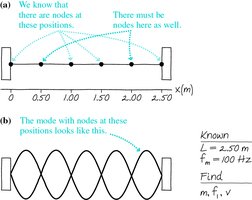
Standing Electromagnetic Waves
Standing Waves in Laser Cavities
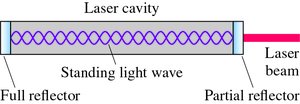
Standing electromagnetic waves can form in a laser cavity between two mirrors. The mirrors act as boundaries, creating nodes at each end.
Mode number: The number of half-wavelengths fitting into the cavity length.
Application: The mode number for a laser cavity of length and wavelength is .
Standing Sound Waves
Nature of Sound Waves
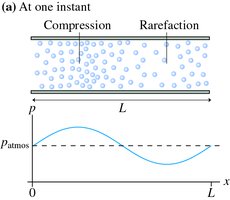
Sound waves are longitudinal pressure waves, consisting of compressions (high pressure) and rarefactions (low pressure).
At the open end of a tube, the pressure is fixed at atmospheric pressure (node).
At the closed end, the pressure varies maximally (antinode).
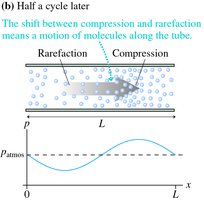
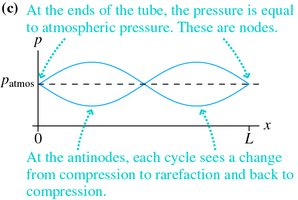
Boundary Conditions and Tube Types
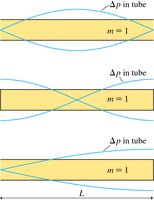
Open-Open Tube: Both ends are open; nodes at both ends.
Closed-Closed Tube: Both ends are closed; antinodes at both ends.
Open-Closed Tube: One end open (node), one end closed (antinode).
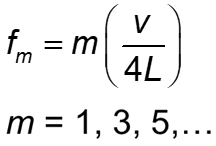
Fundamental frequency for open-closed tube: Half that of open-open or closed-closed tube of same length.
Wavelengths and Frequencies in Tubes
Open-Open and Closed-Closed Tubes: , , 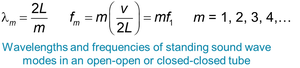 Open-Closed Tubes: , ,
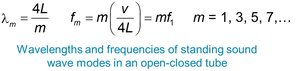
Modes of Standing Sound Waves
The first three standing sound wave modes in columns of air with different ends are illustrated below. 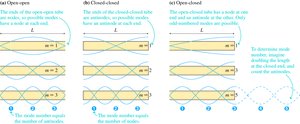
Synthesis: Standing-Wave Modes
General Relationships
There are only two sets of frequency/wavelength relationships for standing-wave modes, depending on boundary conditions. 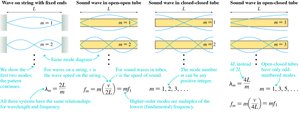
Problem-Solving Approach: Standing Sound Waves
Strategy and Steps
Identify the type of tube or string (open-open, closed-closed, open-closed).
Determine known values: length, frequency, wavelength, positions of nodes/antinodes.
Sketch the mode diagram.
Use appropriate equations to find wavelength and frequency.
Check if frequency times wavelength equals wave speed.
Resonances in the Ear Canal
Ear Canal as an Open-Closed Tube
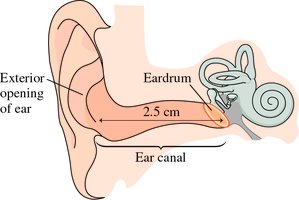
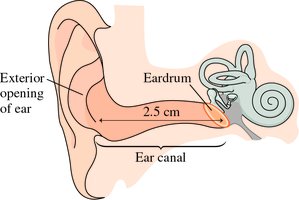
The ear canal acts as an open-closed tube, supporting standing sound waves. The fundamental frequency is high due to the short length.
Length of ear canal: 2.5 cm
Speed of sound: 350 m/s
Fundamental frequency:
Higher harmonics: Odd multiples of
Wind Instruments
Changing Tube Length and Resonance
Wind instruments use holes to change the effective length of the tube, creating nodes at open holes. Resonances produce musical notes.
Principle of Superposition and Interference
Superposition
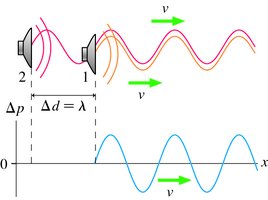
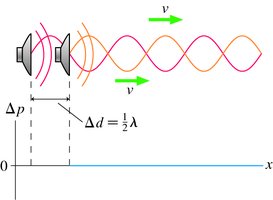
The displacement of a medium with multiple waves is the sum of individual displacements.
Interference
Constructive interference: Waves in phase; path-length difference is a whole number of wavelengths.
Destructive interference: Waves out of phase; path-length difference is a whole number plus half a wavelength.
Summary: Standing Waves
Formation and Boundary Conditions
Standing waves form from two identical traveling waves moving in opposite directions.
Boundary conditions determine allowed frequencies and wavelengths.
Modes are specific standing waves allowed by the system.
Standing Waves in Tubes
Open-open: nodes at both ends
Closed-closed: antinodes at both ends
Open-closed: node at open end, antinode at closed end