 Indietro
Study Guidance for Atomic Structure, Isotopes, and Radioactivity
Guida di studio - Note intelligenti
 Appunti personalizzati basati sui tuoi materiali, ampliati con definizioni chiave, esempi e contesto.
Q29. Which of the beams is actually composed of particles?
Background
Topic: Radioactivity and Subatomic Particles
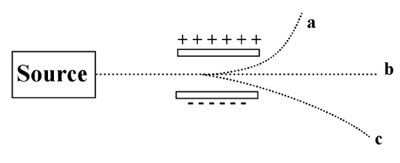
This question tests your understanding of the nature of radiation and the distinction between particle and non-particle radiation. The diagram shows three beams (a, b, c) passing between charged plates, which is a classic setup for identifying types of radiation.
Key Terms and Concepts:
Alpha particles: Positively charged, composed of 2 protons and 2 neutrons.
Beta particles: Negatively charged, essentially high-energy electrons.
Gamma rays: Electromagnetic radiation, not composed of particles.
Deflection in electric fields: Charged particles are deflected, neutral particles are not.
Step-by-Step Guidance
Observe the diagram: Three beams (a, b, c) are shown passing between plates with opposite charges.
Recall that charged particles are deflected by electric fields, while neutral particles are not.
Identify which beams are deflected: Beam 'a' is deflected toward the negative plate, beam 'c' toward the positive plate, and beam 'b' passes straight through.
Consider the nature of each type of radiation: Alpha and beta radiation are composed of particles, while gamma radiation is not.
Try solving on your own before revealing the answer!
Final Answer: D) a and c
Beams 'a' and 'c' are composed of particles (alpha and beta), as they are deflected by the electric field. Beam 'b' is gamma radiation, which is not composed of particles and passes straight through.
Q50. The following image describes which type of change?
Background
Topic: Physical vs. Chemical Changes
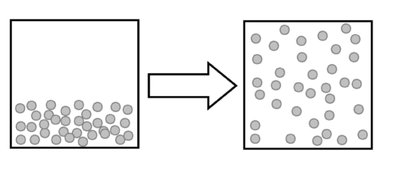
This question tests your ability to distinguish between physical and chemical changes. The image shows particles spreading out from a concentrated area to a more dispersed arrangement.
Key Terms and Concepts:
Physical change: A change in the state or appearance of matter without altering its chemical composition.
Chemical change: A change that results in the formation of new substances.
Diffusion: The process by which particles spread out in a container.
Step-by-Step Guidance
Examine the image: It shows particles moving from a concentrated area to a more evenly distributed arrangement.
Consider whether the identity of the particles changes: Are new substances formed, or is it just a change in distribution?
Recall that physical changes involve changes in state, shape, or distribution, but not in chemical identity.
Think about examples of physical changes: Melting, boiling, diffusion, and dissolving are all physical changes.
Try solving on your own before revealing the answer!
Final Answer: E) a physical change
The image shows a physical change, specifically diffusion, where the particles spread out but their chemical identity remains the same.
