Indietro
Study Notes: Energy, Work, and Power (Physics Ch. 7)
Guida di studio - Note intelligenti
 Appunti personalizzati basati sui tuoi materiali, ampliati con definizioni chiave, esempi e contesto.
Energy, Work, and Power
Energy
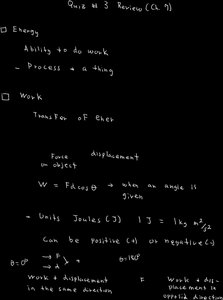
Energy is defined as the ability to do work. It can be considered both as a process and as a property of a system or object.
Ability to do work: Energy enables objects or systems to perform work.
Process vs. Thing: Energy can be transferred or transformed but is not a tangible substance.
Work
Work is the transfer of energy that occurs when a force acts upon an object to cause displacement.
Formula: $W = F d \cos \theta$ where F is the force, d is the displacement, and \theta is the angle between the force and displacement vectors.
Units: Joules (J), where $1\,J = 1\,kg\,m^2/s^2$
Work can be positive (force and displacement in the same direction) or negative (force and displacement in opposite directions).
Work-Energy Theorem
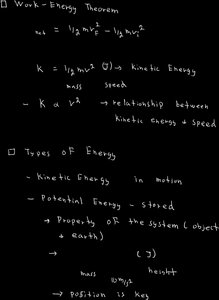
The work-energy theorem states that the net work done on an object is equal to its change in kinetic energy.
Equation: $W_{net} = \Delta KE = \frac{1}{2}mv_f^2 - \frac{1}{2}mv_i^2$
Kinetic Energy (KE): $KE = \frac{1}{2}mv^2$ where m is mass and v is speed.
Kinetic energy is proportional to the square of the speed ($KE \propto v^2$).
Types of Energy
There are two main types of mechanical energy: kinetic and potential energy.
Kinetic Energy: Energy of motion.
Potential Energy: Stored energy due to position or configuration. For gravitational potential energy:
Equation: $PE = mgh$
Depends on mass (m), gravitational acceleration (g), and height (h).
Potential energy is a property of the system (object and Earth).
Position is key for potential energy.
Power
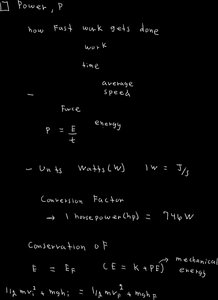
Power is the rate at which work is done or energy is transferred.
Formula: $P = \frac{E}{t}$ where E is energy (or work) and t is time.
Units: Watts (W), where $1\,W = 1\,J/s$
Conversion factor: $1$ horsepower (hp) $= 746$ W
Conservation of Mechanical Energy
The conservation of mechanical energy principle states that the total mechanical energy (kinetic + potential) in a system remains constant if only conservative forces (like gravity) are acting.
Equation: $E_i = E_f$ or $KE_i + PE_i = KE_f + PE_f$
Mechanical energy is the sum of kinetic and potential energy.