Indietro
Study Notes: Gauss's Law, Electric Potential, and Capacitance
Guida di studio - Note intelligenti
 Appunti personalizzati basati sui tuoi materiali, ampliati con definizioni chiave, esempi e contesto.
Gauss's Law and Electric Flux
Gauss's Law: Fundamental Principle
Gauss's Law relates the electric flux through a closed surface to the total charge enclosed within that surface. It is a cornerstone of electrostatics and is one of Maxwell's equations.
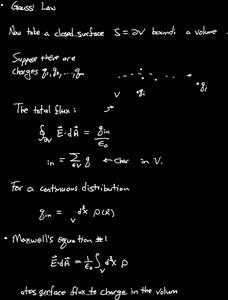
Closed Surface S = ∂V: Consider a closed surface bounding a volume V.
Charges: Suppose there are charges q1, q2, ..., qn inside V.
Total Electric Flux: The total flux through the surface is given by: where is the total charge inside V and is the permittivity of free space.
Continuous Charge Distribution: For a continuous distribution, where is the charge density.
Maxwell's Equation #1: This equates surface flux to charge in the volume.
Electric Flux
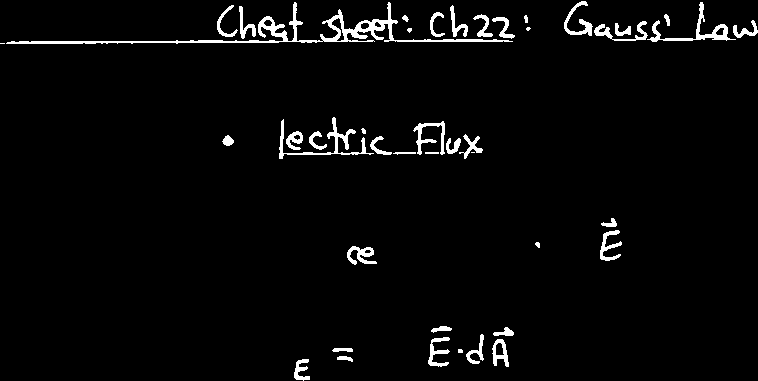
Electric flux quantifies the number of electric field lines passing through a given surface. It is mathematically defined as:
Definition: where is the electric field and is the differential area vector.
Differential Flux for Point Charge
The differential electric flux for a point charge is useful for calculating the field in spherical coordinates.
Differential Flux: where is the differential solid angle.
Law for Spheres: (Additional info: This is a restatement of Gauss's Law for spherical symmetry.)

Solid Angle and Spherical Coordinates
Solid Angle and Area Elements
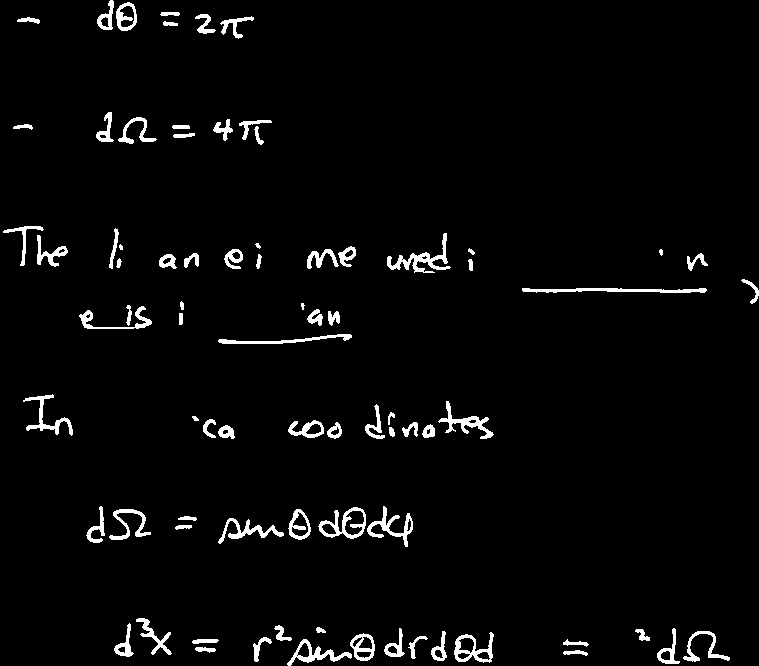
Solid angle is a measure of how large an object appears to an observer looking from a particular point. It is used in spherical coordinate systems to describe area elements.
Angle Measures: (Additional info: is the total solid angle for a sphere.)
Area Element in Spherical Coordinates:
Applications of Gauss's Law
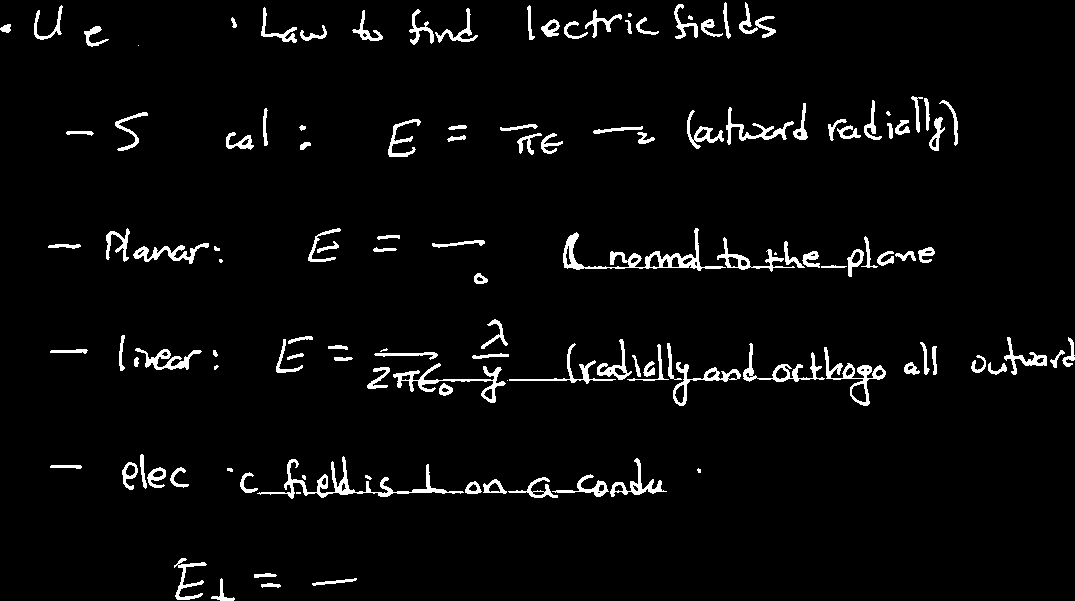
Using Gauss's Law to Find Electric Fields
Gauss's Law is a powerful tool for finding electric fields in cases of high symmetry, such as spherical, planar, and linear charge distributions.
Spherical: (outward radially)
Planar: (normal to the plane)
Linear: (radially and orthogonally outward)
Conductors: The electric field is zero inside a conductor and perpendicular to the surface outside.
Electric Potential
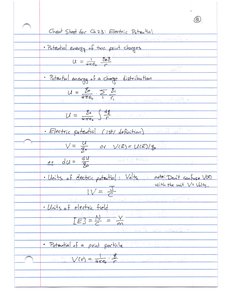
Potential Energy and Electric Potential
Electric potential is the work done per unit charge in bringing a charge from infinity to a point in space. It is related to the electric field and potential energy.
Potential Energy of Two Point Charges:
Potential Energy of a Charge Distribution:
Electric Potential (First Definition): Units: Volts (V)
Units of Electric Potential:
Units of Electric Field:
Potential of a Point Particle:
Electric Potential: Second Definition and Gradient
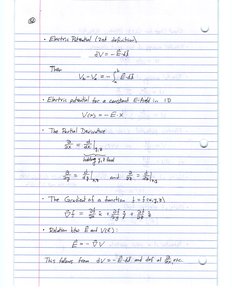
The electric potential difference between two points is related to the electric field by the negative gradient.
Second Definition:
Potential for a Constant Electric Field:
Gradient Operator:
Relation between E and V:
Capacitance
Capacitance and Capacitors
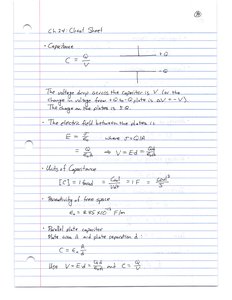
Capacitance is the ability of a system to store electric charge. It is defined for a pair of conductors separated by an insulator.
Definition: where is the charge and is the voltage across the plates.
Parallel Plate Capacitor: where is the area and is the separation.
Units of Capacitance:
Permittivity of Free Space:
Parallel Plate Capacitor with Dielectric: where is the permittivity of the dielectric.