 Indietro
Thermal Expansion and Properties of Matter: Study Notes
Guida di studio - Note intelligenti
 Appunti personalizzati basati sui tuoi materiali, ampliati con definizioni chiave, esempi e contesto.
Thermal Properties of Matter
Thermal Expansion
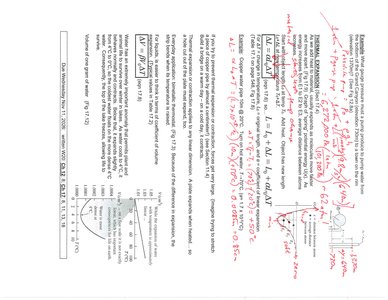
Thermal expansion refers to the increase in size (length, area, or volume) of a material as its temperature rises. This phenomenon is important in engineering and physics, as it affects the behavior of solids, liquids, and gases under temperature changes.
Linear Expansion: The change in length of a solid due to temperature change is given by the formula: where is the change in length, is the coefficient of linear expansion, is the original length, and is the change in temperature.
Volume Expansion: For solids and liquids, the change in volume is: where is the coefficient of volume expansion, is the initial volume.
Area Expansion: The change in area is: where is the coefficient of area expansion, is the initial area.
Coefficients of Expansion: These coefficients are material-specific and are typically provided in tables for reference.
Applications: Thermal expansion is considered in bridge construction, railways, and fitting metal parts.
Example: Calculating the change in length of a steel rod when heated from 20°C to 100°C using the linear expansion formula.
Temperature Scales and Conversions
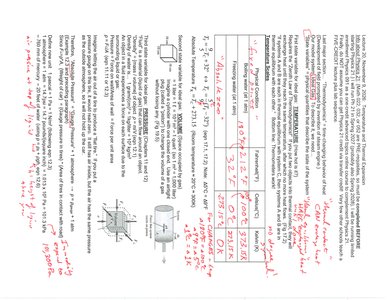
Temperature can be measured in different scales, including Celsius, Fahrenheit, and Kelvin. Understanding how to convert between these scales is essential in thermodynamics and physics.
Celsius (°C): Based on the freezing and boiling points of water (0°C and 100°C).
Fahrenheit (°F): Used primarily in the United States; freezing point of water is 32°F, boiling point is 212°F.
Kelvin (K): The SI unit for temperature; absolute zero is 0 K.
Conversion formulas:
Celsius to Fahrenheit:
Celsius to Kelvin:
Example: Converting 25°C to Fahrenheit and Kelvin.
Thermal Expansion Calculations
Worked Example: Expansion of a Cylinder
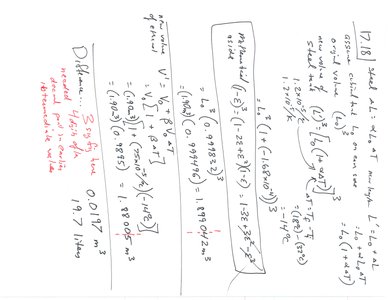
Calculating the change in volume of a cylindrical container when heated involves using the volume expansion formula and the material's coefficient of expansion.
Given: Initial volume, temperature change, and coefficient of volume expansion.
Formula:
Calculation Steps:
Identify , , and .
Plug values into the formula.
Compute and add to for final volume.
Example: A steel cylinder with , , .
Thermal Expansion in Engineering
Practical Considerations
Thermal expansion must be accounted for in engineering designs to prevent structural failure or malfunction. Expansion joints, gaps, and flexible materials are used to accommodate changes.
Expansion Joints: Allow bridges and railways to expand and contract without damage.
Material Selection: Engineers choose materials with appropriate expansion coefficients for specific applications.
Example: Gaps in railway tracks prevent buckling during hot weather.
Summary Table: Coefficients of Expansion
The following table summarizes typical coefficients of linear expansion for common materials:
Material | Coefficient of Linear Expansion () (K-1) |
|---|---|
Steel | 12 x 10-6 |
Aluminum | 24 x 10-6 |
Copper | 17 x 10-6 |
Glass | 8 x 10⁻⁶ |
Additional info: Values may vary slightly depending on alloy and purity. |
Key Equations
Linear Expansion:
Volume Expansion:
Temperature Conversion: ,
