 Indietro
Thermal Properties of Matter and Heat Transfer
Guida di studio - Note intelligenti
 Appunti personalizzati basati sui tuoi materiali, ampliati con definizioni chiave, esempi e contesto.
Thermal Properties of Matter
Specific Heat Capacity
The specific heat capacity of a substance is the amount of heat required to raise the temperature of one kilogram of the substance by one degree Celsius. It is a fundamental property that varies between materials and is crucial in understanding how substances respond to heat.
Definition: The specific heat capacity, denoted as c, is measured in units of J/(kg·°C).
Formula: The heat Q required to change the temperature of mass m by ΔT is given by:
Example: Water has a high specific heat capacity, making it effective for thermal regulation in biological and environmental systems.
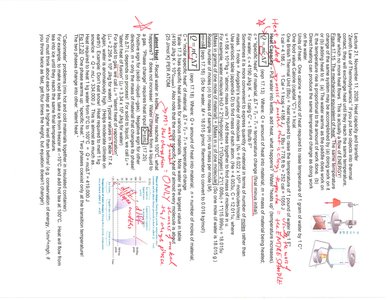
Latent Heat
Latent heat refers to the energy absorbed or released by a substance during a phase change (such as melting or boiling) without a change in temperature. The two main types are the latent heat of fusion (melting) and latent heat of vaporization (boiling).
Formula: where L is the latent heat (J/kg).
Application: During melting or boiling, temperature remains constant while the substance absorbs or releases energy.
Example: Ice melting at 0°C absorbs latent heat without a temperature increase.
Heat Transfer Mechanisms
Conduction, Convection, and Radiation
Heat can be transferred through three primary mechanisms: conduction, convection, and radiation. Each mechanism operates differently and is relevant in various physical contexts.
Conduction: Transfer of heat through direct contact between particles, typically in solids. Formula: where k is thermal conductivity, A is area, ΔT is temperature difference, d is thickness, and t is time.
Convection: Transfer of heat by the movement of fluids (liquids or gases).
Radiation: Transfer of heat via electromagnetic waves, does not require a medium.
Example: A metal rod heated at one end transfers heat to the other end by conduction.
Phase Changes and Energy Calculations
Calculating Heat for Phase Changes
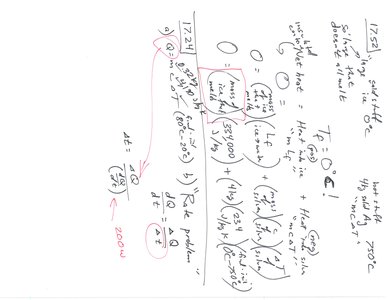
To determine the total heat required for a substance to undergo temperature changes and phase transitions, sum the energy for each step: heating, melting, boiling, etc.
Step 1: Calculate heat to raise temperature to melting/boiling point:
Step 2: Calculate heat for phase change:
Step 3: If multiple steps, add all contributions:
Example: Heating ice from -20°C to 80°C involves:
Heating ice to 0°C
Melting ice at 0°C
Heating water from 0°C to 80°C
Power and Rate of Heat Transfer
Calculating Power
Power is the rate at which energy is transferred or converted. In the context of heat, it is the rate at which heat is supplied or removed.
Formula: where P is power (W), Q is heat (J), and Δt is time (s).
Application: Used to determine how quickly a heater can raise the temperature of a substance.
Example: A 200 W heater supplies 200 J of energy per second.
Summary Table: Heat Transfer and Phase Change Equations
Process | Equation | Key Variables |
|---|---|---|
Heating (no phase change) | m = mass, c = specific heat, ΔT = temperature change | |
Phase Change | m = mass, L = latent heat | |
Power | Q = heat, Δt = time | |
Conduction | k = conductivity, A = area, ΔT = temp diff, d = thickness, t = time |
Additional info:
These notes cover material relevant to Chapter 18: Thermal Properties of Matter and Chapter 17: Temperature and Heat.
Worked examples and diagrams reinforce the calculation steps for heat transfer and phase changes.
